
edwina@edwin-pump.com

View All Products
en
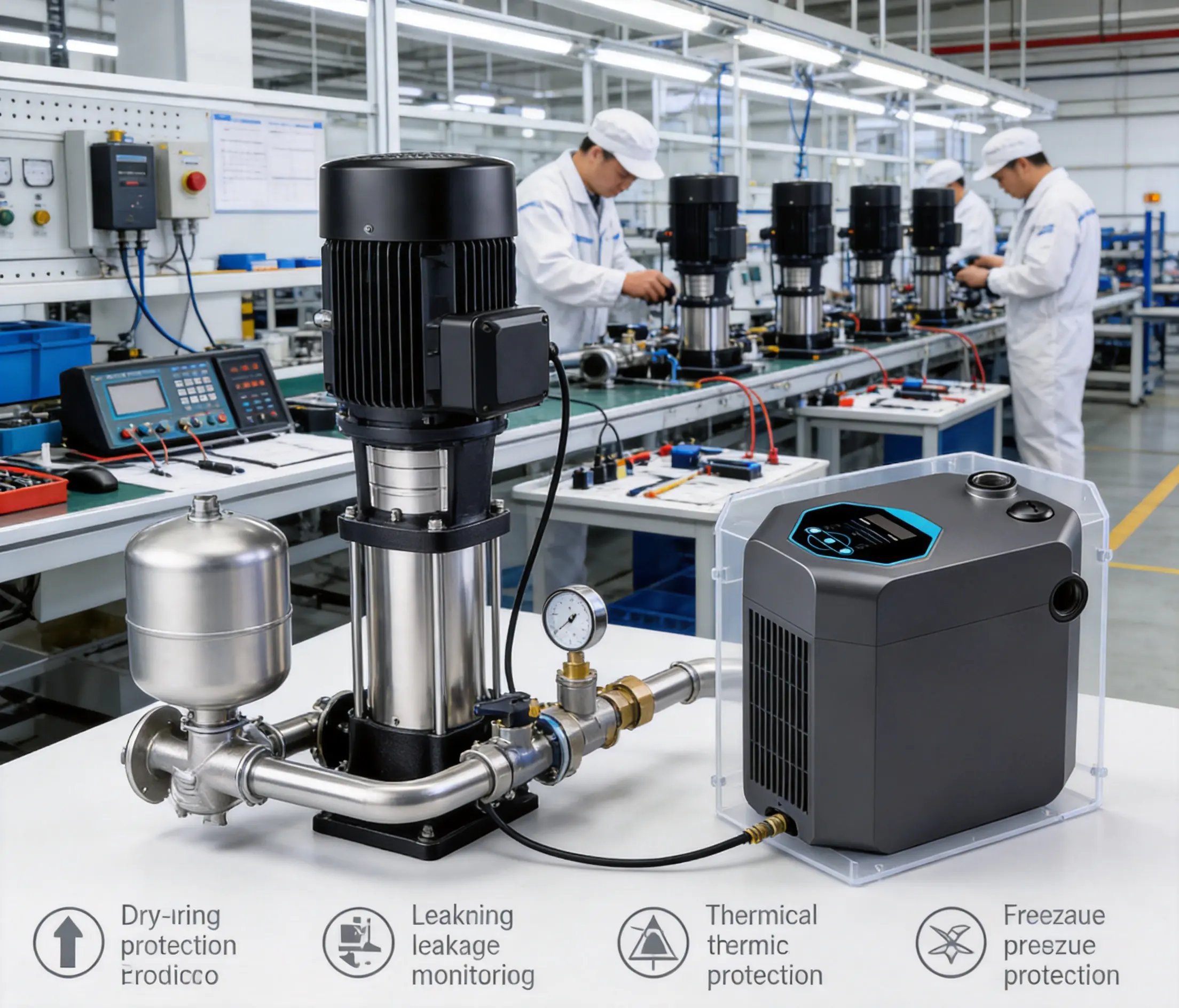
Modern water systems must deliver stable pressure, dependable flow, efficient operation, and reliable protection under changing demand. A pump that performs well at one fixed operating point may become inefficient or unstable when several faucets open simultaneously, when water levels fluctuate, or when the installation requires suction from a storage tank. The C-30/45 Commercial Self-Priming Multistage Intelligent Booster Pump is designed to address these challenges through the combination of intelligent pressure control, permanent magnet motor technology, multistage centrifugal hydraulics, self-priming capability, and integrated safety functions.
Available in the C-30 and C-45 configurations, this pump family is intended for household water supply, tap-water pressurization, garden irrigation, greenhouse water delivery, water circulation, and other applications requiring automatic pressure regulation. Rather than operating as a simple fixed-speed pump, it automatically adjusts its required power as the water demand changes. This enables the system to maintain constant pressure across multiple water outlets while reducing unnecessary energy consumption.
The product is manufactured by Taizhou Edwin Electric Co., Ltd., an integrated pump enterprise with experience in research and development, mass production, quality management, and international export. Through its product development and manufacturing capabilities, the company combines practical hydraulic engineering with intelligent electrical control to create a compact, efficient, and adaptable booster solution for global water applications.
Water pressure requirements are rarely constant in real installations. A residential building may use one faucet in the morning, several showers during peak hours, and an irrigation system later in the day. A commercial facility may experience an even wider range of demand, with valves, washdown equipment, process lines, and service outlets opening and closing at different times. A conventional fixed-speed pump must usually be controlled by simple pressure switches or throttling devices, which can produce pressure fluctuations, frequent starts, and avoidable energy losses.
An intelligent booster pump works differently. It monitors pressure and operating conditions, then adjusts motor output to match the actual requirement. When demand is low, the pump reduces its power requirement instead of running continuously at full capacity. When demand rises, the controller increases output to maintain the desired water pressure. This adaptive behavior improves comfort, helps protect plumbing components, and supports more efficient operation.
The C-30/45 series is particularly suitable for installations where water demand changes frequently. Its automatic power adjustment is designed to meet the constant-pressure requirements of multiple faucets and outlets. This makes it more flexible than a basic booster pump that provides only a fixed pressure level or relies on frequent on-and-off cycling.
Intelligent control also improves the user experience. Stable water pressure is important for showers, washing machines, kitchen fixtures, irrigation nozzles, and other water-consuming equipment. Sudden pressure drops can reduce performance, while excessive pressure may increase leakage risk and place unnecessary stress on pipes and fittings. By continuously responding to demand, the pump helps create a more balanced and predictable water supply.
The C-30/45 product range consists of two models with the same compact external dimensions but different power and head capabilities. The C-30 model uses a 300-watt motor and provides a maximum head of 30 meters. The C-45 model uses a 500-watt motor and provides a maximum head of 45 meters. Both models are designed around a maximum suction capability of 8 meters and a maximum operating voltage range of 165 to 260 volts.
The C-30 is suitable for applications requiring efficient pressure boosting at a moderate head. It offers a maximum flow of 4 cubic meters per hour, a rated flow of 1.5 cubic meters per hour, and a rated head of 20 meters. This makes it suitable for domestic water boosting, small garden irrigation systems, greenhouse water delivery, and compact water circulation arrangements.
The C-45 is designed for higher pressure requirements. It provides a maximum flow of 4.8 cubic meters per hour, a rated flow of 2 cubic meters per hour, and a rated head of 27 meters. It is a practical option where the installation includes more outlets, greater vertical elevation, longer pipe runs, or higher pressure requirements.
| Model | Voltage | Power | Maximum Flow | Maximum Head | Rated Flow | Rated Head | Maximum Suction | Dimensions |
|---|---|---|---|---|---|---|---|---|
| C-30 | 165–260 V | 300 W | 4 m³/h | 30 m | 1.5 m³/h | 20 m | 8 m | 313 × 192 × 279 mm |
| C-45 | 165–260 V | 500 W | 4.8 m³/h | 45 m | 2 m³/h | 27 m | 8 m | 313 × 192 × 279 mm |
The shared dimensions of 313 × 192 × 279 millimeters simplify product planning and installation. System designers can select the required performance level without redesigning the entire equipment layout. The compact format is also advantageous where plant rooms, utility areas, equipment cabinets, or domestic service spaces have limited room.
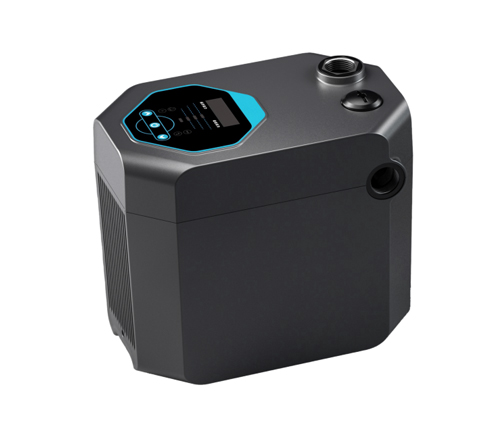
C-30/45 Commercial Self-Priming Multistage Intelligent Booster Pump
One of the most important technical advantages of the C-30/45 series is its use of a high-efficiency permanent magnet motor. Compared with conventional asynchronous motors of the same power, permanent magnet motors can deliver improved electrical efficiency and more responsive speed control. The product information indicates that the complete water-supply machine can save more than 30 percent of electricity compared with asynchronous motors of the same power under comparable operating conditions.
Energy efficiency is not only a matter of motor design. A pump system consumes energy according to the relationship between flow, pressure, operating time, hydraulic efficiency, motor efficiency, and control strategy. A motor that operates at full power when only a small amount of water is required wastes energy. The intelligent controller in this product reduces that problem by automatically adjusting the required power according to load changes.
Permanent magnet motor technology is well suited to variable-demand booster systems because the motor can respond efficiently to changes in operating conditions. At low demand, the pump does not need to run at its maximum output. At higher demand, it can increase performance to meet the pressure requirement. This approach reduces the energy associated with unnecessary speed, throttling, and repeated starting.
Lower energy consumption can produce several practical benefits. Users may reduce operating expenses over the service life of the pump, especially in systems that run for many hours each day. Lower electrical demand can also reduce the required capacity of electrical infrastructure. For commercial facilities, irrigation operations, and buildings with frequent water use, even a modest reduction in consumption can become significant over time.
Energy-efficient operation also supports sustainability objectives. Reducing electricity consumption lowers the indirect environmental impact associated with water pumping. For companies seeking to improve the efficiency of their buildings, farms, workshops, or service facilities, an intelligent permanent magnet booster pump can contribute to broader energy-management goals.
The C-30/45 series uses multistage self-priming centrifugal technology. A multistage pump uses multiple impeller stages arranged to build pressure progressively. This design is especially useful where the system needs greater head without requiring an oversized single-stage pump.
Multistage hydraulic construction allows the pump to support pressure-boosting applications with a compact footprint. The C-30 provides a maximum head of 30 meters, while the C-45 reaches 45 meters. These performance levels make the series suitable for boosting water to elevated points, overcoming pressure loss in longer pipe systems, and supporting several water outlets.
The hydraulic design must balance pressure generation, flow delivery, energy consumption, noise, and mechanical reliability. A pump that produces high pressure but has poor efficiency may create unnecessary operating costs. A pump that offers high flow but insufficient head may fail to meet the needs of upper floors or long distribution networks. The multistage arrangement provides a practical balance for applications requiring both stable flow and meaningful pressure elevation.
Because the pump is self-priming, it is designed to remove air from the suction line and establish water delivery without requiring the same manual priming procedure associated with many standard centrifugal pumps. This is valuable in installations drawing water from a tank, cistern, shallow well, or other source where the pump may not always remain fully flooded.
Self-priming capability can simplify commissioning and improve convenience for users. However, correct installation remains important. The suction pipe must be appropriately sized, connections must be airtight, the water source must be suitable, and the specified maximum suction height must not be exceeded. The maximum suction value for both listed models is 8 meters.
Constant-pressure control is central to the product’s value. Instead of delivering an uncontrolled flow that varies significantly with demand, the pump is designed to regulate output so that the water pressure remains more consistent as outlets open and close.
In a household, constant pressure improves the operation of showers, taps, washing machines, water heaters, and other fixtures. If several outlets are used at the same time, the pump can increase output to compensate for the additional demand. When outlets close, the pump can reduce output rather than continuing to operate at maximum speed.
In garden irrigation, pressure stability helps sprinklers and nozzles operate more evenly. In vegetable greenhouses, it can support more consistent water delivery to irrigation lines. In tap-water pressurization systems, it helps compensate for insufficient municipal pressure or pressure losses within a building.
For commercial applications, stable pressure can improve process consistency. Cleaning equipment, utility wash stations, cooling systems, and general service outlets often work better when pressure does not fluctuate excessively. The C-45 model, with its higher maximum head and rated performance, can be selected for installations where the network has greater resistance or where several demand points may operate simultaneously.
Constant-pressure operation also helps reduce mechanical stress. Repeated rapid cycling can cause thermal and mechanical strain in motors, switches, pipes, and fittings. Intelligent control can reduce the frequency and severity of such cycling by adapting pump output to the real water requirement.
A booster pump used in a variable-demand water system must do more than move water. It must also protect itself against abnormal operating conditions. The C-30/45 series incorporates several functions intended to improve safety, reliability, and user awareness.
The liquid leakage alert function helps identify leakage-related conditions. Leakage can lead to unnecessary pump operation, wasted water, pressure instability, and potential damage to surrounding equipment. Early indication gives users or maintenance personnel an opportunity to inspect pipework, fittings, valves, seals, and connected appliances before a minor problem becomes a major failure.
Dry running occurs when the pump operates without sufficient water at the suction side. This condition can cause overheating, accelerated wear, seal damage, and reduced service life. The dry-running protection function is designed to help prevent continued operation under such circumstances.
Dry-running protection is particularly valuable in systems supplied by tanks, cisterns, shallow wells, or intermittent water sources. Even when the pump includes this function, the installation should still include appropriate source-level controls and proper maintenance procedures. Protection features support good system design; they do not replace correct sizing, inspection, or water-source management.
High-temperature protection helps safeguard the pump when operating conditions cause excessive heat. Heat may result from extended operation, restricted flow, abnormal electrical conditions, insufficient ventilation, or other system problems. Automatic protection can reduce the risk of damage and help preserve the motor and controller.
Water expands when it freezes, which can damage pump chambers, pipes, seals, and fittings. The anti-freezing function is intended to provide additional protection in cold environments. It is especially relevant for outdoor installations, seasonal irrigation systems, unheated utility spaces, and regions that experience low winter temperatures.
Anti-freezing protection should be considered together with appropriate installation practices. Where freezing conditions are severe or prolonged, exposed pipes may still require insulation, drainage, heat tracing, or other measures. The integrated function provides an additional layer of protection within the pump system.
The C-30/45 series offers several advantages over basic fixed-speed booster pumps. The first is adaptive power control. Conventional pumps often run at a fixed speed and rely on a pressure switch to turn on or off. This can result in abrupt pressure changes and frequent cycling. The intelligent system adjusts output more progressively according to demand.
The second advantage is the combination of permanent magnet motor efficiency and multistage hydraulics. A conventional asynchronous motor may be reliable, but it can consume more electricity when operated under variable load. The permanent magnet motor is designed to operate efficiently while responding to the controller’s adjustments.
The third advantage is integrated protection. Many basic pumps require separate devices or external controls to manage dry running, leakage indications, high-temperature conditions, and cold-weather risks. The C-30/45 design brings several of these functions into one coordinated product platform, reducing system complexity and helping users monitor abnormal conditions.
The fourth advantage is self-priming operation. This feature expands the range of possible installations compared with standard non-self-priming centrifugal pumps. It can be particularly helpful where the water source is below the pump or where the suction line may contain air during startup.
The fifth advantage is compactness. Both models use the same 313 × 192 × 279 millimeter dimensions, allowing the installer to choose between moderate and higher performance without requiring a substantially larger installation space. Compact equipment can reduce cabinet, platform, and service-area requirements.
| Performance Area | Traditional Fixed-Speed Booster Pump | C-30/45 Intelligent Booster Pump |
|---|---|---|
| Power Regulation | Usually fixed-speed or basic on/off operation | Automatically adjusts power according to demand |
| Pressure Stability | May fluctuate as outlets open and close | Designed for constant-pressure water control |
| Motor Technology | Often asynchronous motor construction | High-efficiency permanent magnet motor |
| Hydraulic Configuration | Commonly single-stage | Multistage centrifugal configuration |
| Priming Capability | May require manual priming | Self-priming design |
| Protection Functions | May require external accessories | Leakage alert, dry-running, temperature, and anti-freezing functions |
| Installation Footprint | Depends on pump design | Compact 313 × 192 × 279 mm format |
These comparisons describe the design advantages of the product category and should be evaluated together with the actual conditions of each installation. Correct pump selection depends on required flow, total dynamic head, suction conditions, water quality, pipe size, electrical supply, and operating schedule.
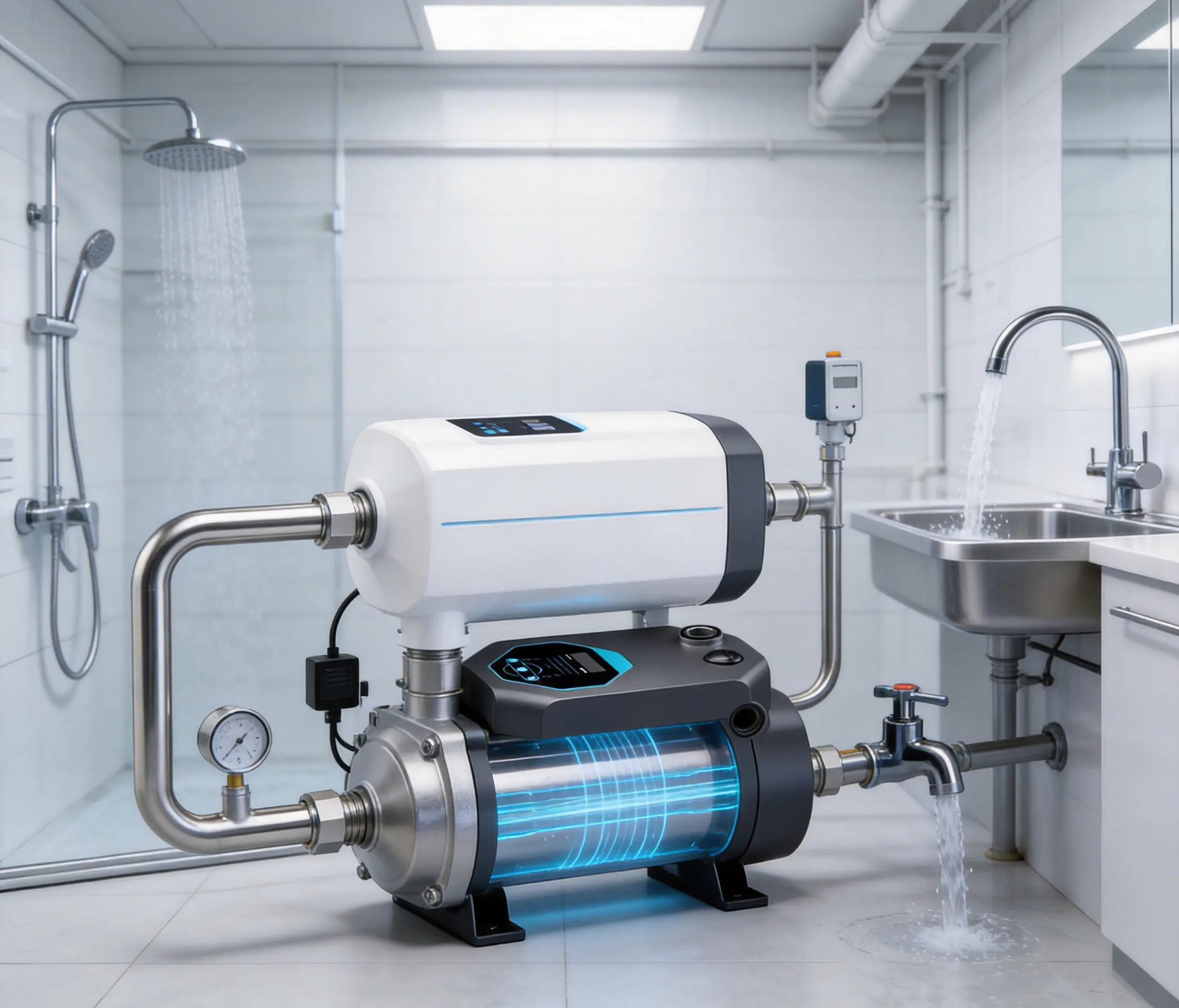
Low or unstable water pressure is a common problem in homes supplied by rooftop tanks, storage tanks, shallow wells, or weak municipal networks. The C-30 model can support smaller homes and moderate pressure requirements, while the C-45 model can be selected when the building has more fixtures or greater vertical elevation.
The intelligent pressure function helps maintain a comfortable supply for bathrooms, kitchens, laundry areas, and utility outlets. The pump’s compact dimensions allow it to be installed in a utility room, equipment area, or other restricted location when the surrounding conditions are appropriate.
Buildings may receive water from a municipal network but still experience inadequate pressure at upper floors or distant fixtures. Installing the booster pump in the appropriate section of the distribution system can help compensate for pressure losses. The multistage design is useful where additional head is required to overcome elevation and pipe resistance.
Garden irrigation systems often include sprinklers, hose outlets, drip lines, or multiple zones. Demand can vary significantly depending on how many zones are active. Intelligent adjustment allows the pump to respond to these changing requirements rather than operating continuously at full capacity.
Greenhouse irrigation requires dependable water delivery to beds, containers, lines, and emitters. Stable pressure helps improve the consistency of irrigation equipment. The pump can also support water circulation and supply functions associated with small agricultural installations.
Some facilities require water to circulate through a service loop, utility system, or equipment network. The pump’s automatic control can help maintain the desired pressure while adapting to changes in flow resistance or outlet use. System designers should confirm that the water temperature and chemical characteristics are compatible with the pump before installation.
Commercial buildings, workshops, small processing facilities, and service areas may need reliable water pressure for cleaning, washdown, general utility outlets, and employee facilities. The C-45 model can be considered where several points of use may operate simultaneously or where the distribution network requires higher head.
Product performance is closely connected to manufacturing discipline. A pump may have an attractive specification, but long-term value depends on how consistently the hydraulic components, motor, controller, seals, housing, wiring, and protective functions are produced and assembled. Taizhou Edwin Electric Co., Ltd. operates as an integrated manufacturing enterprise specializing in independent research and development, mass production, and global export.
The company was founded in 2008 and has developed product experience across deep well pumps, submersible pumps, domestic booster pumps, circulation pumps, solar water pumps, intelligent booster pumps, and related water-treatment peripheral products. This broad product knowledge allows the company to understand different hydraulic conditions and application requirements rather than treating each pump as an isolated product.
Independent research and development supports the integration of mechanical, hydraulic, electrical, and software-related functions. In the C-30/45 series, the motor, multistage pump structure, pressure control, protection functions, and user alerts must work together as one system. Coordinated development helps reduce compatibility problems that can arise when individual components are selected without considering the complete application.
Mass production capability is equally important. Commercial buyers, distributors, engineering contractors, and project customers may require consistent product availability and repeatable specifications. Established production systems help support batch manufacturing, standardized assembly, inspection, packaging, and order fulfillment.
The company’s manufacturing approach is supported by international procurement and export-service capabilities through associated trading and industrial service organizations. These resources help coordinate purchasing plans, order tracking, cross-border delivery, and foreign-trade services. For overseas customers, dependable communication and logistics are important parts of the total product value.
A multistage centrifugal pump requires accurate hydraulic components. Impeller geometry, stage alignment, flow passages, clearances, and sealing surfaces all influence efficiency and pressure performance. Consistent manufacturing helps ensure that the pump delivers repeatable results across production batches.
During production, attention should be given to dimensional control, surface quality, rotor balance, and correct assembly of hydraulic stages. These factors influence vibration, noise, efficiency, and service life. The company’s experience across multiple pump categories provides a practical foundation for managing such requirements.
The permanent magnet motor and intelligent controller are central to the product’s efficiency. Electrical assembly must be carried out with proper attention to winding quality, insulation, connection security, controller integration, and protective grounding. The wide operating voltage range of 165 to 260 volts also requires the electrical system to be designed and tested for stable operation across the specified range.
Reliable electrical assembly helps reduce the risk of overheating, unstable operation, unwanted shutdowns, or premature component failure. It also supports accurate interaction between pressure feedback, motor speed, and power adjustment.
Pump sealing is important for both performance and safety. Poor sealing can reduce pressure, permit air entry on the suction side, cause water leakage, and create additional maintenance requirements. Careful selection and assembly of seals, gaskets, threaded connections, and casing interfaces contribute to reliable operation.
The liquid leakage alert function adds a monitoring layer, but it depends on a well-assembled pump and properly installed external piping. Manufacturing and installation quality therefore work together to protect the complete system.
Quality control for intelligent booster pumps should cover mechanical, hydraulic, electrical, and functional factors. Typical inspection areas include visual quality, dimensional conformity, electrical safety, motor operation, pressure response, flow performance, leakage status, dry-running behavior, temperature protection, and controller operation.
Functional testing is particularly important for an intelligent product. The pump must not only operate as a motor-driven hydraulic machine; it must also respond correctly to changing pressure and demand. Testing helps verify that the pump starts, regulates, alerts, and protects itself in accordance with its intended operating logic.
Correct installation is essential for achieving the listed performance. The pump should be placed on a stable base in a location that permits inspection, ventilation, electrical access, and maintenance. The surrounding area should be protected from flooding, excessive dust, corrosive substances, and physical impact.
The suction pipe should be appropriately sized and kept as short and direct as practical. Excessive bends, undersized piping, rough internal surfaces, or poorly sealed joints can increase suction losses and reduce the actual performance of the system. Because the maximum suction height is 8 meters, designers should evaluate the vertical distance between the water level and the pump inlet carefully.
All suction-side connections must be airtight. Even a small air leak can prevent reliable self-priming, cause unstable flow, increase noise, or lead to loss of pressure. Thread sealant or suitable sealing methods should be used according to the pipe material and local installation practices.
The discharge system should include suitable valves and fittings. A check valve may be required to prevent reverse flow, depending on the system arrangement. Isolation valves can simplify maintenance, while pressure gauges can help technicians evaluate operating conditions. Pipework should be supported independently so that excessive loads are not transferred to the pump connections.
The electrical supply must match the specified voltage range and comply with local safety regulations. Proper grounding, overcurrent protection, disconnecting means, and cable selection are essential. Electrical work should be completed by qualified personnel.
Before commissioning, the installer should confirm that the pump and suction line are filled or prepared according to the manufacturer’s operating procedure. The source must contain sufficient water, the valves must be in the correct position, and the discharge system must be ready to accept flow. The initial startup should be observed for abnormal noise, vibration, leakage, pressure instability, or repeated fault indications.
The correct model should be selected according to the complete duty requirement rather than maximum head alone. A system designer should identify the required flow rate, static elevation, friction losses, desired outlet pressure, simultaneous demand, suction lift, and source conditions.
The C-30 is a practical option when the system requires up to approximately 30 meters of maximum head and moderate flow. It may be suitable for smaller domestic systems, limited irrigation networks, low-rise buildings, and compact water-boosting applications.
The C-45 provides a higher maximum head of 45 meters and a higher maximum flow of 4.8 cubic meters per hour. It may be more appropriate for taller buildings, larger homes, commercial utility systems, longer pipe runs, or applications with greater simultaneous water demand.
Oversizing should also be avoided. A pump that is significantly larger than the actual requirement may cycle more frequently, operate inefficiently, or require additional control measures. Intelligent regulation helps, but accurate system sizing remains the foundation of good performance.
| Selection Consideration | C-30 Suitability | C-45 Suitability |
|---|---|---|
| Maximum Head Requirement | Up to 30 m maximum head | Up to 45 m maximum head |
| Maximum Flow Requirement | Up to 4 m³/h maximum flow | Up to 4.8 m³/h maximum flow |
| Rated Operating Point | 1.5 m³/h at 20 m rated head | 2 m³/h at 27 m rated head |
| Typical Scale | Smaller residential and irrigation systems | Higher-demand residential and commercial systems |
| Motor Power | 300 W | 500 W |
| Physical Size | 313 × 192 × 279 mm | 313 × 192 × 279 mm |
Noise is an important consideration in residential and commercial water systems. A pump installed near bedrooms, offices, kitchens, or public areas should operate as quietly as practical. The product is designed for high efficiency and low noise, supported by its permanent magnet motor, controlled operating speed, and compact multistage hydraulic arrangement.
Low-noise operation improves comfort and reduces disturbance. It can also indicate smoother hydraulic and mechanical performance, although noise should always be assessed together with vibration, installation quality, and system conditions. Incorrect pipe support, cavitation, trapped air, loose fasteners, or operation outside the recommended range can create noise even when the pump itself is functioning correctly.
Intelligent control also contributes to a better user experience by reducing abrupt starts and pressure changes. Instead of a simple full-speed start whenever a faucet opens, the system can respond according to the actual demand. This supports smoother water delivery and can reduce the noticeable impact of pump operation.
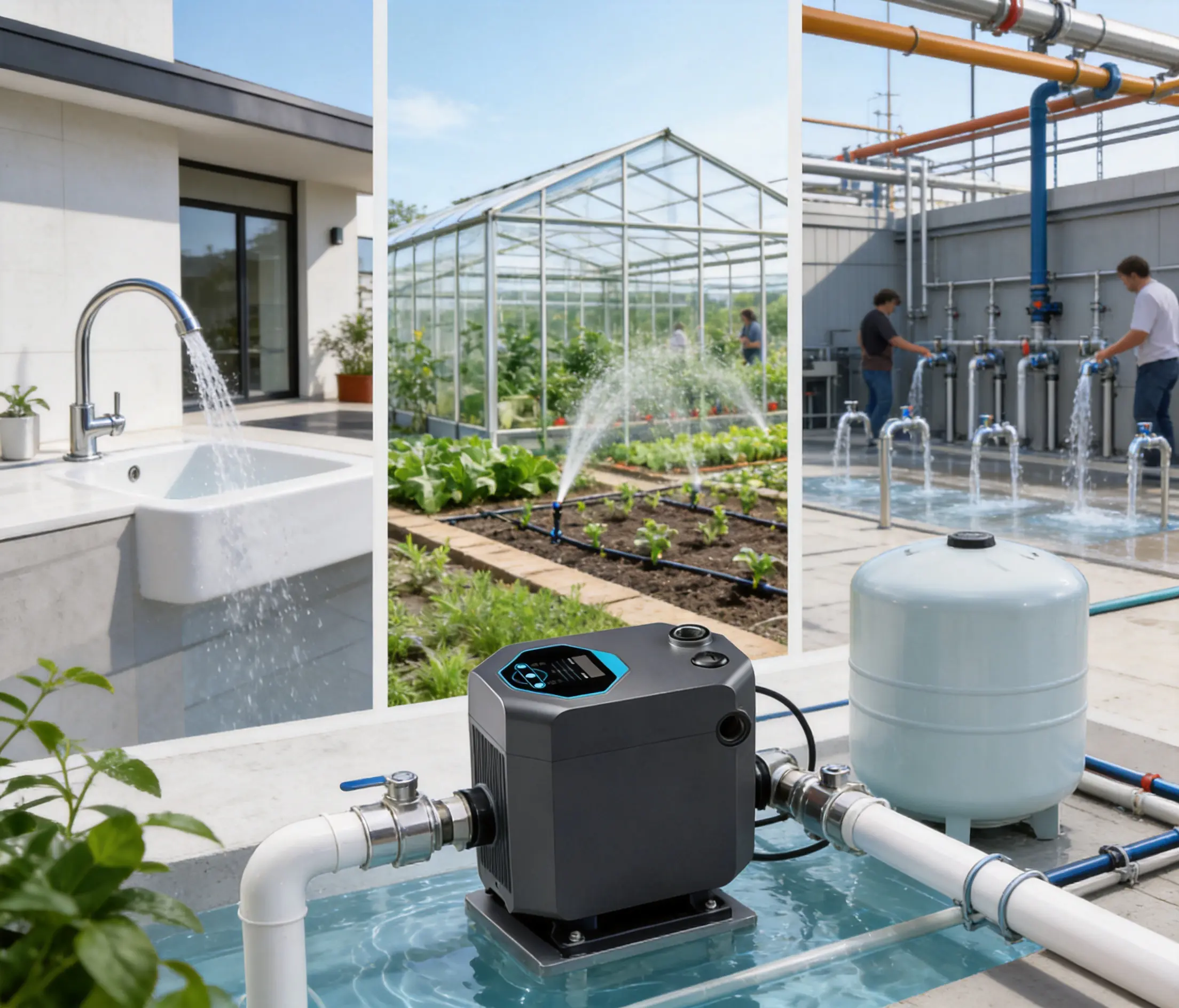
Routine maintenance helps preserve efficiency and reliability. Operators should periodically inspect the pump body, electrical connections, suction line, discharge line, valves, and surrounding area. Any sign of leakage, unusual noise, unstable pressure, repeated fault alerts, or extended dry-running protection should be investigated promptly.
The suction strainer, if used in the system, should be cleaned at suitable intervals. Blockage on the suction side can reduce flow, increase hydraulic losses, and contribute to cavitation or insufficient water supply. Water sources containing sand, sediment, plant matter, or other solids may require additional filtration or pretreatment.
Pipework should be checked for leaks because a small continuous leak can cause the pump to start unnecessarily or operate for longer periods. A leakage alert can assist with detection, but visual inspection and pressure monitoring remain valuable maintenance practices.
During seasonal shutdowns, especially in cold climates, the system should be protected from freezing. Depending on the installation, this may involve draining exposed sections, insulating pipes, or following a suitable winterization procedure. The anti-freezing function provides additional protection but should not be considered the only measure in severe conditions.
Long-term value comes from the combined effect of energy efficiency, stable pressure, reduced maintenance complexity, protective functions, and dependable manufacturing. A pump with a slightly higher purchase price may provide a lower total cost of ownership if it consumes less electricity, protects itself more effectively, and delivers reliable service over a longer period.
Water infrastructure varies widely from one region to another. Some countries rely on municipal networks, while others depend on storage tanks, wells, irrigation reservoirs, or independent water systems. Voltage stability, climate, building height, water quality, and installation practices also differ.
The C-30/45 series addresses several of these variables through its 165–260 volt operating range, self-priming design, adaptive pressure control, compact dimensions, and protective functions. These characteristics provide flexibility for distributors, installers, engineering contractors, and equipment buyers serving different markets.
Taizhou Edwin Electric Co., Ltd. has developed international export experience and serves customers in multiple sectors, including agriculture, construction, municipal engineering, mining, new energy, HVAC, and household water supply. This market exposure supports a practical understanding of the documentation, packaging, order coordination, and communication requirements associated with overseas supply.
The company also provides access to a broader product portfolio. Customers requiring several pump types may source deep well pumps, submersible pumps, domestic booster pumps, circulation pumps, solar water pumps, and intelligent booster pumps from an experienced pump supplier. This one-stop approach can simplify product matching and procurement planning for distributors and project contractors.
The pump is designed to provide automatic water boosting and constant-pressure control. It adjusts its required power as water demand changes, helping maintain stable pressure for multiple faucets and other outlets.
The C-30 uses 300 watts of power, has a maximum flow of 4 cubic meters per hour, and provides a maximum head of 30 meters. The C-45 uses 500 watts, has a maximum flow of 4.8 cubic meters per hour, and provides a maximum head of 45 meters. Both models have the same listed dimensions and maximum suction height.
Yes. The self-priming design is intended for applications where the pump draws water from a tank, cistern, shallow well, or similar source. The maximum suction value is 8 meters, and the suction line must be correctly installed and sealed.
No. The intelligent control system automatically adjusts the required power according to load changes. It can reduce output when demand is low and increase output when more water is required.
The product information states that the complete water-supply machine can save more than 30 percent of electricity compared with asynchronous motors of the same power under comparable operating conditions. Actual savings depend on system design, operating hours, water demand, pipe resistance, and local electricity conditions.
The pump includes liquid leakage alert, dry-running protection, high-temperature protection, and anti-freezing functions. These features are designed to improve operational safety and help protect the equipment under abnormal conditions.
Yes. Garden irrigation is one of the listed applications. The pump can supply sprinklers, hose outlets, drip systems, or other irrigation equipment when the required flow and pressure are within the selected model’s operating range.
Yes. The product can be used for vegetable greenhouse water supply and related irrigation applications. The installer should confirm compatibility with the water source, filtration requirements, pipework, and environmental conditions.
Yes. The product is categorized as a commercial self-priming multistage intelligent booster pump. It can support commercial utility water, tap-water pressurization, service areas, small process systems, and other applications that match its performance range.
The installer should check the required flow, total head, suction lift, water quality, voltage, pipe dimensions, installation space, ventilation, electrical protection, and environmental temperature. The suction line must be airtight and the water source must provide sufficient water.
Additional equipment may be useful depending on the installation. Isolation valves, check valves, pressure gauges, filters, strainers, surge protection, and appropriate electrical protection can improve system operation and serviceability. The exact requirements depend on the application and local regulations.
Potential users include households, agricultural operations, greenhouse growers, building contractors, HVAC service providers, commercial facilities, municipal projects, workshops, and distributors of water-supply equipment.
Permanent magnet motor technology can provide high efficiency and responsive speed control. In an intelligent booster system, this helps the pump adapt to variable demand while reducing unnecessary power consumption compared with conventional fixed-speed arrangements.
Both listed models have dimensions of 313 × 192 × 279 millimeters. This shared size can simplify model selection and replacement planning, provided that the hydraulic and electrical requirements are also suitable.
The C-30/45 Commercial Self-Priming Multistage Intelligent Booster Pump combines the functions required by modern water-supply systems in a compact and adaptable package. Its permanent magnet motor supports high efficiency, while intelligent control adjusts power in response to changing demand. Multistage centrifugal technology provides useful pressure capability, and self-priming operation expands the range of possible installations.
The product also includes practical protective functions, including liquid leakage alert, dry-running protection, high-temperature protection, anti-freezing protection, and constant-pressure water control. These features can improve reliability, convenience, and user confidence in residential, agricultural, commercial, and utility applications.
The C-30 is suited to moderate pressure-boosting requirements, while the C-45 provides greater head and flow for higher-demand systems. Both models share a compact footprint and a wide 165–260 volt operating range, supporting flexible installation planning.
Behind the product is a manufacturing enterprise with experience in independent research and development, mass production, pump engineering, international export, and one-stop procurement services. Taizhou Edwin Electric Co., Ltd. applies its broader knowledge of deep well pumps, submersible pumps, circulation pumps, solar water pumps, domestic booster pumps, and intelligent systems to the development of efficient water equipment for global markets.
For users seeking stable pressure, lower energy consumption, automatic adaptation, self-priming capability, and integrated protection, the C-30/45 series represents a strong solution for dependable water delivery. Proper sizing, professional installation, and regular maintenance will help ensure that the pump delivers its intended performance throughout its service life.
1. Product technical data and application information for the C-30/45 Commercial Self-Priming Multistage Intelligent Booster Pump.
2. General principles of centrifugal pump operation, hydraulic head, flow measurement, and system resistance.
3. Engineering guidance on permanent magnet motor efficiency and variable-speed water-pumping systems.
4. General practices for pump installation, suction-line design, priming, sealing, and pressure control.
5. Technical principles of dry-running protection, thermal protection, leakage monitoring, and anti-freezing measures.
6. General water-supply system design practices for domestic, agricultural, greenhouse, commercial, and utility applications.
7. Manufacturing and quality-control principles for electric motors, multistage centrifugal pumps, intelligent controllers, and integrated water-supply equipment.
edwina@edwin-pump.com
+86-13586290903 (WhatsApp)
Xuri Gongliang Cutting Tool Entrepreneurship Park, Wenqiao Town, Wenling City, Taizhou City, Zhejiang Province, China

High Performance Smart Pump Factory


 English
