edwina@edwin-pump.com

View All Products
en
Reliable water movement is essential in fire protection, municipal water supply, industrial processing, irrigation, pressure boosting, heating, cooling, and air-conditioning systems. In these applications, the pump must do more than simply transfer water. It must provide stable hydraulic performance, withstand continuous operating demands, support efficient maintenance, and integrate smoothly with existing pipework and drive systems. A pump selected for a critical installation should therefore be evaluated as a complete engineering solution rather than as an isolated mechanical device.
The EA Series Horizontal End Suction Fire Centrifugal Pump is designed around these requirements. It is a single-stage, foot-mounted, horizontal end suction centrifugal pump intended for clean-water transfer and other demanding services. Its horizontal suction arrangement, vertical top discharge, robust casing, stainless-steel shaft, interchangeable dimensions, and true back-pull-out construction make it suitable for installations where service continuity and practical maintenance are important.
The series conforms to DIN 24255 and BESN 733 dimensional and performance principles. This standard-oriented design enables the pump to be used as a replacement or alternative to other pumps manufactured to comparable international dimensions. As a result, users may be able to upgrade or replace equipment without redesigning the entire pipe network, changing the motor arrangement, or carrying out extensive civil modifications.
Beyond its mechanical configuration, the EA Series benefits from the manufacturing capabilities of Taizhou Edwin Electric Co., Ltd., also known as Edwin Pump. The company combines independent research and development, mass production, export experience, and a broad product portfolio covering deep-well pumps, submersible pumps, domestic booster pumps, circulation pumps, solar water pumps, intelligent booster pumps, and commercial pumping equipment. This wider technical background supports a practical approach to pump design, component selection, production management, and customer service.
This article examines the EA Series in detail, explains its principal advantages over conventional end suction pumps, and discusses how its design and manufacturing strengths support dependable operation in critical clean-water applications.
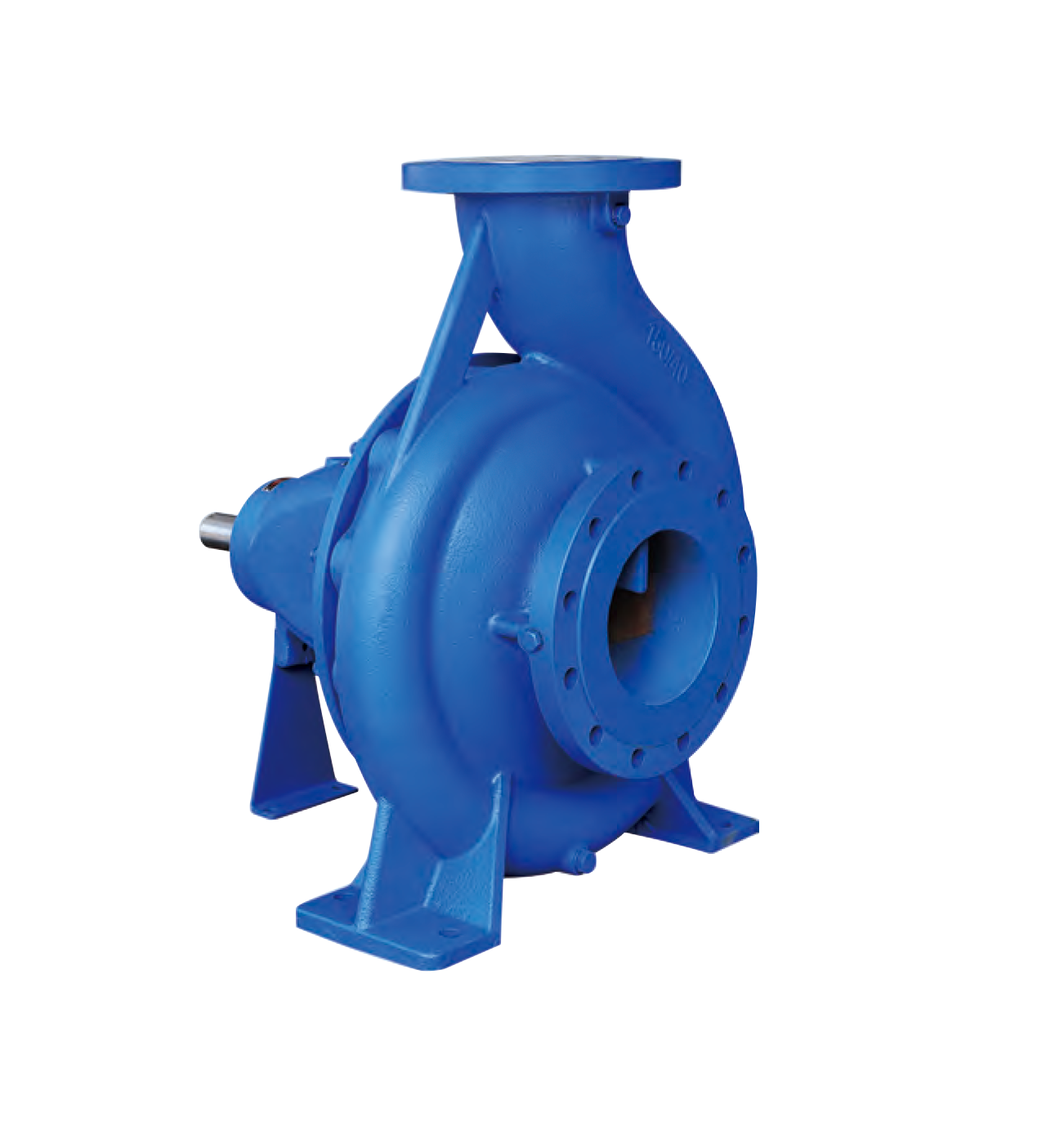
EA Series Reliable Performance Clean Water Horizontal End Suction Fire Centrifugal Pump
The EA Series is a horizontal end suction, single-stage centrifugal pump. In a centrifugal pump, the impeller transfers rotational energy from the motor to the liquid. Water enters through the axial suction opening, passes into the rotating impeller, and is accelerated toward the outer diameter. The volute casing then converts part of the liquid velocity into pressure before directing the flow upward through the discharge connection.
This operating principle is widely used because it provides a balanced combination of flow capacity, pressure generation, mechanical simplicity, and adaptability. A single-stage arrangement is particularly suitable when the required head can be produced by one impeller. Compared with more complex multistage constructions, a single-stage pump generally has fewer internal hydraulic stages and fewer components requiring inspection.
The EA Series is designed for clean water and comparable liquids that are compatible with the selected construction materials and seal arrangement. Typical fluids include treated water, service water, fire-protection water, cooling water, heating water, and industrial process water with suitable cleanliness and temperature characteristics. The final selection should always consider liquid temperature, pressure, viscosity, chemical compatibility, solids content, suction conditions, and required operating point.
The pump uses a horizontal shaft and is normally coupled to an electric motor in an IM B3 configuration. The foot-mounted structure supports the pump and motor assembly on a common foundation or base arrangement. This configuration is familiar to maintenance teams and can be incorporated into a wide range of plant layouts.
The end suction design offers a direct and efficient flow path. The suction nozzle is positioned axially, while the discharge is arranged radially upward. This configuration can simplify pipe routing and is especially useful in plant rooms where vertical discharge alignment is preferred. The arrangement also provides convenient access to the bearing housing, coupling, casing cover, and rotating assembly.
Fire-protection systems and clean-water installations often remain in standby for long periods but must perform immediately when required. The pump therefore needs dependable materials, stable shaft support, effective sealing, and a casing capable of handling the expected system pressure. The EA Series addresses these needs through a rigid casing structure, an oversized shaft, deep-groove ball bearings, and several seal options.
For fire-fighting applications, the pump may form part of a complete system that includes storage tanks, suction pipework, valves, controllers, pressure sensors, standby equipment, and backup power. The EA Series is the hydraulic equipment within that system and should be selected according to the required flow, pressure, duty point, suction conditions, and applicable project standards.
The horizontal end suction layout provides a direct axial inlet into the impeller. This can reduce unnecessary changes in flow direction before the liquid reaches the hydraulic section. The vertical top discharge arrangement supports upward routing of the delivery pipe and can make the pump easier to integrate into compact mechanical rooms.
Because the pump is foot mounted, the casing and bearing housing are supported independently of the connected pipework. Proper installation still requires correct alignment, adequate pipe supports, and protection against excessive external forces. When installed correctly, the arrangement offers a stable foundation for continuous operation.
A single-stage centrifugal pump generates its pressure through one impeller and one hydraulic casing. This straightforward architecture is an important advantage for applications that do not require the very high heads associated with multiple hydraulic stages. Fewer hydraulic stages can mean fewer internal interfaces, simplified inspection, and easier access during overhaul.
The closed radial impeller is designed for efficient clean-water transfer. It incorporates a back seal and balance holes to help manage axial forces and internal leakage paths. The impeller can be trimmed to suit the required flow and head, allowing the pump to be selected more accurately for the duty point rather than operating with excessive throttling or unnecessary power consumption.
One of the most important maintenance advantages of the EA Series is its true back-pull-out design. With an appropriate installation and coupling arrangement, the back plate and rotating assembly can be removed from the casing without disturbing the suction and discharge pipe connections.
This feature reduces the time required for inspection, seal replacement, bearing service, and impeller maintenance. In a fire-protection installation, minimizing service interruption is particularly important because the pump must remain available as part of an emergency system. In industrial plants, reduced maintenance time can also limit production interruptions and reduce the need for extensive isolation work.
The back-pull-out principle is especially effective when the pump is fitted with a spacer coupling. A spacer coupling allows the motor to remain in position while the pump rotating assembly is serviced. The maintenance team can therefore avoid disconnecting the motor, disturbing motor alignment, or removing large sections of the drive arrangement.
The standard coupling is semi-elastic, providing a practical connection between the motor and pump shaft. A spacer coupling is available when the application places a higher value on maintenance speed and motor stability. The spacer element creates working clearance between the pump and motor hubs, making it possible to remove the pump assembly without moving the motor.
This arrangement can provide several advantages. It reduces the risk of disturbing the motor foundation, limits the need for repeated alignment checks, and simplifies the replacement of mechanical seals and bearings. The result is a maintenance process that is more predictable and less disruptive.
The EA Series follows DIN 24255 and BESN 733 dimensional principles. This is valuable for users replacing older equipment or standardizing pump dimensions across a facility. When the existing pump, pipework, base, and motor arrangement correspond to the same dimensional standard, the replacement process may require fewer modifications.
Dimensional interchangeability does not mean that every pump can be exchanged without engineering verification. Flow, head, speed, motor power, flange rating, rotation, shaft height, base dimensions, seal design, and operating temperature must all be checked. However, compliance with recognized dimensional standards creates a strong foundation for replacement projects and can significantly reduce adaptation work.
The pump body and impeller are available in cast iron or stainless steel options. The shaft is manufactured from stainless steel, while the shaft seal can be configured with a mechanical seal, gland packing, or dynamic seal depending on the service requirements.
Standard stainless-steel options include SUS304 and SUS316 for suitable components and applications. Duplex stainless steel grades such as 2205 or 2507 may be considered where higher corrosion resistance or strength is required. Material selection should be based on the pumped liquid, chloride concentration, temperature, pressure, erosion risk, and project specifications.
This material flexibility provides an advantage over products available in only one standard construction. A cast-iron configuration may be suitable for general clean-water service, while stainless steel can provide a better solution for corrosive environments, treated water, certain industrial processes, or projects requiring enhanced cleanliness.
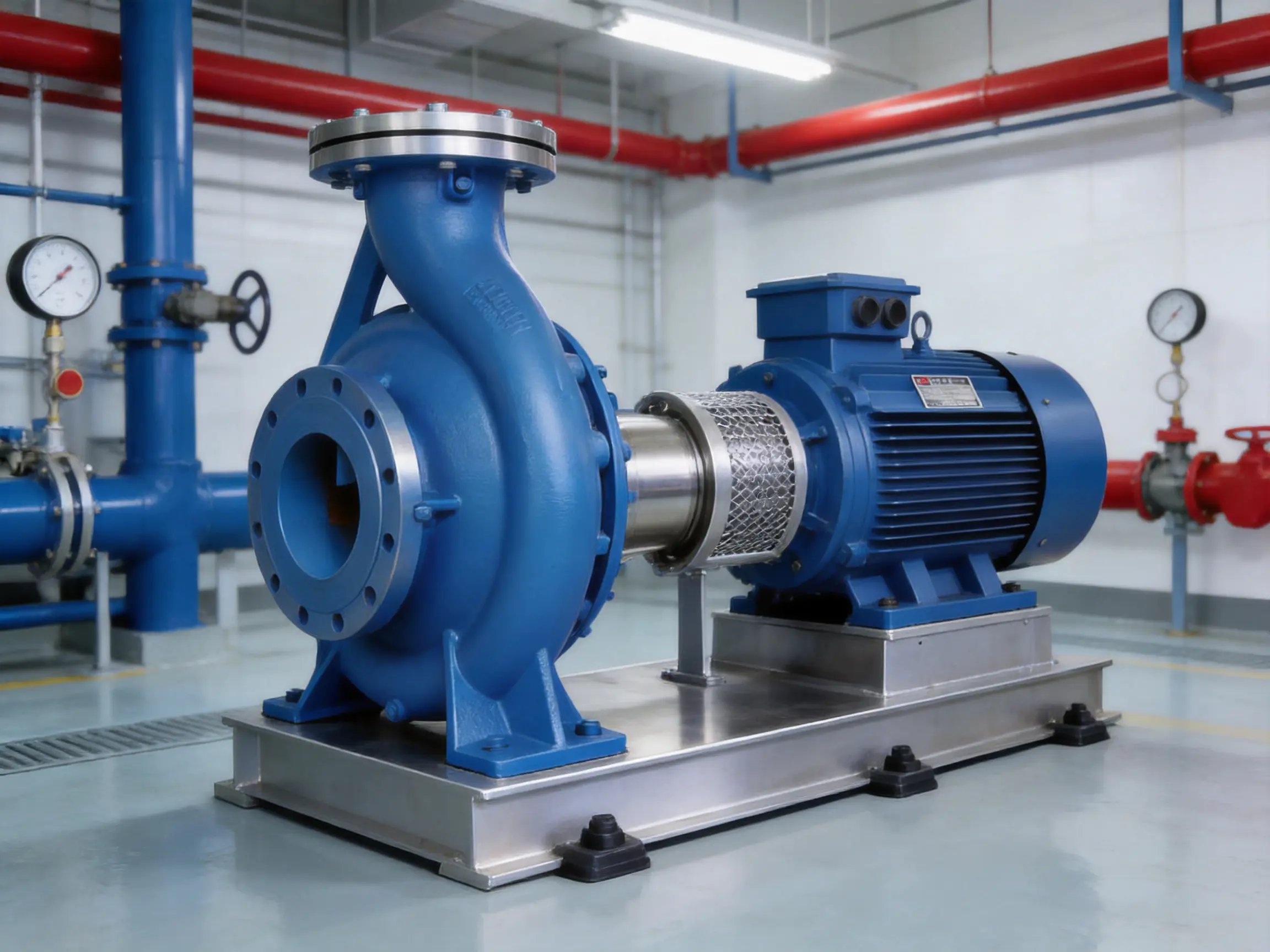
The EA Series uses a high-efficiency closed radial impeller. The hydraulic passage is designed to guide clean water through the pump while converting motor power into useful flow and pressure. Correct impeller trimming allows the pump to match the required duty point and can help avoid excessive energy use caused by oversizing.
Hydraulic efficiency is influenced by many factors, including impeller diameter, rotational speed, casing geometry, suction conditions, liquid properties, pipe friction, and operating point. A pump should normally operate near its preferred efficiency region rather than far to the left or right of its performance curve. Proper selection is therefore essential to achieving the expected service life and energy performance.
The shaft is oversized in accordance with ISO 5199 design principles. A rigid shaft helps limit deflection and supports stable operation of the impeller and mechanical seal. Lower shaft deflection can reduce vibration, improve seal performance, and extend the service life of rotating components.
The stainless-steel shaft also provides improved resistance to corrosion compared with ordinary carbon steel in many clean-water environments. A shaft sleeve can be used to protect the shaft in the seal area, helping reduce wear caused by packing or liquid exposure and simplifying future maintenance.
The bearing housing is monobloc and supported by a support foot. The bearings are oversized deep-groove ball bearings designed to guide the motor shaft and support the rotating assembly. Grease lubrication is available, while oil lubrication can be selected for applications requiring a different bearing lubrication arrangement.
The bearing design contributes to stable shaft rotation and helps maintain the alignment of the rotating components. A centrifugal deflector is used to reduce the risk of liquid migrating into the bearing area. Correct lubrication intervals, operating temperature monitoring, alignment, and vibration checks remain necessary for reliable service.
The standard shaft seal is a single mechanical seal adapted to the pumped liquid. A mechanical seal provides controlled sealing around the rotating shaft and normally does not require servicing during ordinary operation. The exact seal materials should be selected according to liquid temperature, pressure, chemical characteristics, and expected operating conditions.
Gland packing is available for applications where that sealing method is preferred. Packing can be useful in certain industrial environments because it is adjustable and familiar to maintenance personnel. Dynamic sealing arrangements may also be considered for specific designs. Offering more than one sealing approach enables the pump to be adapted to project requirements instead of forcing every customer into a single configuration.
The standard EA Series configuration uses IM B3 electric motors. Drive power should be selected according to the actual hydraulic duty and a suitable safety margin. The recommended margins provided for the series are 25 percent for motors up to 4 kW, 20 percent for motors from 4 to 7.5 kW, and 15 percent for motors above 7.5 kW.
These margins are intended to provide practical allowance between the calculated hydraulic requirement and the selected motor rating. Final motor selection should also consider starting conditions, voltage, frequency, service factor, ambient temperature, altitude, duty cycle, efficiency class, control method, and local electrical standards.
| Motor Power Range | Recommended Safety Margin | Selection Consideration |
|---|---|---|
| Up to 4 kW | +25% | Allowance for small-power operating variation and starting requirements |
| 4 to 7.5 kW | +20% | Balanced allowance for general industrial and water-service duties |
| Above 7.5 kW | +15% | Applied to larger drives after confirming the duty point and system curve |
A pump’s performance depends not only on its internal design but also on how it is installed. The EA Series is intended to be mounted on a stable foundation with the motor and pump correctly aligned. The foundation should be sufficiently rigid to limit vibration and should support the equipment without creating distortion in the casing or bearing housing.
The suction pipe should be arranged to provide a smooth, stable flow into the pump. Sudden changes in direction, undersized pipework, air pockets, excessive fittings, and poor reducer orientation can cause turbulence and reduce the available net positive suction head. The suction line should be supported independently so that its weight is not carried by the pump casing.
For systems using a flooded suction arrangement, the pump should be positioned so that the suction line remains full and air entry is prevented. For lift applications, the suction conditions must be checked carefully because the pump’s available suction head may be limited by atmospheric pressure, water temperature, elevation, pipe friction, and inlet losses.
The vertical top discharge can simplify upward pipe routing, but the discharge line must still be sized according to the required flow and acceptable friction loss. Isolation valves, check valves, pressure gauges, air-release provisions, and other accessories should be installed according to the system design.
Because the pump is frequently used in fire protection and pressure-boosting systems, the discharge arrangement should allow the pump to deliver its required flow without excessive throttling. The system curve should be considered together with the pump performance curve before final selection.
Maintenance access is one of the strongest practical advantages of the EA Series. Sufficient clearance should be provided behind the pump so that the back plate and rotating assembly can be removed. The coupling guard, bearing housing, seal chamber, and lubrication points should also remain accessible.
A pump room that is too crowded can eliminate many of the benefits of a back-pull-out design. During layout planning, users should allow space for lifting equipment, replacement components, tools, and safe technician movement. Good access can reduce maintenance time and improve workplace safety.
The EA Series includes service connections for functions such as casing drainage, housing drainage, and gauge connections. Connection sizes vary according to the pump model, with smaller models generally using 1/4-inch connections and larger models using a 3/8-inch casing drain with 1/4-inch auxiliary connections.
These connections support commissioning, draining, pressure measurement, and maintenance activities. The exact connection arrangement should be confirmed against the selected pump model and installation drawing before fabrication of auxiliary pipework.
Fire-fighting systems require dependable equipment that can remain ready for emergency operation. The EA Series is suitable for clean-water fire pump duties when its flow, pressure, materials, motor, controls, and system configuration are selected in accordance with the project requirements.
The back-pull-out design is valuable in this sector because routine inspection and maintenance can be performed with less disruption to connected pipework. The foot-mounted construction, robust casing, and optional spacer coupling support practical maintenance planning for fire pump rooms.
Fire protection system designers must also evaluate standby pumps, jockey pumps, emergency power, automatic starting, testing arrangements, pressure maintenance, alarm systems, and applicable national or international codes. The pump is one part of a complete life-safety installation and should be integrated by qualified professionals.
The pump can be used for general water supply in commercial buildings, industrial facilities, municipal installations, storage-tank transfer systems, and utility networks. Its standard dimensions and available flange configurations support integration into many conventional water systems.
For replacement projects, the dimensional interchangeability of the EA Series may reduce pipework changes. This can be especially useful when an existing pump has reached the end of its service life but the customer wants to preserve the current plant-room arrangement.
Many industrial facilities require the transfer of clean or lightly treated water for production, washing, equipment cooling, utility services, and process support. The availability of cast-iron and stainless-steel materials allows the pump to be matched to different levels of corrosion exposure and cleanliness requirements.
Industrial users can also specify alternative shaft-sealing arrangements and bearing lubrication methods. This flexibility helps the pump address different maintenance philosophies and operating environments.
The EA Series can be used in pressure-boosting installations where a stable increase in water pressure is required. These systems may serve commercial buildings, production lines, irrigation networks, utility services, and other applications where incoming pressure is insufficient.
Proper pressure-boosting design requires consideration of demand fluctuations, minimum and maximum flow, control strategy, storage volume, pump cycling, and pressure vessel sizing. The pump can be installed as an individual unit or as part of a larger packaged system, depending on the required capacity and redundancy.
Cooling plants and air-conditioning systems often use centrifugal pumps to circulate water through heat exchangers, cooling towers, chillers, condensers, and associated piping. The EA Series can support these applications when the liquid temperature, water treatment, pressure rating, and materials are suitable.
Stable operation is important in cooling systems because unexpected circulation loss can affect production, indoor comfort, or equipment protection. Correct pump selection, air removal, balancing, and control are essential to achieving reliable performance.
The pump may also be used in commercial heating systems and district-heating applications. These duties can expose the pump to elevated liquid temperatures, thermal cycling, and higher system pressures. The selected mechanical seal, gasket, materials, bearing arrangement, and motor must be confirmed for the actual operating conditions.
When used in hot-water circulation, the system should be designed to prevent vapor formation and ensure that the pump operates within its permissible temperature and suction limits. Appropriate insulation and safety provisions should be provided around hot surfaces and pipework.
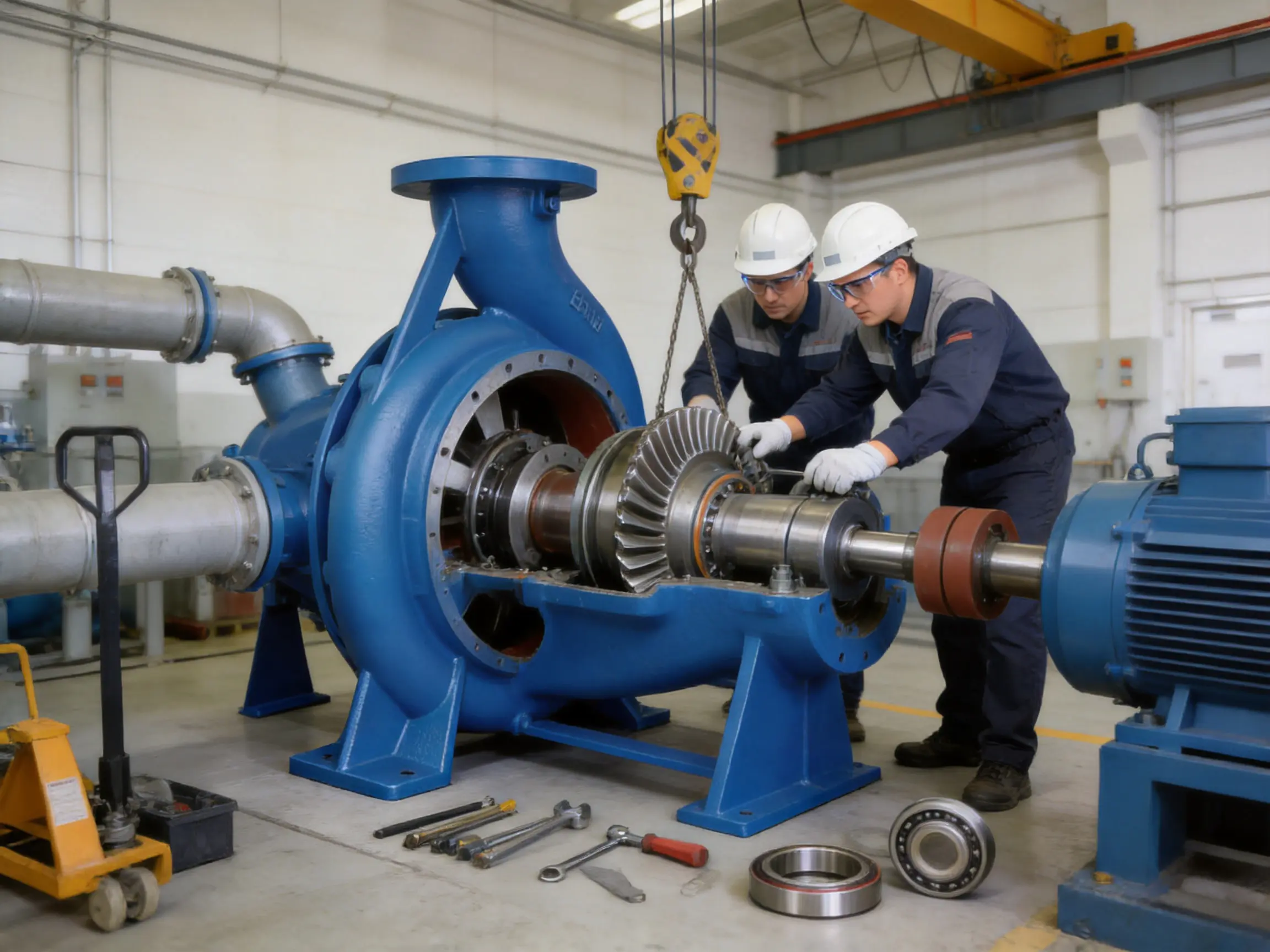
The performance of a pump is closely related to the consistency of its manufacturing process. Hydraulic geometry, shaft concentricity, bearing fit, seal chamber dimensions, casing accuracy, impeller balance, and coupling alignment all influence the final product. A strong pump manufacturer must therefore combine product design capability with disciplined production and inspection.
Taizhou Edwin Electric Co., Ltd. was founded in 2008 and operates as an integrated manufacturing enterprise. Its capabilities include independent research and development, mass production, and global export. This combination allows the company to develop products, organize serial manufacturing, and support international customers through a coordinated supply chain.
Independent research and development enables a manufacturer to adapt pump structures to changing market needs. For the EA Series, this is reflected in the combination of standard dimensions, service-friendly construction, material options, different sealing arrangements, and motor-power recommendations.
Research and development in pump manufacturing is not limited to creating a new impeller. It also includes evaluating hydraulic passages, mechanical strength, vibration behavior, seal compatibility, bearing loads, manufacturing tolerances, installation dimensions, and maintenance procedures. A product that is easy to service and replace can provide greater lifecycle value than a pump judged only by its initial purchase price.
Mass production can improve consistency when it is supported by controlled processes and appropriate inspection. Standardized components, repeatable machining procedures, defined assembly methods, and organized testing help reduce variation between individual units.
The EA Series benefits from being part of a broader pump manufacturing portfolio. Experience with different pump categories exposes the manufacturer to a wide range of hydraulic requirements, motor arrangements, materials, sealing systems, and customer applications. This accumulated knowledge can support more practical decisions in the design and production of commercial end suction pumps.
The main components of the EA Series include the pump body, impeller, shaft, shaft seal, bearings, casing cover, bearing housing, coupling, and casing seal. Each component has a direct or indirect effect on reliability.
Cast iron can provide a cost-effective and mechanically robust solution for general water service. Stainless steel can improve corrosion resistance and support more demanding water or industrial environments. Stainless-steel shafts help protect the rotating assembly, while NTN bearings provide a recognized bearing-brand option for the bearing arrangement.
Material selection must be consistent across the pump. The casing, impeller, shaft, wear areas, seal faces, elastomers, gaskets, and fasteners should all be evaluated for compatibility with the liquid and operating conditions. A manufacturer with multiple material options can provide a more technically appropriate solution than one limited to a single standard configuration.
Precise machining is necessary for casing fits, shaft diameters, seal chambers, bearing seats, coupling interfaces, and impeller clearances. Excessive dimensional deviation can lead to leakage, vibration, premature bearing wear, or reduced hydraulic performance.
During assembly, the rotating components must be positioned correctly, the bearings must be installed without damage, and the mechanical seal must be handled according to its design requirements. Coupling alignment is also important. A pump can be well designed yet perform poorly if assembly and alignment are not controlled.
Performance verification should confirm that the completed pump is capable of operating near the specified flow and head. Depending on the order and project requirements, testing may include hydraulic performance checks, leakage inspection, rotation verification, vibration observation, and motor-related checks.
For critical applications, customers may request additional documentation such as dimensional records, material certificates, test reports, inspection records, or quality-control documents. The precise scope of testing should be agreed before production and reflected in the purchase specification.
Edwin Pump has experience serving customers in international markets and has established related companies to support procurement planning, order tracking, cross-border delivery, and foreign-trade services. This organizational structure can be valuable for customers purchasing pumps for overseas projects, distributors managing inventory, and contractors coordinating equipment delivery.
International project support involves more than shipping a pump. It may include confirming technical specifications, checking voltage and frequency, selecting flange standards, preparing documentation, coordinating packaging, arranging spare parts, and responding to installation or commissioning questions. An integrated export and manufacturing structure can help reduce communication gaps between production and customer service.
Traditional end suction pumps without a true back-pull-out structure may require the motor to be moved or the connected pipework to be disconnected during service. The EA Series can reduce this disruption by allowing the rotating assembly to be withdrawn from the rear of the casing.
When fitted with a spacer coupling, the motor can remain undisturbed. This is a practical advantage in systems where alignment work is time-consuming or where the motor is large and difficult to move.
Equipment replacement can become expensive when a new pump requires new pipework, a modified base, or a different motor position. The EA Series follows internationally recognized dimensions and offers standard flange configurations with options such as ANSI 150 and JIS 10K. This can improve compatibility with existing installations.
Compatibility should always be confirmed through engineering drawings and measurements, but a standardized design provides a better starting point for replacement work than a proprietary, non-standard layout.
Many basic pumps are offered only in a single material combination. The EA Series provides cast-iron and stainless-steel options, with additional duplex stainless-steel possibilities for demanding services. This allows users to balance cost, corrosion resistance, strength, and expected service life.
The ability to select mechanical seals, gland packing, or dynamic sealing arrangements can be valuable for industrial operators with established maintenance practices. Likewise, grease or oil lubrication options can be considered according to bearing size, speed, operating environment, and service preferences.
The EA Series is designed with more than initial installation in mind. The oversized shaft, accessible rotating assembly, standard dimensions, replaceable sealing components, stable bearing housing, and available materials all contribute to lifecycle value.
Lifecycle cost includes energy consumption, spare parts, labor, downtime, inspection, replacement, and disposal. A pump with a slightly higher initial price may be more economical over time if it delivers better efficiency, easier maintenance, and longer component life.
Before ordering an EA Series pump, the user should prepare a complete duty specification. Important information includes required flow rate, total head, liquid temperature, liquid properties, suction arrangement, operating hours, system pressure, motor voltage, frequency, installation altitude, ambient temperature, flange standard, and preferred materials.
The duty point should be identified from the system curve rather than estimated from the pipe diameter alone. The system curve includes static head, friction loss, valve losses, fittings, heat exchangers, filters, and other equipment. If the system demand changes substantially, the pump may need a control strategy, variable-speed drive, multiple-pump arrangement, or bypass system.
Suction conditions should be reviewed carefully. The available net positive suction head must exceed the pump’s required value with a suitable margin. Water temperature, elevation, suction pipe friction, tank level, and inlet fittings all affect this calculation.
Motor selection should include the recommended power margin, but oversizing should also be avoided where possible. An excessively large motor can increase purchase cost, starting current, operating cost, and the risk of operating the pump far from its best efficiency point.
Material selection should be based on the actual water quality. Ordinary clean water may permit cast iron, while saline water, treated water containing aggressive chemicals, or industrial liquids may require stainless steel or duplex materials. Seal faces and elastomers should be reviewed together with the casing and impeller materials.
For replacement projects, users should provide dimensional drawings or measurements of the existing pump. Important measurements may include flange sizes, flange centers, shaft height, base dimensions, coupling type, motor frame, shaft diameter, bearing housing, and service-clearance requirements.
Before commissioning, the pump should be inspected for shipping damage, correct rotation, secure fasteners, proper lubrication, and correct coupling installation. The suction line must be filled and vented as required, and the pump should not be operated dry unless the specific design permits it.
The suction and discharge valves should be operated according to the commissioning procedure. Pressure gauges should be installed where they can provide useful information without creating unsafe exposure. Any temporary construction debris, welding residue, or foreign material should be removed from the pipe system before operation.
During initial operation, technicians should observe vibration, noise, pressure, leakage, bearing temperature, motor current, and flow. A small amount of controlled leakage may be acceptable with certain packing arrangements, while a mechanical seal should be checked for abnormal leakage or overheating.
Maintenance intervals depend on operating conditions. Routine activities may include checking coupling alignment, inspecting the seal area, confirming lubrication condition, monitoring bearing temperature, recording vibration, checking flange and foundation fasteners, and reviewing motor current.
Performance records are useful for identifying gradual deterioration. A reduction in flow or pressure may indicate impeller wear, blocked suction, air ingress, excessive system resistance, incorrect rotation, seal problems, or changes in the system itself. Trend monitoring can allow corrective action before a failure occurs.
When the pump must be disassembled, the system should be isolated, depressurized, drained, and electrically locked out. The back-pull-out design can simplify the work, but safe lifting methods and proper handling of the rotating assembly remain essential. After reassembly, alignment and rotation should be verified before return to service.
The EA Series combines a widely accepted centrifugal-pump arrangement with features intended to reduce ownership difficulty. Its value comes from the interaction of several design decisions: standardized dimensions, serviceable construction, flexible materials, accessible rotating components, stable shaft support, and suitable application coverage.
For fire protection, service continuity and readiness are essential. For industrial plants, downtime and maintenance labor affect production economics. For commercial buildings, reliable water pressure and manageable service costs influence occupant comfort and facility operation. For municipal and irrigation systems, energy use, compatibility, and long-term availability are important. The same pump design can address these needs when correctly selected and configured.
The manufacturing strength behind the product also matters. A company with independent research and development, mass-production capability, international export experience, and a broad range of pump technologies is better positioned to support different customer requirements. Edwin Pump’s product portfolio and manufacturing background provide a foundation for supplying complete pump solutions rather than isolated standard units.
The EA Series is therefore well suited to customers seeking a dependable horizontal end suction pump for clean-water applications, particularly where maintenance access, replacement compatibility, and material flexibility are important purchasing criteria.
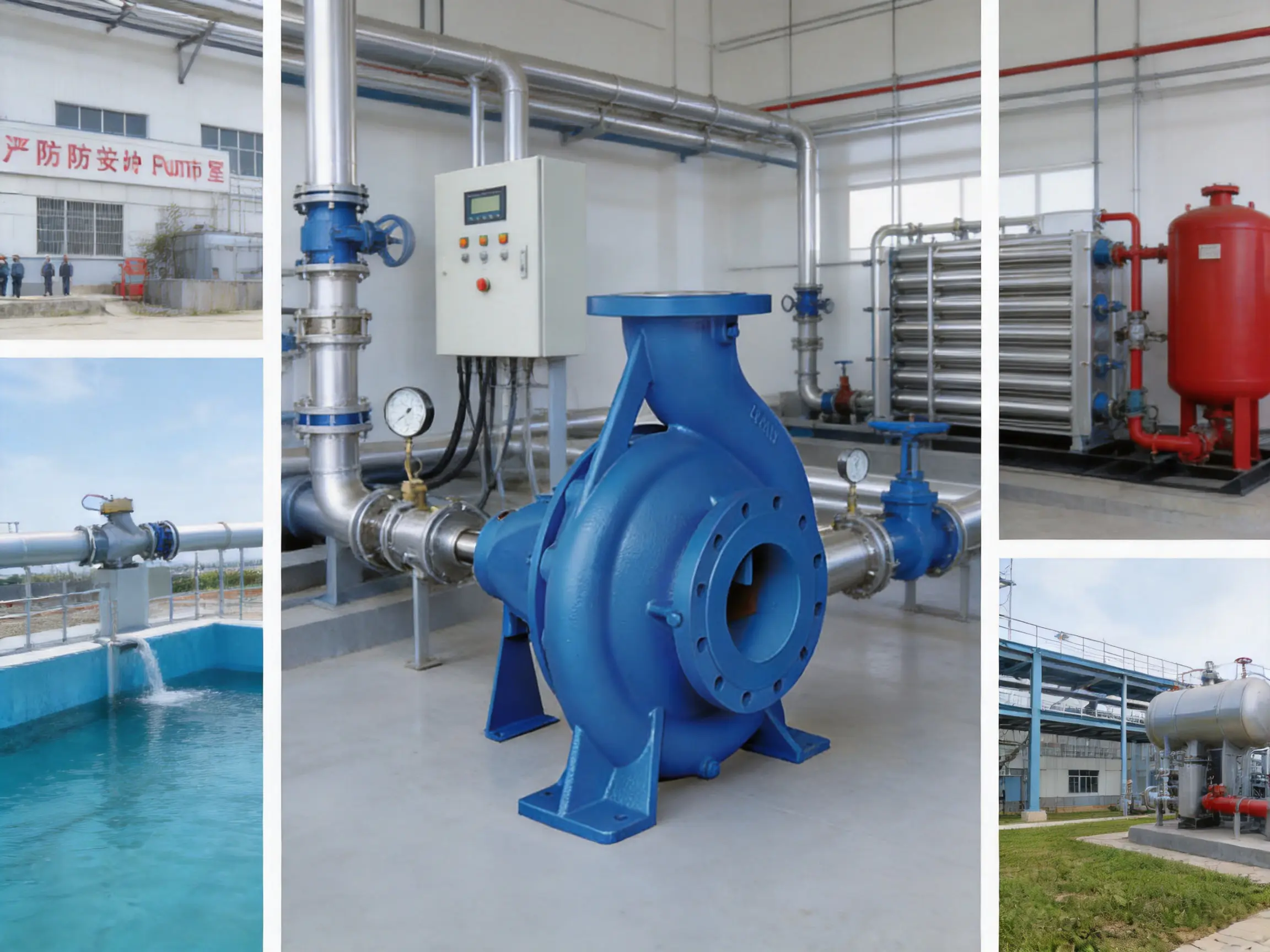
The EA Series is a horizontal end suction, single-stage, foot-mounted centrifugal pump with axial suction and vertical top discharge. It is designed primarily for clean-water transfer and related applications.
Yes. The EA Series is intended for fire-fighting and fire-protection water applications when the selected model, motor, controls, materials, and system arrangement meet the project requirements and applicable regulations.
The main advantage is the true back-pull-out construction. The back plate and rotating assembly can be removed from the rear without normally disturbing the connected suction and discharge pipework. A spacer coupling can also allow the motor to remain in place during servicing.
The pump body and impeller can be supplied in cast iron or stainless steel. The shaft is stainless steel. SUS304, SUS316, and selected duplex stainless-steel options may be considered according to the liquid and project requirements.
The pump can use a mechanical seal, gland packing, or dynamic seal arrangement depending on the application. The seal should be selected according to liquid characteristics, pressure, temperature, and operating conditions.
EA pumps are equipped as standard with IM B3 electric motors. The motor power should be selected based on the actual pump duty and the recommended safety margin.
The EA Series follows DIN 24255 and BESN 733 dimensional principles, which can support direct interchangeability with pumps manufactured to comparable standards. However, the actual flow, head, speed, motor, flange, base, shaft, and installation dimensions must be verified before replacement.
Applications include water supply, fire-fighting systems, industrial process transport, pressure boosting, cooling plants, air-conditioning systems, heating systems, district heating, irrigation, and other clean-water duties.
The user should confirm flow, head, liquid properties, temperature, suction conditions, system pressure, motor voltage and frequency, flange standard, materials, seal type, installation dimensions, and operating schedule.
The manufacturer combines production, research and development, export experience, procurement planning, order tracking, cross-border delivery, and foreign-trade services. Customers can therefore coordinate technical and commercial requirements through an integrated supply structure.
The EA Series Horizontal End Suction Fire Centrifugal Pump is a robust clean-water pumping solution built around practical engineering principles. Its single-stage horizontal design, vertical top discharge, foot-mounted structure, high-efficiency closed impeller, oversized stainless-steel shaft, reliable bearing arrangement, and flexible sealing options support a wide range of applications.
Its true back-pull-out construction and optional spacer coupling provide a clear advantage where reduced downtime and simplified maintenance are priorities. Its dimensional compliance with DIN 24255 and BESN 733 helps support replacement and standardization projects, while cast-iron, stainless-steel, and duplex material options provide flexibility for different operating environments.
Supported by Edwin Pump’s independent research and development, mass-production capabilities, international export experience, and broad pump portfolio, the EA Series offers more than a standard hydraulic machine. It represents a service-oriented approach to pump engineering in which reliability, maintainability, compatibility, and lifecycle value are considered together.
For clean-water transfer, fire protection, industrial utility service, pressure boosting, heating, cooling, and related duties, the EA Series can provide a dependable foundation when correctly selected, installed, commissioned, and maintained.
DIN 24255, End-Suction Centrifugal Pumps with Rating and Nomenclature Principles.
BESN 733, Standardized Dimensions for End-Suction Centrifugal Pump Arrangements.
ISO 5199, Technical Specifications for Centrifugal Pumps, Class II.
ISO 2084, Flanges and Connecting Dimensions for Industrial Piping Applications.
Manufacturer Product Information, EA Series Horizontal End Suction Fire Centrifugal Pump.
Manufacturer Technical Information, Pump Components, Materials, Service Connections, and Motor Selection Guidance.
Manufacturer Company Information, Research and Development, Manufacturing, Export, and Global Customer-Service Capabilities.
edwina@edwin-pump.com
+86-13586290903 (WhatsApp)
Xuri Gongliang Cutting Tool Entrepreneurship Park, Wenqiao Town, Wenling City, Taizhou City, Zhejiang Province, China

High Performance Smart Pump Factory


 English