edwina@edwin-pump.com

View All Products
en
Heating systems depend on stable pressure, controlled water volume, and dependable protection against thermal expansion. When water is heated, its volume increases. If the system does not have sufficient expansion capacity, pressure can rise beyond the safe operating range. This may cause leakage, premature component wear, safety-valve discharge, pump problems, and unnecessary maintenance. The VT-XY Series Fixed Membrane Expansion Vertical Tank is designed to manage these pressure changes and support the safe, efficient operation of heating and water systems.
As a carbon steel pressure tank developed for heating applications, the VT-XY Series combines a fixed membrane, durable steel construction, a stainless steel flange, and a wide working-temperature range of -20°C to +99°C. Its vertical format makes it suitable for applications where equipment-room space must be used efficiently. Available in multiple capacities and connection configurations, the series can be selected for domestic, commercial, HVAC, and industrial heating installations.
The tank is manufactured by Taizhou Edwin Electric Co., Ltd., an integrated enterprise with experience in research and development, mass production, and international export. Although the company is widely associated with water pumps, its broader product portfolio includes water-treatment peripheral products and pressure-management equipment. This combination of pump expertise, system knowledge, and export-oriented manufacturing provides an important advantage when customers are selecting a tank for a complete water or heating installation.
Water is often treated as incompressible in basic engineering calculations, but it still expands when its temperature rises. In a closed heating circuit, the water has limited room to increase in volume. Without a properly sized expansion tank, even a relatively small increase in water volume can create a substantial pressure rise.
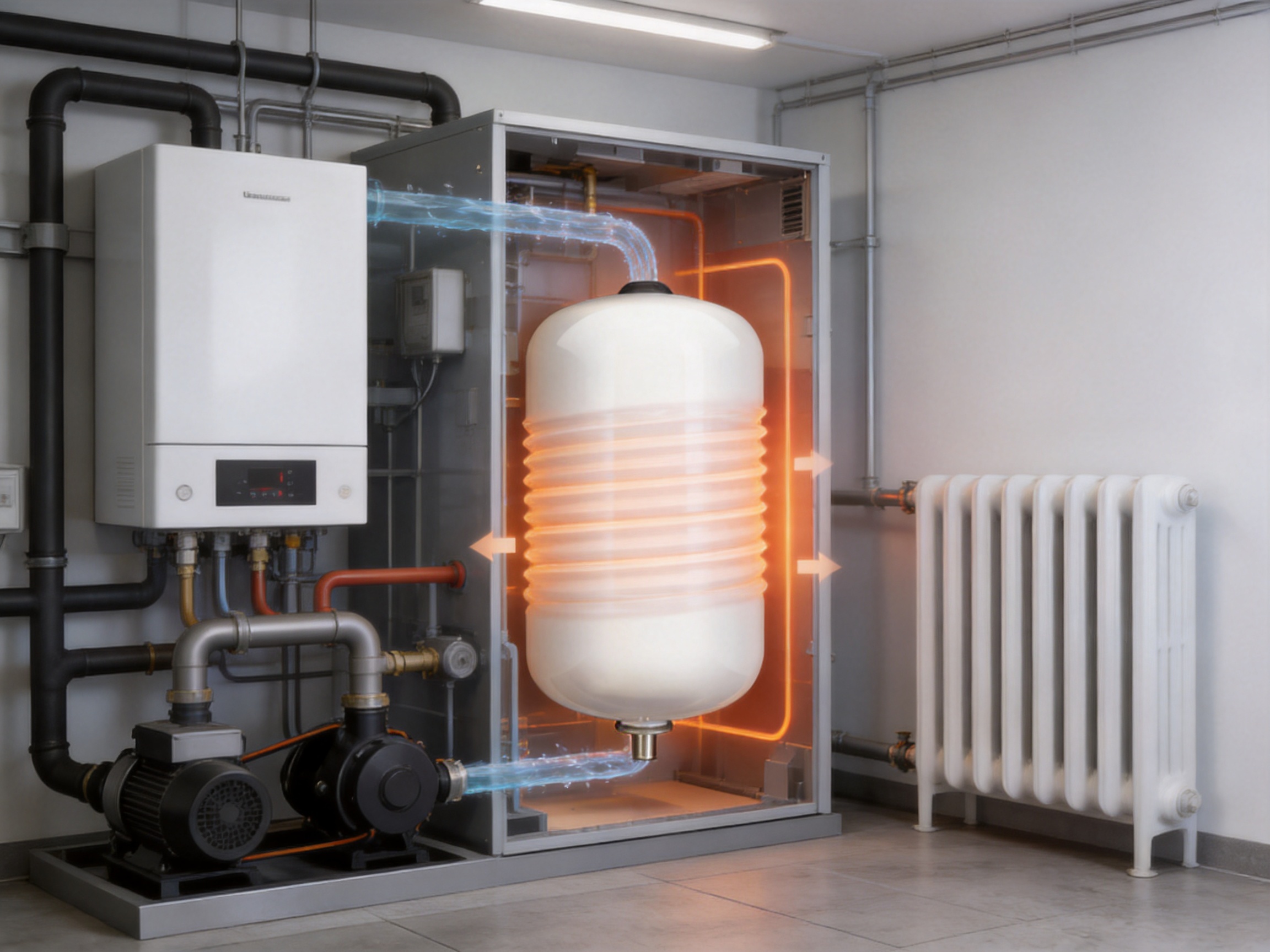
A fixed membrane expansion tank provides a controlled space for this change. The tank contains a water chamber and a gas chamber separated by a flexible membrane. Before installation, the gas side is charged to a specified precharge pressure. As the heating-system water expands, it enters the tank and pushes against the membrane. The gas on the opposite side compresses, absorbing the additional volume and helping to limit pressure fluctuations.
When the system cools, the compressed gas expands and pushes water back into the heating circuit. This allows the tank to support system pressure during both heating and cooling cycles. The result is a more stable operating environment for boilers, pumps, radiators, valves, heat exchangers, pipes, and control equipment.
Without adequate expansion capacity, a heating installation may experience repeated pressure changes. These changes can activate safety valves, introduce air into the system, stress joints, and increase the possibility of corrosion or component failure. A properly selected expansion tank is therefore not simply an accessory. It is a key pressure-control component that contributes to system safety, reliability, and service life.
The VT-XY Series is a fixed membrane expansion vertical tank intended primarily for heating systems. The product category is carbon steel pressure tank, and the design is focused on long-term pressure containment, thermal-cycle stability, and convenient integration with water systems.
The series includes compact models such as the VT0.16-XY, small auxiliary models such as the VT2L-XY, and larger capacities including the VT8L-XY, VT10L-XY, VT12L-XY, VT19L-XY, VT24L-XY, and VT36L-XY. The range allows installers, system designers, and distributors to select a tank according to available space, system volume, pressure requirements, and connection size.
Maximum pressure ratings in the listed models are generally 8 or 10 bar, while the VT0.16-XY is listed with an 8-bar maximum pressure. The standard precharge pressure is 3.5 bar across the listed models. The connector options include 1/2-inch and 3/4-inch connections, supporting integration with a broad range of heating and water-system piping arrangements.
The working temperature range of -20°C to +99°C gives the series flexibility for a wide variety of heating applications. This range is suitable for many hydronic systems, including radiator circuits, underfloor heating installations, heat-pump systems, boiler circuits, and other closed-loop water applications, subject to correct design and installation.
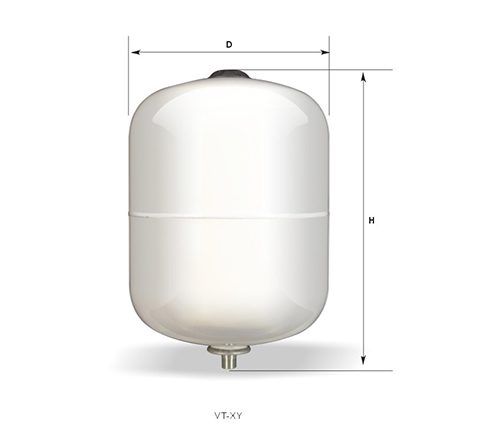
VT-XY Series Fixed Membrane Expansion Vertical Tank for Heating System
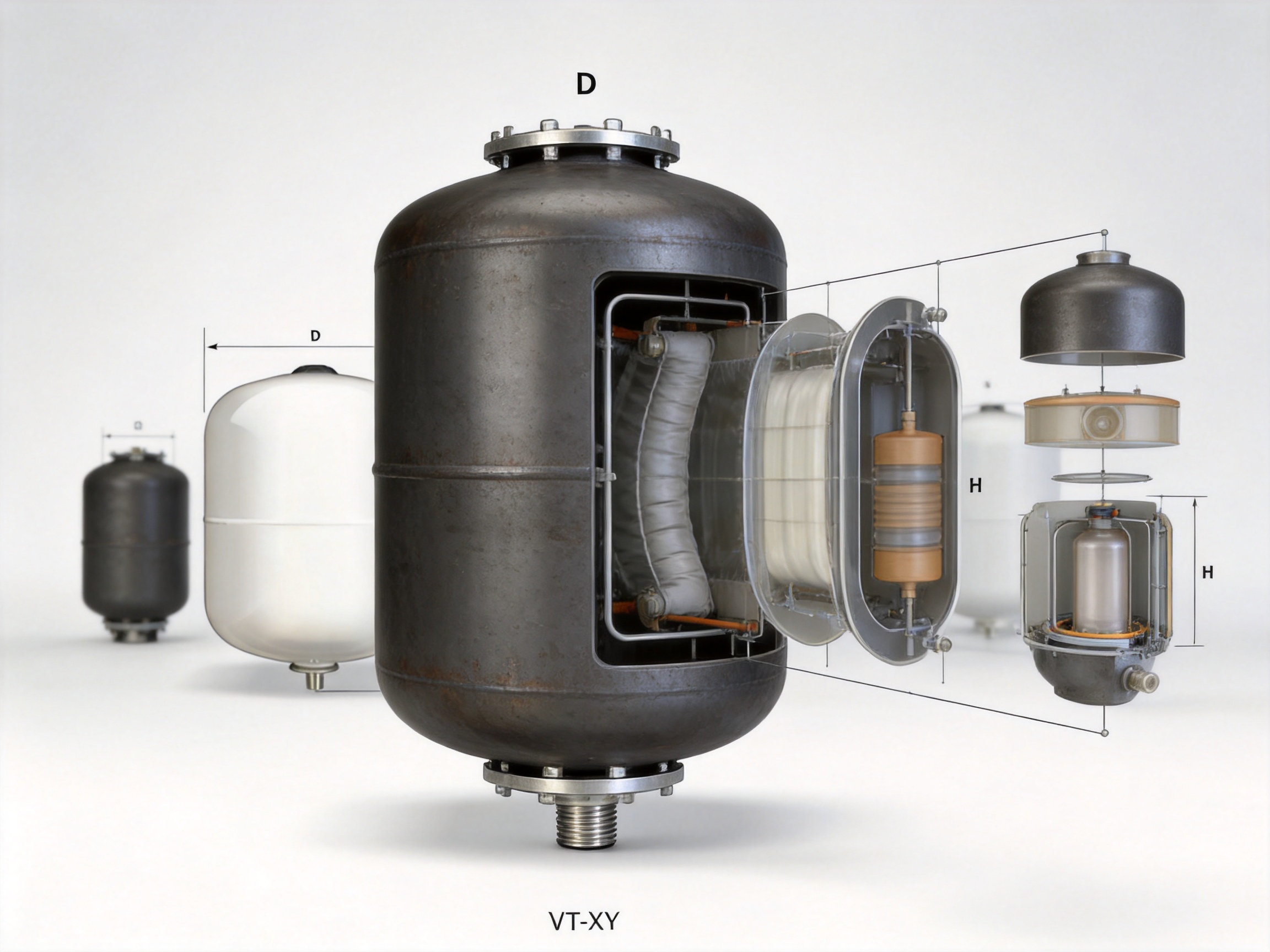
The fixed membrane is one of the most important features of the VT-XY Series. In a fixed membrane design, the diaphragm is secured within the tank rather than being installed as a freely replaceable bladder. This arrangement provides a stable separation between the system water and the precharged gas.
Keeping water and gas separated helps reduce direct contact between the heating fluid and the tank’s internal gas chamber. It also allows the tank to respond predictably as the system heats and cools. A stable membrane position can support consistent pressure behavior over repeated operating cycles when the tank is correctly sized and maintained.
Compared with simple air-cushion tanks that allow air to dissolve into the water, a membrane expansion tank provides more controlled pressure compensation. This can reduce the need for frequent air management and help maintain the designed expansion performance for a longer period.
The vertical tank configuration provides practical benefits in mechanical rooms, plant rooms, boiler rooms, and utility spaces. A vertical body uses floor space efficiently and can be positioned near the heating-system connection point. This is especially useful where horizontal clearance is limited or where a system layout requires a compact footprint.
Vertical installation can also simplify visual inspection. The tank body, connection, pressure information, and surrounding isolation components can remain accessible to service personnel. Proper clearance should always be provided around the tank, and the installer should follow the applicable installation instructions and local safety requirements.
Carbon steel provides a strong and economical foundation for a pressure tank. It offers the structural strength required for a pressurized water system while remaining suitable for large-scale production. The tank body is designed to withstand the mechanical demands associated with pressure cycling and temperature variation.
The use of carbon steel also makes the product commercially attractive compared with some higher-cost alternative materials. For many heating-system applications, the key requirement is not that every component be manufactured from stainless steel, but that the pressure vessel, coating, connection, membrane, and manufacturing controls are appropriate for the intended service.
The stainless steel flange adds an additional layer of corrosion resistance at a critical connection area. Flanges and water connections are exposed to moisture, installation handling, and possible condensation. A stainless steel component can help protect this interface and support long-term service performance.
The flange also contributes to installation durability. During assembly and maintenance, connection components may be exposed to repeated tightening, loosening, and inspection. A corrosion-resistant flange can help preserve connection quality when the tank is installed in a demanding mechanical environment.
The specified operating range of -20°C to +99°C allows the VT-XY Series to serve systems that experience both low ambient temperatures and elevated heating-water temperatures. This makes the range adaptable to many residential, commercial, and industrial water circuits.
Temperature compatibility should always be considered together with pressure, system fluid, heating technology, and installation conditions. The stated range identifies the intended operating capability of the product, but the complete system must also be designed so that the tank is not exposed to temperatures or pressures beyond its rated limits.
The VT-XY Series carries CE marking, indicating that the product is presented as conforming to applicable European requirements within the relevant product scope. For distributors and international buyers, this provides useful documentation support when evaluating equipment for European projects or projects influenced by European technical standards.
CE marking does not replace professional system design or local inspection. However, it is an important commercial and compliance feature that can simplify product evaluation, technical documentation, and procurement decisions.
The following table summarizes the technical information supplied for the VT-XY Series. Dimensions and packaging information should be confirmed with the manufacturer before final ordering, especially when the product is being purchased in bulk or installed in a restricted equipment room.
| Model | Maximum Pressure | Diameter | Height | Precharge Pressure | Connector | Packing Information |
| VT2L-XY | 8 or 10 bar | 124 mm | 242 mm | 3.5 bar | 1/2 inch | 0.0896 CBM / 20 pieces |
| VT8L-XY | 8 or 10 bar | 200 mm | 330 mm | 3.5 bar | 3/4 inch | 0.014 CBM |
| VT10L-XY | 8 or 10 bar | 230 mm | 330 mm | 3.5 bar | 3/4 inch | 0.01799 CBM |
| VT12L-XY | 8 or 10 bar | 270 mm | 295 mm | 3.5 bar | 3/4 inch | 0.02333 CBM |
| VT19L-XY | 8 or 10 bar | 270 mm | 395 mm | 3.5 bar | 3/4 inch | 0.03214 CBM |
| VT24L-XY | 8 or 10 bar | 270 mm | 455 mm | 3.5 bar | 3/4 inch | 0.03606 CBM |
| VT36L-XY | 8 or 10 bar | 350 mm | 435 mm | 3.5 bar | 3/4 inch | 0.05390 CBM |
| VT0.16-XY | 8 bar | 65/79 mm | 105 mm | 3.5 bar | 1/2 inch | 0.0309 CBM / 30 pieces |
The model names indicate different nominal capacities, but the supplied technical information should be checked against the final product datasheet. In particular, the packing entries may represent different packaging configurations, carton volumes, or batch arrangements. Professional buyers should request confirmation of net volume, gross volume, unit weight, carton dimensions, pallet quantity, and container-loading data before preparing a purchase order.
A conventional tank without a membrane may depend on an air pocket that gradually changes as air dissolves into the water. This can reduce effective expansion capacity and cause more frequent pressure fluctuations. The fixed membrane configuration provides a dedicated separation between water and gas, allowing the tank to maintain a more controlled expansion function.
For heating-system operators, better pressure control can reduce nuisance discharge from safety valves and help prevent low-pressure conditions after the system cools. It also supports more stable operation of circulation pumps and automatic controls.
When an unseparated air cushion is gradually absorbed into the water, the tank can become waterlogged. A waterlogged tank no longer has sufficient compressible gas volume to absorb thermal expansion. The fixed membrane helps reduce this risk by maintaining the physical separation of the gas and water chambers.
This does not eliminate the need for inspection. Precharge pressure should still be checked according to the maintenance schedule, and the membrane should be evaluated if the tank shows abnormal pressure behavior. Nevertheless, the membrane construction provides a more dependable operating principle than an uncontrolled air pocket.
Pressure fluctuations can accelerate wear in boilers, heat exchangers, valves, pumps, pipe joints, and control components. By absorbing expansion volume, the VT-XY Series helps reduce the severity and frequency of pressure changes. This can contribute to longer equipment life and lower maintenance requirements.
The tank can also help reduce water hammer and pressure-related disturbances when integrated correctly into the system. Water hammer is influenced by many factors, including valve-closing speed, pipe layout, flow velocity, and pump control. An expansion tank is not a complete solution for every hydraulic transient, but it can be an effective part of a broader pressure-management strategy.
The vertical design provides a compact installation footprint relative to the capacity offered. In plant rooms where floor area is limited, the ability to use vertical clearance can simplify system layout. This can be especially valuable in retrofit projects, where the available installation space is often constrained by existing boilers, pumps, pipework, electrical equipment, and access paths.
A single tank size cannot meet every heating-system requirement. The VT-XY Series provides several model choices, from compact units to larger 36-liter options. This enables distributors and installers to stock a practical range for different project sizes.
The 1/2-inch and 3/4-inch connector options further improve application flexibility. Smaller models can be used in compact domestic systems or auxiliary circuits, while the larger models can support more substantial heating and hydronic installations when the calculated expansion volume is within their capacity.
Boiler systems heat water through a controlled thermal cycle. As the water temperature rises, its volume increases. The expansion tank provides a pressure buffer that helps protect the boiler circuit from excessive pressure. It is suitable for use with many closed-loop hot-water heating systems when selected according to system volume and temperature.
Radiator circuits may contain a considerable volume of water distributed through pipes, radiators, valves, and heat exchangers. The VT-XY Series can be installed as part of the hydraulic design to compensate for expansion in the circuit and help maintain stable pressure during daily heating cycles.
Underfloor heating systems often contain long pipe circuits and operate with regular temperature changes. A correctly sized expansion tank can help accommodate water-volume variation and protect the circulation equipment. The installation location should be selected carefully so that the tank can be inspected and serviced without removing floor or wall finishes.
Heat-pump heating systems rely on controlled water circulation and may operate over extended periods. Depending on the hydraulic design, an expansion tank can be connected to the closed water circuit to manage thermal expansion. The tank’s temperature and pressure limits must be compared with the heat-pump manufacturer’s requirements.
Commercial heating and HVAC systems often contain larger water volumes and more complicated pipe networks than residential systems. Expansion tanks are used in these systems to protect pumps, valves, heat exchangers, and distribution circuits. The larger VT-XY models may be appropriate
edwina@edwin-pump.com
+86-13586290903 (WhatsApp)
Xuri Gongliang Cutting Tool Entrepreneurship Park, Wenqiao Town, Wenling City, Taizhou City, Zhejiang Province, China

High Performance Smart Pump Factory


 English