edwina@edwin-pump.com

View All Products
en
Reliable water access is one of the most important requirements in agricultural production, livestock management, rural development, and environmental infrastructure. In many areas, however, conventional electric power is unavailable, unstable, or too expensive to extend to a remote pumping site. Diesel generators can provide temporary power, but fuel costs, maintenance requirements, noise, and emissions make them less attractive for long-term operation. Solar water pumping offers a practical alternative by converting available sunlight into a dependable source of water for wells, boreholes, storage tanks, irrigation networks, and off-grid communities.
The 4EPC Brushless DC Powered Solar Irrigation Deep Well Pump is designed for these demanding conditions. It combines a brushless direct-current motor, stainless steel construction, solar-compatible electrical characteristics, high lift capability, and a broad range of flow and power configurations. The result is a flexible pumping platform for users who need to match a pump to a particular well depth, irrigation layout, water demand, or photovoltaic array.
Unlike a standard pump selected only by its motor power, a solar deep well pump must operate as part of a complete energy and water system. The pump, solar panels, controller, cables, well, pipes, valves, storage tank, and irrigation equipment must work together. The 4EPC series is developed with this system-level requirement in mind. Its available voltage and performance options help engineers and distributors configure systems for different installation conditions instead of forcing every project into one fixed specification.
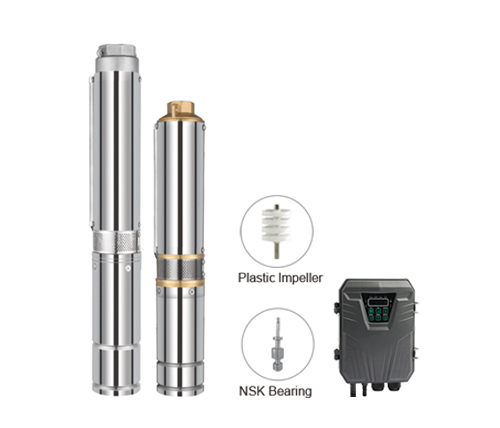
4EPC Brushless DC Powered Solar Irrigation Deep Well Pump
A deep well pumping application creates several challenges at the same time. The pump must fit inside a narrow borehole, lift water through a considerable vertical distance, overcome friction losses in the discharge pipe, and maintain stable operation even when sunlight changes during the day. It must also resist corrosion, tolerate outdoor conditions, and operate with limited supervision in locations where service technicians may be far away.
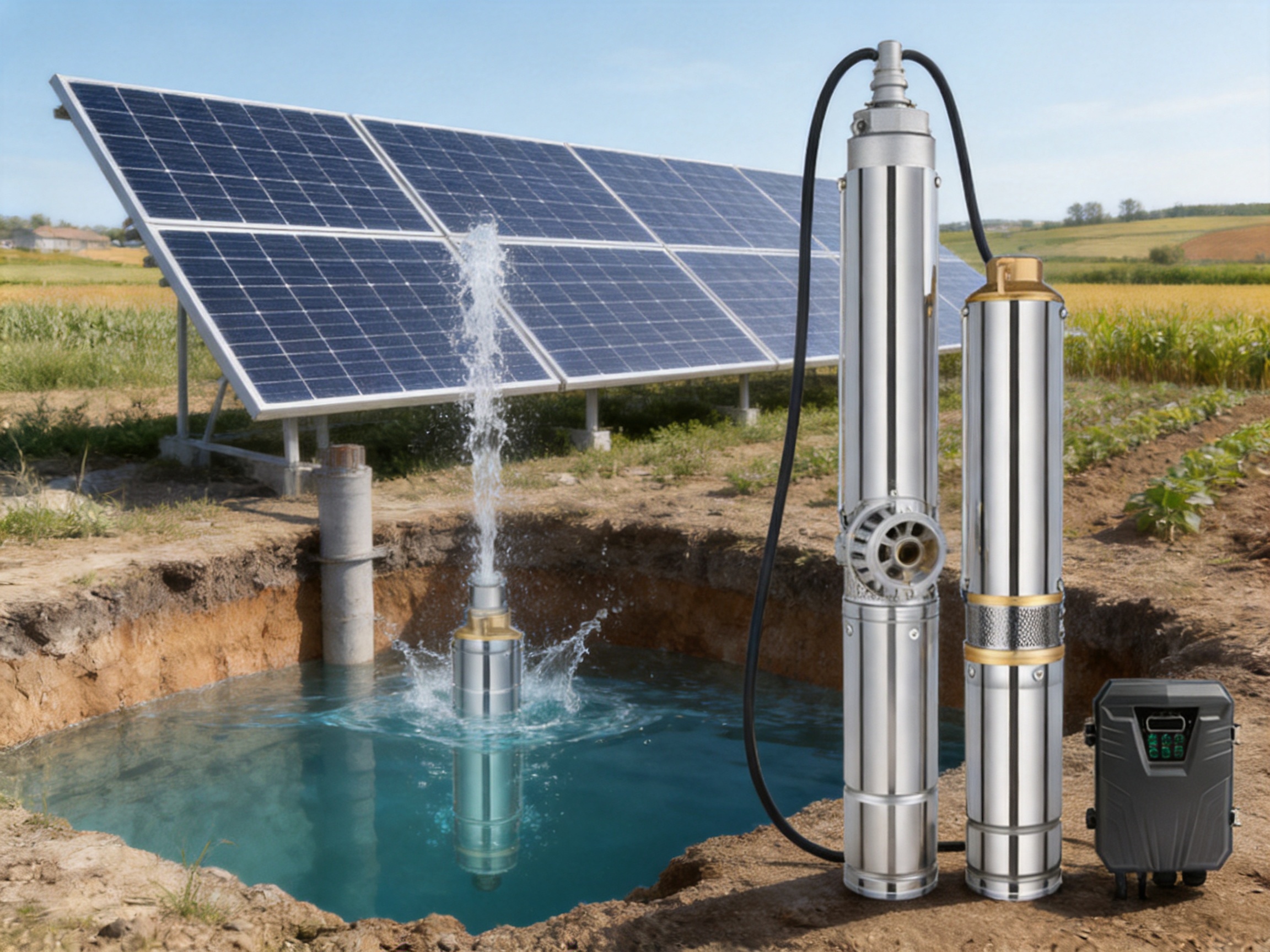
The 4EPC series addresses these needs through a submersible configuration and brushless DC drive technology. Because the pump is installed below the water level, it does not need to draw water through a long suction line. This arrangement helps reduce suction-related limitations and makes the pump suitable for deep wells and boreholes. The pump pushes water upward through the delivery pipe, allowing the system designer to use the available hydraulic energy more effectively.
Solar operation is particularly useful for irrigation because water demand and solar availability often occur during the same part of the day. When sunlight is strong, the photovoltaic array can provide greater input power and the pump can produce a higher useful output. Water can be delivered directly to crops, a raised tank, a reservoir, or an irrigation distribution system. Where water is required after sunset, the pump can fill a storage tank during daylight rather than relying entirely on batteries.
The pump can work with solar panels or a hybrid arrangement. A hybrid system may include battery backup, another DC source, or a compatible control arrangement, depending on the project design. This flexibility allows the same basic pump platform to be applied to agricultural, household, livestock, and public water projects.
The motor is the core of any submersible pump, and the brushless DC motor used in the 4EPC range offers several advantages over conventional brushed motors. A brushed motor transfers current through physical carbon brushes and a commutator. These components wear during operation and may create electrical arcing, friction, heat, and maintenance demands. A brushless motor uses electronic commutation instead, eliminating the need for internal brushes.
Without brushes, the motor has fewer wear components and does not require brush replacement during normal service. This is valuable in remote wells, agricultural fields, and rural installations where routine maintenance can be inconvenient or expensive. The motor also supports smooth operation and high torque output, which helps the pump start and operate effectively when the available solar input changes.
Brushless construction can also contribute to quieter operation. Reduced mechanical contact inside the motor means less friction-related noise and wear. Quiet operation is especially beneficial near homes, schools, livestock buildings, and environmentally sensitive locations.
Electronic motor control provides an additional advantage in a solar system. Photovoltaic output is not constant. Cloud cover, changing sun angles, dust, temperature, and partial shading all influence the power available to the pump. A suitable controller can regulate motor operation according to the available input, helping the pump operate more smoothly than a simple fixed-speed arrangement.
It is important to understand that a brushless DC motor does not remove the need for correct system design. The controller must be matched to the motor and voltage configuration, and the photovoltaic array must remain within the specified input limits. When these requirements are respected, the brushless design provides a strong combination of efficiency, low maintenance, and long-term suitability for solar pumping.
The 4EPC pump is designed for direct connection to appropriately configured solar photovoltaic panels through a compatible controller. The product range includes 48-volt, 72-volt, and 110-volt motor options. The listed optimum DC input ranges are generally 60–90 volts for 48-volt models, 90–120 volts for 72-volt models, and 110–150 volts for 110-volt models.
These figures are important because a solar array must be configured according to the controller and pump requirements rather than by panel wattage alone. Panels connected in series increase voltage, while panels connected in parallel increase current. The final array must provide the necessary operating voltage under real conditions and must not exceed the specified open-circuit voltage limit.
The product information specifies a solar panel power requirement of at least 1.3 times the pump power. This provides a practical starting point for array selection. For example, a 500-watt pump requires a solar panel capacity of at least approximately 650 watts, while a 1,500-watt pump requires at least approximately 1,950 watts. Actual system designers may select a larger array when they need longer operating hours, improved performance during weak sunlight, or additional allowance for panel aging, dust, temperature, and seasonal solar variation.
Smart MPPT controller compatibility helps improve the use of available solar energy. Maximum Power Point Tracking technology continuously seeks a suitable operating point for the photovoltaic array, allowing the system to extract more usable energy under changing conditions than a basic controller may achieve. The controller also forms an important protection layer for the motor and pump.
The listed control functions include protection against overvoltage, dry running, and overheating. Overvoltage protection helps prevent damage caused by an incorrectly configured or unexpectedly high photovoltaic input. Dry-run protection helps reduce the risk of operating without adequate water around the pump. Overheating protection helps safeguard the motor when operating conditions become abnormal. These functions are especially valuable in unattended installations.
Controller selection should always be based on the exact pump model, nominal voltage, operating input range, maximum open-circuit voltage, current requirements, and the electrical characteristics of the chosen solar panels. A professional installer should verify the complete system before commissioning.
The 4EPC product family is available in several hydraulic groups, including approximately 4.5 cubic meters per hour, 5 cubic meters per hour, 6 cubic meters per hour, 6.5 cubic meters per hour, 9 cubic meters per hour, 13 cubic meters per hour, and 17 cubic meters per hour maximum flow configurations. Maximum head options range from approximately 36 meters to 135 meters, depending on the selected model.
This range allows the pump to serve both moderate-flow irrigation and larger water transfer applications. A smaller flow model with a higher head may be suitable for a deep borehole, elevated tank, long pipeline, or pressurized irrigation network. A larger flow model with a moderate head may be better suited to filling a reservoir, supplying flood irrigation, or transferring water over a shorter vertical distance.
Maximum flow and maximum head are separate performance limits. A pump’s maximum flow is normally associated with low or minimal total system resistance, while its maximum head is normally associated with very low or zero flow. The actual operating point will be somewhere between these conditions and will depend on the pump curve and the total dynamic head of the installation.
Total dynamic head includes static lift, pressure requirements at the point of use, friction losses in pipes and fittings, elevation changes, valves, filters, irrigation equipment, and other restrictions. For example, a pump with a stated maximum head of 80 meters should not automatically be selected for a system requiring 80 meters of total head at the desired irrigation flow. A safety margin and the actual performance curve are necessary for correct selection.
The available models include 1.25-inch and 2-inch outlets. The 1.25-inch outlet models cover a broad group of 4.5, 5, 6, and 6.5 cubic meter per hour applications. The 2-inch outlet models support higher-flow configurations from 9 to 17 cubic meters per hour. Selecting the correct outlet size helps reduce unnecessary restrictions and simplifies connection to the discharge pipeline.
| Model | Voltage | DC Input Range | Power | Maximum Flow | Maximum Head | Outlet | Solar Panel Power |
| 4EPC4.5-40-48-500 | 48V | 60–90V | 500W | 4.5m³/h | 40m | 1.25" | At least 1.3 times pump power |
| 4EPC4.5-55-48-600 | 48V | 60–90V | 600W | 4.5m³/h | 55m | 1.25" | At least 1.3 times pump power |
| 4EPC4.5-80-48-750 | 48V | 60–90V | 750W | 4.5m³/h | 80m | 1.25" | At least 1.3 times pump power |
| 4EPC5-105-72-1100 | 72V | 90–120V | 1100W | 5m³/h | 105m | 1.25" | At least 1.3 times pump power |
| 4EPC6.5-135-110-1500 | 110V | 110–150V | 1500W | 6.5m³/h | 135m | 1.25" | At least 1.3 times pump power |
| 4EPC9-58-110-1100 | 110V | 110–150V | 1100W | 9m³/h | 58m | 2" | At least 1.3 times pump power |
| 4EPC13-54-110-1300 | 110V | 110–150V | 1300W | 13m³/h | 54m | 2" | At least 1.3 times pump power |
| 4EPC17-48-110-1500 | 110V | 110–150V | 1500W | 17m³/h | 48m | 2" | At least 1.3 times pump power |
The table shows only representative configurations from the wider performance range. The full series includes additional combinations of flow, head, voltage, and motor power. The model code itself provides useful selection information, but purchasers should confirm the detailed product data and performance curve for the exact configuration before ordering.
A solar deep well pump may operate for long periods in contact with groundwater, minerals, sediment, and changing water chemistry. Outdoor installations also expose equipment to humidity, dust, temperature variation, and difficult service conditions. For these reasons, material selection is a major factor in pump reliability.
The 4EPC pump uses a high-grade stainless steel housing and corrosion-resistant components. Stainless steel construction helps protect the pump from rust and supports a longer service life in challenging environments. It also provides a clean, professional appearance suitable for agricultural, municipal, commercial, and residential installations.
Corrosion resistance is not only a cosmetic consideration. Corroded surfaces can weaken structural components, restrict moving parts, damage connection points, and introduce contamination into the water system. A corrosion-resistant pump body is therefore an important advantage when the unit is placed in a wet well for extended periods.
Material suitability should still be evaluated against the actual water conditions. Very aggressive water, high mineral concentration, abrasive sand, unusual acidity, or other special conditions may require additional technical review. Proper well development, filtration where necessary, correct installation depth, and avoidance of excessive sediment can also improve service life.
The pump’s precision-machined internal components support accurate assembly and stable hydraulic operation. Precise dimensions help maintain proper clearances and alignment between rotating and stationary parts. This is particularly important in a compact submersible pump, where efficient use of internal space must be combined with mechanical durability.
One of the strongest advantages of the 4EPC series is its low-maintenance brushless design. A conventional brushed motor may require periodic inspection or replacement of brushes. In contrast, the brushless motor does not use these consumable parts. The absence of brushes also eliminates the need for lubricating oil in the motor design described for this product.
Lower maintenance does not mean that the pump can be installed without planning. The well should be inspected, the cable should be protected, the pump should be suspended correctly, and the discharge pipe should be sized for the required flow. The controller should be kept in a suitable location, and solar panels should be installed to minimize shading and excessive dust accumulation.
Once installed correctly, the pump can reduce the number of routine service visits. This is a significant benefit for farms spread across large areas, remote livestock sites, rural communities, and public projects where equipment access is difficult. Reduced maintenance can lower the total cost of ownership even when the initial purchase price is higher than that of a basic conventional pump.
Protective control functions further reduce operating risk. Dry-run protection is important because groundwater levels can vary seasonally or because a borehole may temporarily produce less water than expected. Overheating protection provides an additional safeguard under abnormal loading or insufficient cooling conditions. These functions should be regarded as part of a complete protection strategy rather than a substitute for correct installation.
Diesel pumps can provide high power and independent operation, but they require regular fuel delivery, engine servicing, oil changes, exhaust management, and noise control. Fuel prices may fluctuate, and remote sites may experience supply interruptions. Solar pumping has no fuel consumption during operation and can operate quietly with fewer moving mechanical components.
The 4EPC pump is especially advantageous where irrigation demand is predictable during daylight hours. Although solar equipment requires an initial photovoltaic investment, ongoing energy costs can be substantially reduced. A storage tank can provide water after sunset without requiring the pump to run continuously at night.
Brushed DC pumps may be simple and economical, but their brushes and commutators are wear points. Brush replacement can be inconvenient in a deep well, and mechanical contact may increase noise and reduce long-term efficiency. The brushless motor in the 4EPC series removes this specific maintenance burden and works with electronic control for smoother solar operation.
A single-voltage product may restrict system design, particularly when panel availability, cable length, battery configuration, or regional electrical standards differ. The 4EPC range offers 48V, 72V, and 110V options across different performance levels. This makes it easier to balance cable current, array configuration, pump power, and project requirements.
Surface pumps are convenient for shallow water sources but may be limited by suction lift, inlet conditions, priming requirements, and long suction lines. A submersible deep well pump is placed closer to the water source and pushes water to the surface. This makes the 4EPC series better suited to boreholes and deep wells where a surface pump would be inefficient or impractical.
Small solar pumps can be useful for household tanks or light-duty irrigation, but they may not provide sufficient head or flow for larger agricultural fields, elevated storage, or long distribution lines. The 4EPC range extends to 1,500 watts, 17 cubic meters per hour maximum flow, and 135 meters maximum head in selected models. This broader range gives professional buyers more choices for commercial and agricultural projects.
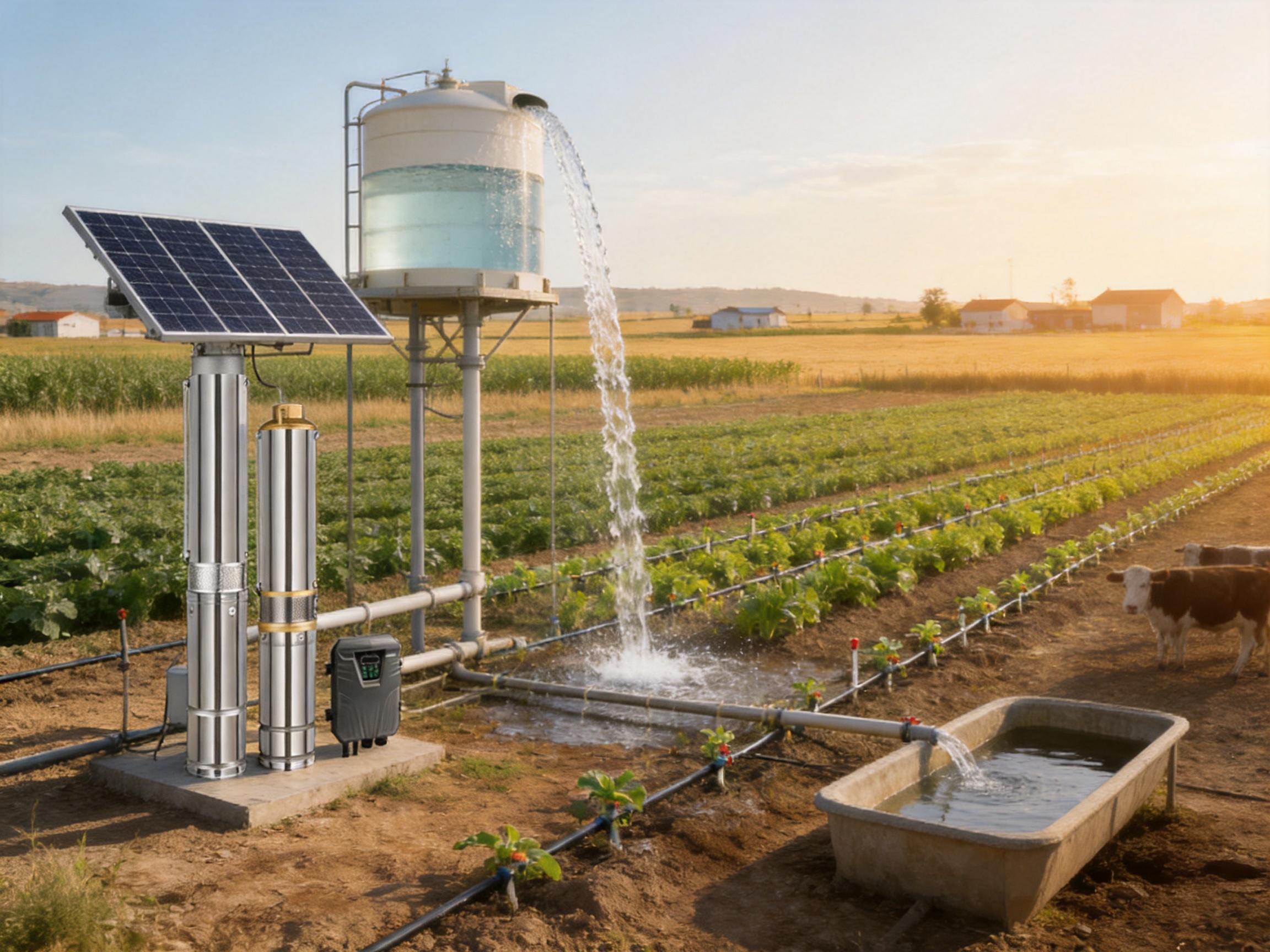
Water requirements differ according to crop type, soil, climate, irrigation method, field elevation, and planting density. The 4EPC pump can support drip irrigation, sprinkler irrigation, and flood irrigation when the selected model matches the hydraulic requirements of the system.
Drip irrigation normally requires controlled flow and suitable pressure at the distribution manifold. A pump may deliver water to a filter, pressure regulator, fertigation unit, and network of lateral lines. In such a system, the designer must consider pressure losses through filters and valves as well as the elevation of the field. A pump with excessive head may waste energy or require additional regulation, while insufficient head may produce uneven irrigation.
Sprinkler systems often require more pressure than open-channel or simple flood irrigation. The pump must overcome the required sprinkler operating pressure, pipe friction, elevation differences, and any filtration equipment. The higher-head models in the 4EPC range can be considered for these applications, provided the actual performance curve confirms the required flow at the total dynamic head.
Flood irrigation and reservoir filling may emphasize flow capacity over high pressure. The 9, 13, and 17 cubic meter per hour configurations can be suitable candidates for moving larger volumes of water, particularly where the lift is moderate. The 2-inch outlet on these models can also help accommodate larger delivery pipes.
Solar pumping may be combined with water storage to improve irrigation reliability. During sunny hours, the pump fills a tank or pond. The stored water can then be distributed according to crop requirements, even when clouds reduce solar input or when irrigation is scheduled in the evening. This approach can be more economical than installing a large battery bank for the entire pumping load.
Livestock farms and poultry operations require dependable water for drinking, cleaning, cooling, and general management. A solar submersible pump can supply water from a borehole to storage tanks, troughs, or treatment equipment without relying on a nearby utility connection. The use of a tank also provides a reserve for periods of weak sunlight or unexpected demand.
Remote households, schools, clinics, and villages may benefit from solar pumping where grid extension is difficult. A properly designed system can lift groundwater to an elevated tank, from which water flows through a distribution network. The pump’s low-maintenance construction is useful in communities with limited access to specialized repair services.
For drinking-water projects, the pump should be selected and installed according to the water quality, local regulations, and the requirements of any treatment equipment. The pump itself is a water conveyance component; purification, disinfection, filtration, and testing remain separate parts of a safe water supply project.
Environmental and government water projects can also use solar pumping to support renewable-energy targets and reduce dependence on fuel. Possible applications include remote water points, ecological restoration, emergency water storage, small municipal supply systems, and water management infrastructure in areas with limited electricity.
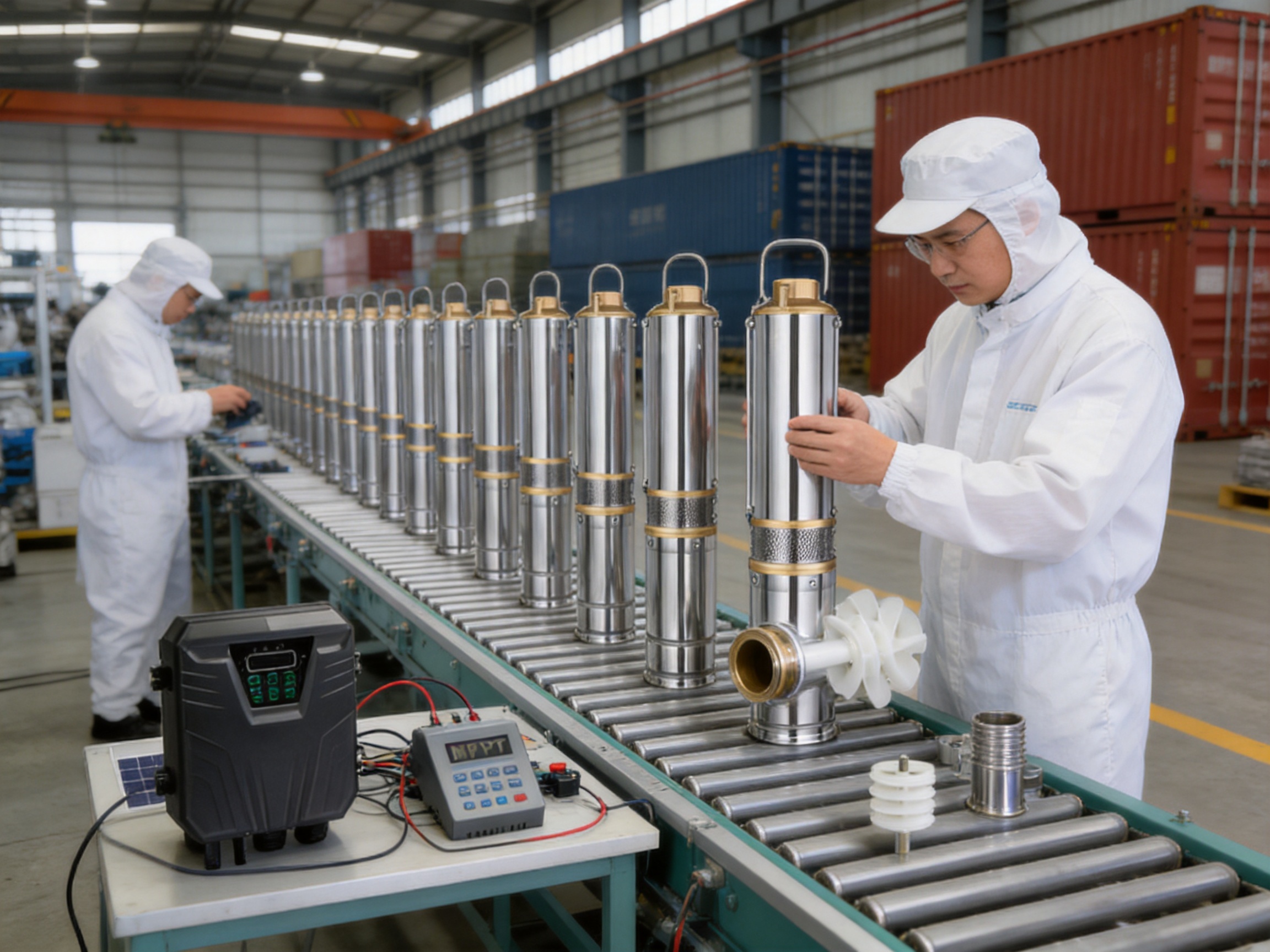
The product is manufactured by Taizhou Edwin Electric Co., Ltd., an integrated enterprise established in 2008. The company focuses on independent research and development, mass production, and global export. This combination is important for buyers seeking more than a one-time product purchase. A manufacturer with product development and production capabilities can support model selection, configuration, repeat orders, technical communication, and international supply requirements.
The company’s wider product portfolio includes deep well pumps, submersible pumps, domestic booster pumps, circulation pumps, and other water pump categories. This broad experience gives the manufacturer a practical understanding of different water movement requirements, from borehole extraction to building water pressure and circulation systems.
The 4EPC series reflects an approach that combines mechanical construction with electronic control. The pump body, hydraulic components, motor, cable, and controller compatibility must be considered together. The product’s multiple voltage levels and extensive flow-head combinations indicate a manufacturing platform designed to support different configurations rather than a single standardized duty point.
Manufacturing quality begins with appropriate material preparation and component consistency. Stainless steel housings and corrosion-resistant parts must be formed, machined, finished, and assembled with care. Precision-machined internal parts require dimensional control so that the rotating assembly can operate with suitable clearances. Electrical components must be matched to the motor’s voltage and power requirements.
Assembly quality is also essential for submersible equipment. Sealing, cable connection, motor protection, hydraulic alignment, and final enclosure integrity all influence field performance. A pump may have a strong motor but still fail prematurely if sealing or cable handling is poor. For this reason, an integrated manufacturing organization can coordinate mechanical and electrical production more effectively than a fragmented supply chain.
Mass production offers another advantage for distributors and project contractors. Consistent processes can improve repeatability between batches, simplify spare-parts planning, and support the delivery of multiple units for larger agricultural or infrastructure projects. Buyers can select from a family of related models while maintaining a consistent product platform.
The company also established Taizhou Haipai Import & Export Co., Ltd. and Golden Falcon Industrial Co., Ltd. to support procurement planning, order tracking, cross-border delivery, and foreign trade services. These capabilities are relevant to international customers who need coordinated documentation, production communication, shipment planning, and one-stop procurement assistance.
Since 2018, the company has invested in new energy and intelligent technology, including solar water pumps and intelligent booster pumps. The 4EPC pump belongs to this development direction because it is designed not simply as a conventional motor and impeller assembly, but as part of an intelligent solar energy conversion system.
Modern pump development requires attention to electrical efficiency, motor control, protection logic, hydraulic performance, installation convenience, and system compatibility. A solar pump must respond to a variable energy source, so development work must consider operating behavior across different voltage and power conditions. The availability of multiple voltage options also reflects the need to adapt the pump to different photovoltaic configurations.
Intelligent control can make a major difference in unattended operation. A controller that monitors input conditions and protects the motor can help prevent avoidable damage. MPPT functionality can help use solar energy more effectively. These features are particularly valuable when the operator cannot manually adjust the system throughout the day.
For professional buyers, intelligent technology should be evaluated together with serviceability. The best system is not necessarily the one with the most features, but the one whose controls are compatible, understandable, and appropriately protected for the intended installation. Technical documents, wiring guidance, model confirmation, and after-sales communication should form part of the purchasing process.
The first selection factor is the required flow rate. Calculate how much water is needed per hour, day, or irrigation cycle. For drip irrigation, consider the number of emitters and their discharge. For sprinklers, calculate the number of operating zones and the flow required by each sprinkler. For tank filling, determine the desired filling time and storage volume.
The second factor is total dynamic head. Measure or estimate the vertical distance from the water level to the discharge point, then add the required pressure and all pipe and equipment losses. The depth of the well alone is not always the same as the pumping head. The water level may change during pumping, and the delivery point may be at a higher elevation than the ground around the well.
The third factor is the solar resource. Consider local sunlight, seasonal variation, panel orientation, shading, dust, ambient temperature, and the expected number of pumping hours. A pump may achieve its stated maximum performance under favorable conditions, but the daily water volume depends on the available solar energy over the full operating period.
The fourth factor is electrical configuration. Select the nominal voltage according to the planned photovoltaic array and controller. Confirm the optimum input voltage range and the maximum solar open-circuit voltage. The listed limits include less than 110 volts for many 48-volt configurations, less than 170 volts for many 72-volt configurations, and less than 220 volts for many 110-volt configurations.
The fifth factor is pipe size. A pipe that is too small can create excessive friction loss and reduce the water available at the delivery point. The outlet size provides a starting reference, but the final pipe diameter should be selected according to flow, distance, material, elevation, and acceptable pressure loss.
The sixth factor is well condition. Confirm the borehole diameter, static water level, dynamic water level, yield, sediment level, pump setting depth, and available clearance. The pump should not be placed where it can draw excessive sand or debris. The well must be capable of supplying the required water volume without excessive drawdown.
Finally, confirm the complete accessory package. This may include a compatible controller, solar panels, support cable, discharge pipe, check valve, protection devices, tank controls, float switches, filters, pressure equipment, and mounting hardware. A pump is only one part of a successful solar water system.
Installation should be performed by qualified personnel familiar with submersible pumps and photovoltaic electrical systems. Before lowering the pump, inspect the well, confirm the pump dimensions, verify the cable length, and ensure that the discharge connection is secure. The pump should be supported by an appropriate suspension arrangement and should not hang solely from the electrical cable or a weak pipe connection.
The controller should be installed in a dry, ventilated, and accessible position. It should be protected from direct water exposure, excessive heat, and unnecessary dust. Solar cables must be correctly sized for the current and distance, and all electrical connections must be properly insulated and protected from weather.
Check the direction and performance of the system during commissioning. Confirm that water is flowing, the pump is not running dry, the controller is displaying normal operating conditions, and the voltage remains within the specified range. If the water contains sediment, initial pumping may require controlled flushing before the system is connected to sensitive irrigation equipment or household plumbing.
Valves should be installed where needed to support maintenance and system control. A check valve may help prevent reverse flow and reduce water hammer, depending on the system design. Pipes should be routed to avoid sharp bends, crushing, excessive vibration, and unsupported weight at the pump outlet.
Safety is especially important when solar panels are connected. Photovoltaic arrays can generate hazardous voltage whenever exposed to light. Installers should follow applicable electrical codes, use suitable disconnects and protection devices, and verify polarity before energizing the controller.
The low-maintenance design of the 4EPC pump reduces routine service requirements, but periodic inspection remains advisable. Operators should observe the water output, pumping time, controller status, unusual noise, vibration, and changes in the well water level. A gradual decrease in flow may indicate blocked filters, pipe restrictions, falling groundwater, sediment accumulation, panel contamination, or a change in system voltage.
Solar panels should be kept reasonably clean and free from shading. Dust, bird deposits, leaves, and nearby vegetation can reduce energy production. The panels, supports, cables, and controller should be inspected periodically, particularly after storms or extreme weather.
The well should be monitored for sediment and water quality. Excessive sand can damage hydraulic parts and reduce pump life. If the water level falls below the appropriate operating level, the dry-run protection should help reduce risk, but the cause of the low water level should still be investigated.
When the pump is removed for inspection, the cable, seals, outlet connection, housing, and hydraulic components should be checked. Any maintenance should be carried out according to the technical documentation for the exact model. Replacement parts should be compatible with the specified voltage, power, and hydraulic configuration.
With suitable sizing, proper installation, and appropriate water conditions, the brushless motor and corrosion-resistant structure can support long service intervals. The actual service life will depend on operating hours, water quality, sediment, voltage stability, installation quality, and maintenance practices.
Distributors can benefit from stocking a product family with several voltage, power, flow, head, and outlet options. The range supports different customer requirements without requiring a completely different supplier for every project. The consistent 4EPC platform can simplify training, sales communication, and technical support.
Project contractors can use the series for farms, ranches, water tanks, rural supply points, and renewable-energy installations. Model availability across several hydraulic ranges helps contractors prepare proposals for different site conditions. The manufacturer’s experience in independent development, production, export, and procurement support can also assist with larger orders.
Original equipment manufacturers and system integrators may value the combination of pump hardware and intelligent solar compatibility. The product can be incorporated into packaged solar pumping systems that include photovoltaic panels, control cabinets, water storage, filtration, and irrigation equipment.
International customers also require dependable communication and logistics. The company’s export-related structure supports order tracking, cross-border delivery, procurement planning, and foreign trade services. These services can reduce coordination difficulties when the customer is purchasing pumps for a project outside the manufacturing region.
Solar pumping can reduce dependence on purchased electricity or diesel fuel. Once the photovoltaic system is installed, sunlight provides the primary energy source, and operating expenditure can be lower than that of a fuel-powered alternative. The brushless motor and low-maintenance construction can further reduce the cost of routine servicing.
The economic result depends on local sunlight, water demand, system size, installation cost, financing, and the price of grid electricity or fuel. A careful comparison should include the entire life cycle, including panels, controller, structure, cables, storage, pump replacement, maintenance, and possible battery costs.
Environmental benefits include reduced fuel consumption, lower local exhaust emissions, and quieter operation. Solar pumping is particularly appropriate for projects that aim to improve water access while supporting renewable-energy use. Agricultural producers may also combine solar pumping with efficient irrigation methods to reduce both energy and water consumption.
The most sustainable system is one that is correctly sized. Oversizing the pump can increase equipment costs and may create unnecessary pressure or water use. Undersizing can result in insufficient water delivery and poor crop performance. Proper hydraulic calculation and solar resource assessment are therefore essential to achieving the expected environmental and economic benefits.
The 4EPC pump is a brushless DC submersible pump designed for solar-powered irrigation, deep wells, boreholes, livestock water supply, rural water systems, and other off-grid applications. It is intended for installation below the water level and connection to a compatible solar controller and photovoltaic array.
Yes, the pump is designed for solar photovoltaic operation through a suitable controller. The controller must match the specific pump voltage and power configuration. The solar array must also remain within the specified optimum input range and open-circuit voltage limit.
The product family includes 48-volt, 72-volt, and 110-volt configurations. The correct choice depends on the selected model, controller, solar array, cable arrangement, and project requirements.
The listed requirement is at least 1.3 times the pump power. For example, a 750-watt pump should generally be paired with a solar array of at least approximately 975 watts. A professional system designer may select additional capacity to compensate for real-world factors such as heat, dust, shading, seasonal sunlight, and panel aging.
No. Maximum flow and maximum head are different points on a pump’s performance range. Actual performance depends on the total dynamic head and the system resistance. The relevant pump curve should be consulted to determine the flow available at the required head.
A brushless motor does not use mechanical brushes that wear during operation. This can reduce maintenance, improve operating smoothness, lower noise, and support a longer service interval compared with a brushed motor, provided the pump is correctly installed and operated.
Yes, suitable models can support drip irrigation when the flow, pressure, filtration, and control requirements are correctly calculated. Drip systems often require filters, pressure regulation, and careful pipe design, so the pump should be selected according to the complete irrigation network rather than the pump’s maximum flow alone.
Yes. Sprinkler irrigation can be supported by models that provide the required flow and pressure. The installer must account for sprinkler operating pressure, elevation, pipe friction, valves, filters, and the number of sprinklers operating at one time.
Yes. Tank filling is a common solar pumping application. A float switch or other level-control arrangement can be used where appropriate. Storage tanks are especially useful because they allow water to be collected during sunlight hours and used later.
The product information identifies compatibility with smart MPPT controllers that can provide protection against overvoltage, dry running, and overheating. The exact functions and settings depend on the controller selected for the specific pump model.
The listed models use either 1.25-inch or 2-inch outlets. The smaller outlet configurations cover many 4.5 to 6.5 cubic meter per hour models, while the larger-flow configurations generally use 2-inch outlets.
The well should be properly developed and monitored, and the pump should be installed at a suitable depth above excessive sediment. Where necessary, the system may require filtration or other water-quality measures. Excessive abrasive sand can reduce the life of hydraulic components.
A battery is not necessarily required for a direct solar pumping system if water can be pumped during daylight or stored in a tank. Battery backup may be added when water is needed during low-sun periods or when the project requires a more continuous electrical supply. The battery and controller must be compatible with the selected pump.
The 4EPC series is manufactured by Taizhou Edwin Electric Co., Ltd., an integrated manufacturer established in 2008 with activities covering research and development, mass production, and global export.
Customers should provide the required flow, total head, well diameter, water level, water quality, expected daily operating time, solar resource, available panel voltage, destination country, and intended application. This information allows the appropriate model, controller, solar array, and accessories to be recommended.
The 4EPC Brushless DC Powered Solar Irrigation Deep Well Pump is a versatile solution for modern water pumping where energy efficiency, low maintenance, and off-grid operation are important. Its brushless motor removes brush wear, its stainless steel construction supports durability, and its compatibility with solar panels and MPPT control allows the system to respond to changing photovoltaic conditions.
The broad model range is one of its most important practical advantages. With options from approximately 4.5 to 17 cubic meters per hour maximum flow, maximum heads from approximately 36 to 135 meters, power ratings from 500 to 1,500 watts, and 48V, 72V, and 110V configurations, the series can be matched to many different well and irrigation requirements.
Its value is strengthened by the manufacturer’s integrated capabilities in research and development, production, export, and procurement support. Since 2008, Taizhou Edwin Electric Co., Ltd. has developed a product portfolio covering several major pump categories and has expanded into solar and intelligent pumping technologies. This combination gives agricultural users, distributors, contractors, and international project buyers a reliable foundation for sourcing solar water pumping equipment.
Successful results still depend on correct engineering. The pump must be selected according to actual flow and total dynamic head, the solar array must meet the required voltage and power conditions, and installation must protect the pump from dry running, sediment, electrical faults, and mechanical stress. When these principles are followed, the 4EPC series can provide an efficient and dependable method of moving groundwater for irrigation, livestock, rural communities, and renewable-energy water projects.
1. Product technical information for the 4EPC Brushless DC Powered Solar Irrigation Deep Well Pump, including model configurations, voltage ranges, power ratings, flow data, head data, outlet sizes, cable length, and photovoltaic requirements.
2. Solar Water Pumping: Technical and Economic Assessment Guidelines, general principles for photovoltaic array sizing, water storage, pump selection, and solar resource evaluation.
3. Hydraulic Institute, centrifugal and submersible pump selection principles, including pump curves, total dynamic head, flow requirements, and system resistance.
4. International Electrotechnical Commission, general principles for low-voltage DC equipment, photovoltaic system safety, electrical protection, and installation practice.
5. Agricultural irrigation engineering references covering drip irrigation, sprinkler pressure requirements, filtration, pipe friction, water storage, and irrigation scheduling.
6. General motor engineering references concerning brushless DC motor operation, electronic commutation, motor protection, efficiency, and maintenance reduction.
7. Manufacturer information concerning Taizhou Edwin Electric Co., Ltd., its founding in 2008, integrated research and development, mass production, global export activities, solar pump development, and procurement support services.
edwina@edwin-pump.com
+86-13586290903 (WhatsApp)
Xuri Gongliang Cutting Tool Entrepreneurship Park, Wenqiao Town, Wenling City, Taizhou City, Zhejiang Province, China

High Performance Smart Pump Factory


 English