edwina@edwin-pump.com

View All Products
en
Reliable water transfer is essential in homes, gardens, farms, small commercial facilities, and many civil water-supply systems. In these applications, a pump must do more than move water. It must start consistently, tolerate occasional air in the suction line, maintain useful pressure, resist corrosion in critical areas, and provide stable performance over a long service life. The JSP Series High Flow Rate and High-Lift Self-Priming JET Pump is designed to address these practical requirements in one compact and versatile pumping solution.
The JSP Series combines a self-priming hydraulic design with a brass impeller, a carbon-and-ceramic mechanical seal, an AISI 304 stainless steel shaft, and a copper-winding motor. Its construction is intended for clean-water transfer and liquids with physical and chemical properties similar to water. With models from 0.45 kW to 1.5 kW, maximum flow rates from 40 to 85 L/min, and maximum heads from 40 to 65 meters, the series provides a useful range for domestic, agricultural, and small equipment applications.
Unlike a basic surface pump that may require manual priming before each start, a self-priming jet pump can evacuate air from the suction line and restore water movement after installation or temporary interruption. This feature is especially valuable when the water source is below the pump, when suction piping contains air, or when the system is used intermittently. The JSP Series is also designed to support demanding lifting conditions, with a maximum suction height of 8 meters under suitable installation conditions.
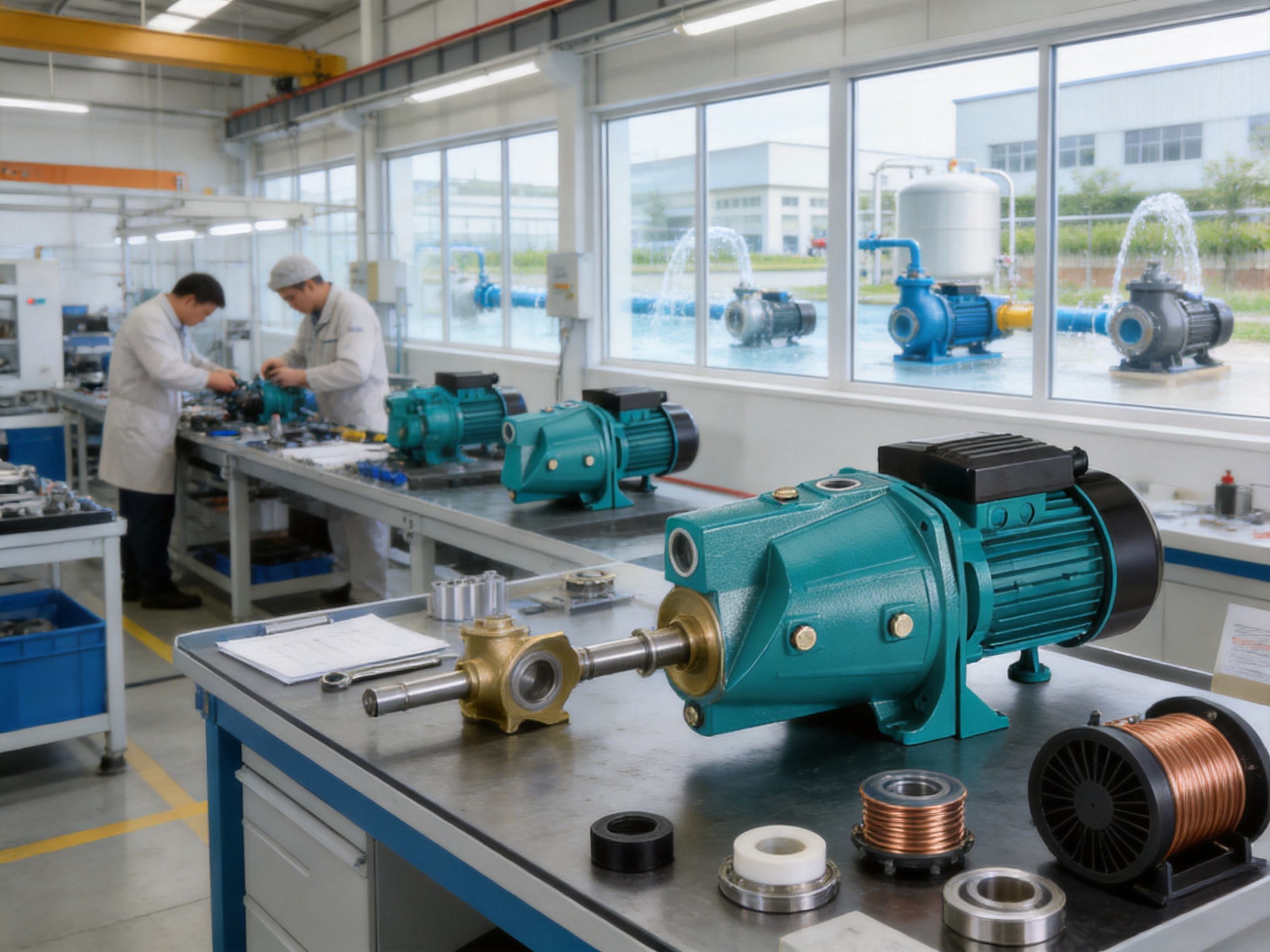
Behind the product is an integrated manufacturing enterprise with experience in pump research and development, mass production, and international export. Its product portfolio includes deep well pumps, submersible pumps, domestic booster pumps, circulation pumps, solar water pumps, intelligent booster pumps, and related water-handling products. This broader manufacturing background supports product development, component sourcing, production coordination, inspection, and one-stop supply for overseas customers.
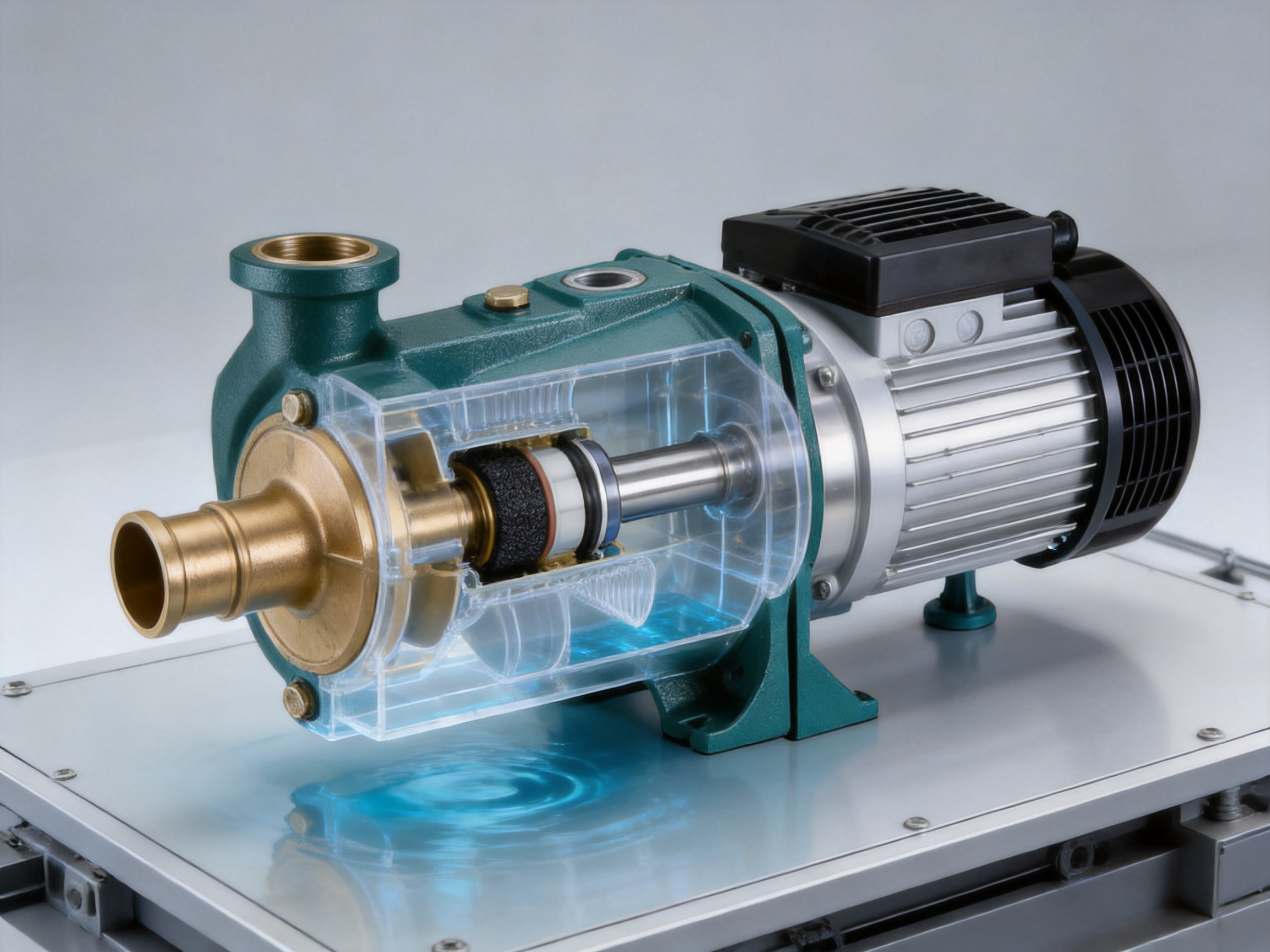
A jet pump is a surface-mounted centrifugal pump that uses a nozzle, venturi, and diffuser arrangement to improve suction performance. During operation, the impeller creates flow and pressure. A portion of the pressurized water is directed through the jet assembly, where velocity changes create a pressure difference that helps draw water from the suction pipe. The mixture then returns to the impeller and is discharged through the outlet.
The self-priming function depends on maintaining water inside the pump and correctly filling the pump casing during the initial installation. Once the hydraulic chamber is properly filled, the pump can remove air from the suction line during startup. This makes the design appropriate for installations where the pump is positioned above a tank, well, cistern, or other water source.
The JSP Series is intended for clean water or liquids similar to water in physical and chemical properties. It is not designed for abrasive slurries, heavily contaminated wastewater, flammable liquids, or liquids containing large solids. Correct application is important because pump performance and service life depend on the liquid being compatible with the impeller, seal, casing, and motor.
The series is available in five principal models. The smaller units are suitable for household water distribution, garden irrigation, tank transfer, and modest pressure requirements. The larger units provide greater head and flow for more demanding domestic, agricultural, and small commercial installations.
| Model | Rated Power | Rated Power | Inlet/Outlet | Maximum Flow | Maximum Head | Maximum Suction |
| JSP-60 | 0.45 kW | 0.6 HP | 1 x 1 inch | 40 L/min | 40 m | 8 m |
| JSP-80 | 0.60 kW | 0.8 HP | 1 x 1 inch | 45 L/min | 45 m | 8 m |
| JSP-100 | 0.75 kW | 1.0 HP | 1 x 1 inch | 50 L/min | 50 m | 8 m |
| JSP-150 | 1.10 kW | 1.5 HP | 1.25 x 1 inch | 80 L/min | 55 m | 8 m |
| JSP-200 | 1.50 kW | 2.0 HP | 1.25 x 1 inch | 85 L/min | 65 m | 8 m |
The published maximum values represent the upper capability of each model and should not be interpreted as simultaneous operating points. Actual flow depends on total dynamic head, suction conditions, pipe diameter, fittings, elevation, water temperature, voltage, and system resistance. Proper model selection should therefore consider the expected duty point rather than relying only on the maximum flow or maximum head.
For example, a system requiring moderate flow but a relatively high delivery elevation may be better served by a higher-head model. A short-distance garden irrigation system may need less head but benefit from a model that provides the required flow at an efficient operating point. A pump professional or system designer should compare the required flow and total head with the pump curve and installation conditions before final selection.
One of the principal advantages of the JSP Series is the balance between flow and lift. Many small surface pumps are optimized primarily for flow, while other compact models prioritize pressure but provide limited delivery volume. The JSP range is designed to cover both requirements across several motor sizes, allowing users to select a model according to the installation rather than adapting the installation to a single fixed pump.
The JSP-60, JSP-80, and JSP-100 provide a progressive increase in maximum head from 40 to 50 meters. The JSP-150 and JSP-200 extend the range to 55 and 65 meters respectively, while also increasing maximum flow to 80 and 85 L/min. This makes the larger models suitable for applications involving longer pipelines, increased elevation, multiple outlets, or higher irrigation demand, provided the system is designed within the appropriate operating range.
Compared with an ordinary low-cost transfer pump, a high-lift jet pump can offer more useful pressure when the water source and delivery point are separated by elevation or long piping. Compared with a large industrial pump, the JSP Series offers a simpler and more compact option for small and medium water systems. This combination can reduce installation complexity, space requirements, and equipment oversizing.
The hydraulic arrangement also helps the pump deal with air that may be present in the water to be pumped. This does not mean the pump should be operated dry or used as an air compressor. The suction line should still be airtight, the pump casing should be filled before initial operation, and the pump should be protected from extended dry running. Within those conditions, the self-priming design can make routine operation more forgiving than a conventional non-self-priming surface pump.
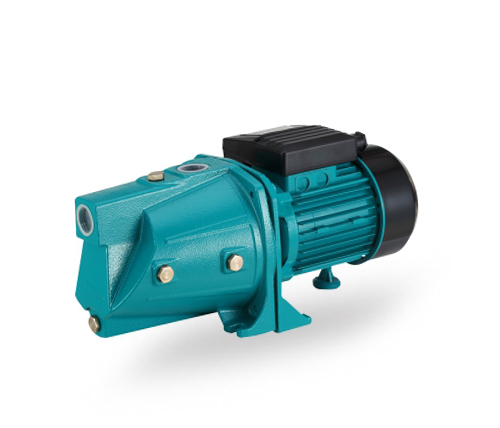
JSP Series High Flow Rate and High-lift Self-priming JET Pump
The materials used in the JSP Series are selected according to the functional demands of each pump component. The main body and support are made from HT200 cast iron, while the impeller is brass. The shaft is AISI 304 stainless steel, and the mechanical seal uses a carbon-and-ceramic combination. The motor case is aluminum, the motor cover is cast iron, and the cooling fan is made from PP.
The HT200 cast iron pump body and support provide structural strength and dimensional stability. Cast iron is widely used in pump housings because it can withstand pressure and vibration while offering good machinability and cost efficiency. The product information specifies a special anti-rust treatment for the cast iron body and support, helping improve durability during normal service and storage.
A robust casing is important in a jet pump because the hydraulic chamber must maintain its geometry and withstand repeated pressure cycles. The casing also supports the alignment of internal hydraulic components and provides a stable mounting structure for the motor assembly. Proper casting quality, machining accuracy, surface treatment, and inspection are therefore essential to dependable pump operation.
The brass impeller is a central performance component. It transfers rotational energy from the motor to the water and is exposed to continuous hydraulic loading. Brass offers good corrosion resistance in many clean-water applications and can provide smooth operation when produced with accurate geometry.
The product design also includes rust-free copper inserts associated with the impeller assembly. These inserts help support smooth restarting after the pump has remained inactive for an extended period. This characteristic is useful in seasonal irrigation, vacation homes, standby water systems, and other applications where the pump may not operate every day.
The AISI 304 stainless steel shaft provides a corrosion-resistant interface between the motor and hydraulic assembly. Because the shaft is located in an area exposed to moisture and mechanical stress, material selection affects both service life and sealing reliability. Stainless steel helps reduce the risk of rust in water-contact areas and supports stable rotation of the impeller.
A stainless steel shaft is particularly beneficial where the pump is installed in humid environments or where intermittent operation may allow moisture to remain around the shaft and seal. Although AISI 304 is not intended for every aggressive chemical or saline application, it is a practical material for many ordinary clean-water duties.
The mechanical seal prevents water from moving along the rotating shaft into the motor section. The JSP Series uses a carbon-and-ceramic mechanical seal, a widely established combination for clean-water pumps. The two mating faces are designed to remain closely sealed while allowing the shaft to rotate.
Mechanical seal life depends on correct installation, water quality, temperature, alignment, and avoidance of dry running. The specified maximum liquid temperature is 60°C, so the pump should not be used beyond this limit. If the pumped liquid contains abrasive particles or chemical additives, seal compatibility should be confirmed before use.
The pump is paired with a copper-winding motor. Copper windings provide good electrical conductivity and efficient heat transfer compared with lower-conductivity winding materials. They also support stable motor performance when the pump is correctly sized and operated within its rated electrical conditions.
The motor uses C&U bearings, identified in the product information as high-efficiency bearings for smooth operation. Bearing quality affects noise, vibration, shaft alignment, and long-term mechanical reliability. In a pump, even small increases in bearing friction or misalignment can influence motor temperature and seal loading, so bearing selection is an important part of the overall design.
Single-phase models include a built-in thermal protector. This protective device is intended to interrupt or protect the motor when abnormal temperature conditions occur, such as overload, restricted ventilation, excessive voltage fluctuation, or other operating problems. Thermal protection is an important safeguard, but it does not replace correct electrical installation, suitable overload protection, grounding, or a properly rated circuit.
The motor has Class F insulation and an IP44 protection rating. Class F insulation provides a defined thermal endurance level for the motor winding insulation system. IP44 indicates protection against solid objects above a specified size and water splashing from different directions. The pump should still be installed in a suitable location protected from direct flooding, heavy weather exposure, and conditions outside the stated environmental limits.
The maximum ambient temperature is specified as 40°C. Adequate ventilation should be maintained around the motor so that heat can dissipate. Installing the pump in a confined, poorly ventilated enclosure can increase motor temperature and reduce service life, even when the water flow and electrical supply are correct.
Self-priming is one of the most important functional differences between the JSP Series and a standard non-self-priming centrifugal pump. In a conventional surface pump, air trapped in the suction pipe may prevent the impeller from creating sufficient pressure to lift water. The user may need to refill the pump and suction line manually before each start. A self-priming jet pump is designed to separate and evacuate this air more effectively after the initial filling process.
This capability is helpful in domestic water supply systems where a pump draws from an underground tank or well. It is also useful in garden irrigation, small agricultural plots, water tower supply, and installations where the water level changes. Intermittent users can benefit because the pump is more capable of recovering from normal air entry than a basic transfer pump.
The maximum suction height is specified as 8 meters. This value is affected by atmospheric pressure, water temperature, altitude, suction pipe diameter, pipe length, fittings, foot valve condition, and the airtightness of the entire suction line. A theoretical suction limit should never be treated as a guaranteed result in every installation. For reliable performance, the pump should be installed as close as practical to the water source, with a short and correctly sized suction pipe.
The suction pipe should be strong enough to resist collapse under negative pressure. All threaded connections should be sealed appropriately, and the foot valve or check valve should prevent the suction line from draining when the pump stops. Air leaks are a common cause of poor priming and unstable flow. A pump may appear to be defective when the actual problem is a loose fitting, damaged seal, blocked foot valve, or incorrectly routed pipe.
During initial commissioning, the pump casing should be filled with clean water according to the installation instructions. The pump should not be started dry. After filling, the operator should check that the suction line, discharge line, electrical connections, and valves are correctly arranged. If the pump does not prime within a reasonable period, it should be stopped and the installation inspected rather than left running without water.
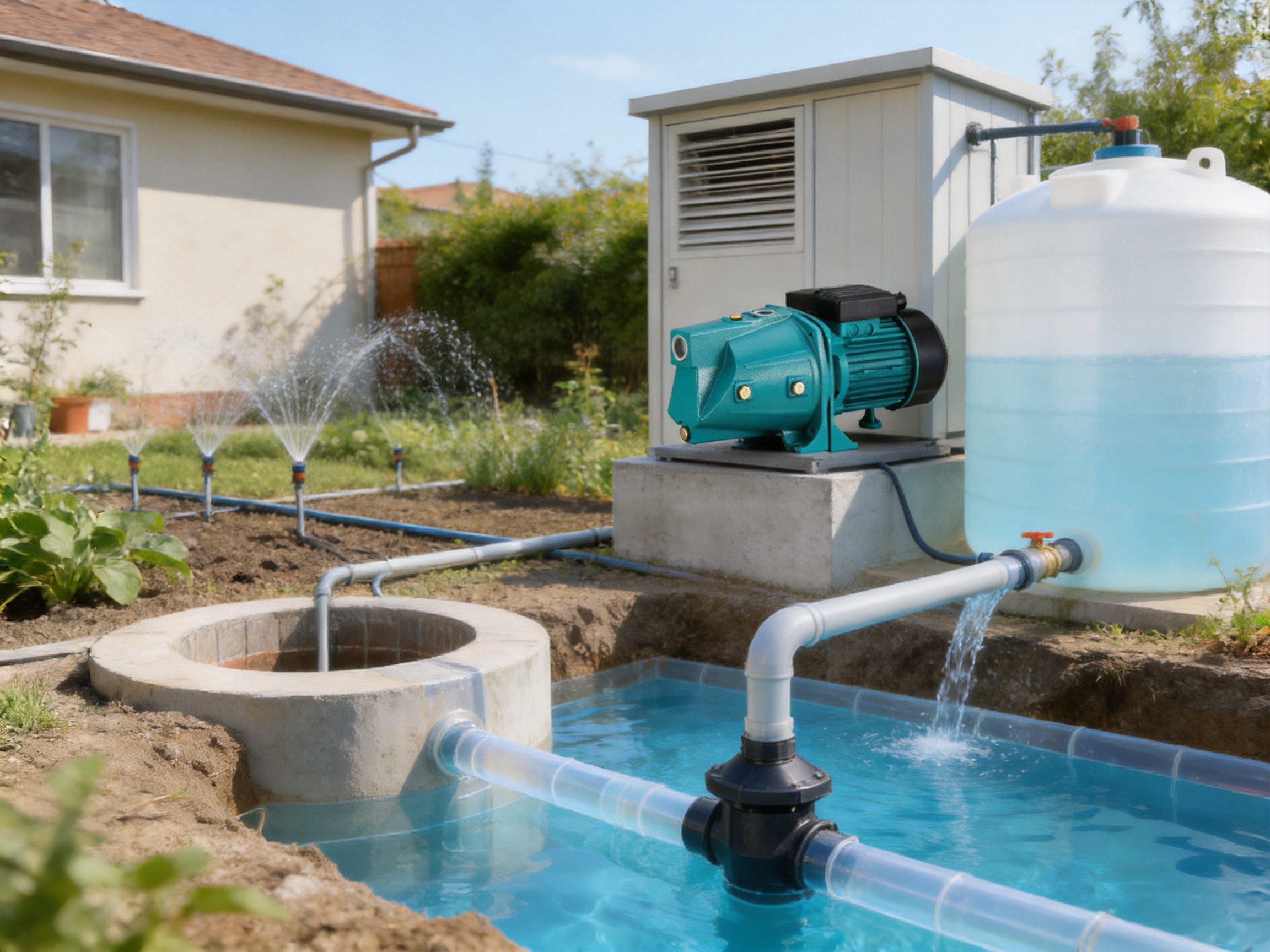
The JSP Series can be used to distribute clean water in homes where a tank, well, or low-pressure source does not provide sufficient pressure. It may supply taps, washing areas, small household appliances, or modest pressure sets. The selected model should match the number of outlets likely to operate simultaneously and the height of the building or delivery point.
Garden irrigation often requires a pump that can draw water from a tank and deliver it through hoses, sprinklers, or drip lines. The self-priming function helps simplify seasonal operation, while the available flow range gives users flexibility for different garden sizes. The pump should be protected from leaves, sand, and other debris by a suitable inlet strainer or filtration arrangement.
The pump can transfer water between storage tanks, cisterns, and elevated reservoirs. Its high-lift capability is useful when the receiving tank is located above the source. Users should consider the total vertical elevation and friction loss in the pipe, as these factors determine the actual flow available at the outlet.
For shallow well applications within the specified suction limit, a surface-mounted self-priming jet pump can offer easier access for inspection and maintenance than a submerged unit. The well casing, water quality, suction pipe, and water level must be suitable. If the dynamic water level is deeper than the practical suction capability, a deep well or submersible pump may be more appropriate.
The pump can be integrated into small automatic irrigation systems using pressure switches, controllers, valves, and appropriate protection devices. Automation can improve convenience, but the pump must be selected for the system’s pressure requirements. Frequent cycling should be controlled with a suitable pressure vessel or control arrangement to reduce unnecessary starts and stops.
The JSP Series can support various small water-handling equipment systems where clean water must be transferred with moderate pressure. Potential uses include utility water supply, small washing systems, equipment filling, and water circulation duties that remain within the pump’s temperature and liquid compatibility limits.
Product selection is easier when the advantages and limitations of different pump types are understood. The JSP Series is not intended to replace every pump. Its value comes from combining the characteristics of a surface centrifugal pump, a jet assembly, and a self-priming function in a practical package.
| Comparison Factor | Self-Priming Jet Pump | Basic Non-Self-Priming Surface Pump | Submersible Pump |
| Installation position | Above the water source | Above the water source | Installed inside the water source |
| Air-handling during startup | Designed to evacuate suction-line air | More sensitive to trapped air | Usually avoids suction lift because it operates underwater |
| Maintenance access | Accessible above ground | Accessible above ground | Requires removal from the source for many service tasks |
| Suitable application | Clean-water lifting, tanks, shallow wells, irrigation | Short, flooded-suction transfer duties | Deep wells, drainage, submerged water transfer |
| Important limitation | Limited by practical suction height and clean-liquid requirements | Requires dependable flooded suction or manual priming | Requires compatible submerged installation and cable protection |
Compared with a basic non-self-priming pump, the JSP Series offers greater convenience where air may enter the suction line. Compared with a submersible pump, it provides above-ground access for inspection and maintenance and can be installed without placing the motor in the water. Compared with a large multistage pump, it offers a simpler solution for smaller flow and pressure requirements.
Competitor products may offer similar pump categories, but the practical difference often lies in the combination of materials, motor construction, hydraulic design, production consistency, and after-sales support. The JSP Series distinguishes itself through its brass impeller, stainless steel shaft, self-priming jet arrangement, copper-winding motor, thermal protection, and broad model range.
The manufacturer behind the product operates as an integrated enterprise covering independent research and development, mass production, and global export. This structure is significant because pump quality depends on coordination across design, materials, machining, assembly, testing, packaging, and logistics. A company that manages these functions as part of a connected production system can respond more efficiently to product improvements and customer requirements.
Independent research and development supports the adaptation of hydraulic structures, motor specifications, materials, and product configurations. For self-priming pumps, development work may involve the relationship between the impeller, nozzle, venturi, diffuser, casing volume, suction passage, and discharge path. Small dimensional changes can affect priming time, flow stability, head, noise, and efficiency.
A product portfolio that includes deep well pumps, submersible pumps, booster pumps, circulation pumps, solar pumps, and intelligent pumping systems also provides useful technical experience across different application conditions. Knowledge gained from one product family can support improvements in another, particularly in motor design, sealing, control, corrosion resistance, and system integration.
Mass production requires repeatable processes rather than one-time assembly. Castings must maintain consistent dimensions, machined faces must remain within suitable tolerances, shafts and rotating parts must be aligned, and electrical assemblies must be completed according to defined procedures. Production scale can also improve purchasing efficiency and the availability of replacement components.
For the JSP Series, manufacturing consistency is especially important in the jet assembly. The nozzle, venturi, and diffuser must work together as a hydraulic system. Variation in passages, seating surfaces, or assembly position can influence the self-priming function. Consistent production methods help ensure that units within the same model range deliver comparable performance.
The product incorporates multiple material types, including HT200 cast iron, brass, AISI 304 stainless steel, aluminum, PP, PPO, carbon, and ceramic. Each material requires suitable handling and processing. Cast iron components require controlled casting and machining. Brass impellers require accurate forming or machining. Stainless steel shafts require appropriate dimensional finishing. Polymer components must maintain the intended geometry and fit.
Coordinating these materials within one pump requires control over component specifications, incoming inspection, assembly procedures, and final testing. It also allows the manufacturer to balance performance and cost instead of using one material indiscriminately throughout the entire product.
The company has developed a professional team for procurement planning, order tracking, cross-border delivery, and foreign trade services. This capability is valuable for distributors, wholesalers, contractors, and project buyers who need more than an individual pump. They may require multiple models, accessories, packaging requirements, documentation, delivery coordination, and communication throughout the order cycle.
One-stop supply is also supported by the broader product range. A customer sourcing a self-priming surface pump may also need a submersible pump, booster pump, circulation pump, pipe, valve, controller, or accessory. A manufacturer with multiple related product lines can simplify procurement and reduce the need to coordinate with several unrelated suppliers.
Since 2018, the company has invested in new energy and intelligent technology, including solar water pumps and intelligent booster pumps. Although the JSP Series is a conventional electric self-priming pump, experience with intelligent and solar products demonstrates an ongoing focus on efficient water movement, application-specific control, and evolving customer requirements.
This broader technology direction can support future product development in areas such as automatic pressure control, remote monitoring, energy management, and integrated water systems. It also reflects an understanding that modern pump customers increasingly evaluate complete system performance rather than the pump motor alone.
Buyers should evaluate a self-priming pump using both specifications and application conditions. A high maximum head does not automatically mean that the pump is suitable for every high-pressure system. Likewise, a high maximum flow does not guarantee that the pump will deliver that flow through a long, narrow, or highly restricted pipeline.
The first step is to estimate the required flow. Domestic use may involve several simultaneous outlets, while irrigation demand depends on the number and type of sprinklers or irrigation zones. The second step is to calculate total dynamic head, including static elevation, discharge pressure, pipe friction, fittings, valves, filters, and any equipment installed downstream.
The suction side deserves special attention. The maximum suction height is 8 meters, but the practical result may be lower in hot climates, high-altitude locations, long suction pipes, or systems with many elbows and valves. A larger suction pipe can reduce friction loss, and a short, straight route can improve priming reliability. The suction pipe must also be airtight.
Water quality is another selection factor. The JSP Series is intended for clean water or similar liquids. Sand, gravel, abrasive particles, fibrous material, and chemical contaminants can damage the impeller, seal, and internal passages. If the source contains sediment, a suitable filtration or settling arrangement should be installed before the pump.
Temperature must remain within the stated maximum liquid temperature of 60°C. The ambient temperature should remain within the specified maximum of 40°C. Applications involving hot process water, chemicals, salt water, or aggressive cleaning solutions require a separate material compatibility review.
Install the pump on a firm, level foundation that can support its weight and absorb normal vibration. Excessive vibration may result from soft mounting, pipe strain, poor alignment, or an unsuitable foundation. The pump should be positioned where air can circulate around the motor and where routine inspection is convenient.
Use a suction pipe with a suitable diameter and keep it as short and direct as practical. Avoid high points where air can accumulate. The suction pipe should rise continuously toward the pump where possible, or be arranged according to sound hydraulic practice. A foot valve may be used to retain water in the suction line and prevent repeated loss of prime.
Install an appropriate valve and filter arrangement without restricting the suction side excessively. A clogged strainer can reduce inlet pressure and contribute to unstable operation. The discharge line should include the valves and fittings required for isolation, maintenance, and system control.
Before starting the pump, fill the casing with clean water. Confirm that the electrical supply matches the motor rating and that the pump is properly grounded. Electrical work should be carried out by qualified personnel. The built-in thermal protector is a useful safety feature, but the installation should also include suitable circuit protection and a correctly rated switch or control device.
After startup, observe the pump for abnormal noise, vibration, leakage, overheating, or unstable pressure. Check the mechanical seal area and all pipe connections. If the pump fails to prime, stop it and inspect the water level, foot valve, suction-line airtightness, casing fill, and pipe layout.
Routine maintenance helps preserve the performance advantages of the JSP Series. Periodically inspect the suction strainer, foot valve, pipe connections, mechanical seal area, electrical terminals, and motor ventilation openings. Remove dirt that could restrict cooling or water flow.
If the pump is used seasonally, drain or protect it according to local climate conditions and the installation instructions. Freezing water inside the casing can damage the housing and internal components. Before returning the pump to service after a long idle period, inspect the shaft, electrical connections, seals, and pipework.
Do not operate the pump without water. Dry running can overheat the mechanical seal and cause premature leakage. If an automatic control system is used, it should include protection against dry running where appropriate. Frequent cycling should also be reviewed because repeated starts increase thermal and mechanical stress.
When servicing the pump, use suitable replacement components and preserve the original alignment of the rotating assembly. The mechanical seal should be installed carefully, with clean contact faces and no damage to the sealing surfaces. If a pump exhibits repeated seal failure, the cause may be misalignment, cavitation, dry running, excessive temperature, pipe strain, or unsuitable liquid rather than the seal alone.
The main competitive advantage of the JSP Series is its combination of features rather than one isolated specification. It provides self-priming convenience, useful suction capability, high-lift performance, multiple motor sizes, durable wetted materials, and an accessible surface-mounted format.
Its brass impeller and AISI 304 stainless steel shaft provide a stronger material package than many basic pumps that rely heavily on lower-cost components in water-contact areas. The carbon-and-ceramic mechanical seal is a proven configuration for clean-water service. The copper-winding motor, C&U bearings, Class F insulation, IP44 protection, and thermal protector further support dependable operation when the pump is correctly installed.
The five-model range gives distributors and system builders flexibility. Instead of offering one general-purpose pump for every application, the series allows the user to choose a motor size according to the required head and flow. This can help avoid both under-sizing, which causes poor pressure and overloading, and over-sizing, which may increase purchase and operating costs.
The product is also supported by a manufacturer with experience in multiple pump categories and international order fulfillment. For overseas customers, this can be an important advantage. Reliable procurement involves communication, production planning, inspection, packaging, shipping coordination, and after-sales support. A technically capable supplier that can manage these areas provides value beyond the hardware itself.
The pump is intended for clean water or liquids with physical and chemical properties similar to water. It should not be used for abrasive slurries, liquids containing large solids, aggressive chemicals, flammable liquids, or heavily contaminated wastewater unless compatibility has been specifically confirmed.
Self-priming means that, after the pump casing has been initially filled with water, the pump is designed to remove air from the suction line and re-establish water flow during startup. It does not mean the pump can run dry or operate without initial filling.
The specified maximum suction height is 8 meters. Actual suction performance depends on atmospheric pressure, water temperature, elevation, pipe length, pipe diameter, fittings, foot valve condition, and airtightness. Installing the pump closer to the water source generally improves reliability.
The maximum liquid temperature is specified as 60°C. The pump may therefore be suitable for some warm-water duties within this limit, but the liquid’s chemical compatibility and the complete system design must also be considered.
The JSP-200 provides the highest published maximum head in the series, at 65 meters. It has a rated power of 1.5 kW, a maximum flow of 85 L/min, and a maximum suction height of 8 meters.
The JSP-200 also provides the highest published maximum flow, at 85 L/min. The JSP-150 provides up to 80 L/min. Actual flow at a particular installation will be lower or different depending on the system head and resistance.
It can be used for shallow well lifting when the water level and suction conditions remain within the practical 8-meter suction limit. For deeper wells, a deep well pump or submersible pump is generally more suitable because the pump must be positioned closer to the water level.
The product information specifies a built-in thermal protector for the single-phase motor. Correct electrical installation and external circuit protection are still required.
The motor protection rating is IP44. The pump should be installed in a suitable, ventilated location and protected from flooding, direct immersion, and environmental conditions beyond the stated design range.
A brass impeller offers good corrosion resistance for many clean-water applications and supports stable hydraulic operation. The product information also identifies rust-free copper inserts intended to help the pump restart smoothly after periods of inactivity.
Yes, the pump can be used in suitable automatic irrigation systems. The pressure, flow, control method, filtration, and dry-run protection should be designed according to the irrigation layout and operating schedule.
Check whether the pump casing contains water, whether the suction pipe is airtight, whether the foot valve is functioning, whether the water level is within the practical suction range, and whether the suction pipe is blocked or incorrectly installed. Stop the pump before troubleshooting to avoid dry running.
Its self-priming jet arrangement is designed to improve startup and air evacuation from the suction line. It also combines high-lift capability with a brass impeller, stainless steel shaft, mechanical seal, copper-winding motor, and several power options.
Distributors, contractors, agricultural suppliers, project buyers, and equipment manufacturers can benefit from sourcing multiple pump categories from one experienced supplier. The broader range includes submersible, deep well, booster, circulation, solar, intelligent, and other water pump products.
The JSP Series High Flow Rate and High-Lift Self-Priming JET Pump is designed for users who need dependable clean-water transfer with easier startup and useful lifting capability. Its self-priming jet hydraulic design addresses air in the suction line, while the 8-meter maximum suction specification supports a range of shallow-well, tank, and domestic applications.
The combination of HT200 cast iron construction, brass impeller, AISI 304 stainless steel shaft, carbon-and-ceramic mechanical seal, copper-winding motor, C&U bearings, Class F insulation, IP44 protection, and thermal protection provides a balanced package for household and small equipment duties. Five models extend the selection from 0.45 kW to 1.5 kW, with maximum heads from 40 to 65 meters and maximum flows from 40 to 85 L/min.
Its advantages over simpler competitors are found in the complete design: self-priming convenience, high-lift performance, corrosion-resistant critical components, motor protection, and model flexibility. Its value is further supported by an integrated manufacturer with independent research and development, mass production, global export experience, and a broad portfolio of water-pumping technologies.
For best results, the pump should be selected according to the actual duty point, installed with an airtight and correctly sized suction line, operated only with compatible liquids, and maintained according to sound pump-service practices. When applied within its design limits, the JSP Series can provide a practical and durable solution for domestic water supply, irrigation, tank transfer, shallow-well lifting, and other clean-water applications.
1. Product technical information for the JSP Series High Flow Rate and High-Lift Self-Priming JET Pump.
2. Manufacturer-provided materials and component specifications for self-priming surface pumps.
3. General principles of centrifugal pump operation, suction lift, total dynamic head, and hydraulic system design.
4. General engineering guidance on mechanical seals, pump materials, motor insulation classes, and enclosure protection ratings.
5. General installation and maintenance practices for clean-water surface pumps and small automatic irrigation systems.
edwina@edwin-pump.com
+86-13586290903 (WhatsApp)
Xuri Gongliang Cutting Tool Entrepreneurship Park, Wenqiao Town, Wenling City, Taizhou City, Zhejiang Province, China

High Performance Smart Pump Factory


 English