edwina@edwin-pump.com

View All Products
en
Reliable water access is essential for agriculture, rural communities, industrial facilities, construction projects, and renewable-energy installations. In many of these applications, the water source is located deep underground, while the available power supply may vary between solar energy and the electrical grid. A pumping system must therefore do more than move water. It must provide stable hydraulic performance, operate efficiently, tolerate demanding environmental conditions, and remain practical to install and maintain over many years.
The 4ADSC AC/DC Brushless Motor Stainless Steel Impeller Deep Well Pump is designed to address these requirements through a combination of hybrid power compatibility, brushless motor technology, stainless steel hydraulic components, intelligent controller compatibility, and a broad range of flow and head configurations. It is intended for deep wells, boreholes, agricultural irrigation, domestic water supply, livestock watering, industrial water transfer, construction dewatering, and hybrid solar pumping systems.
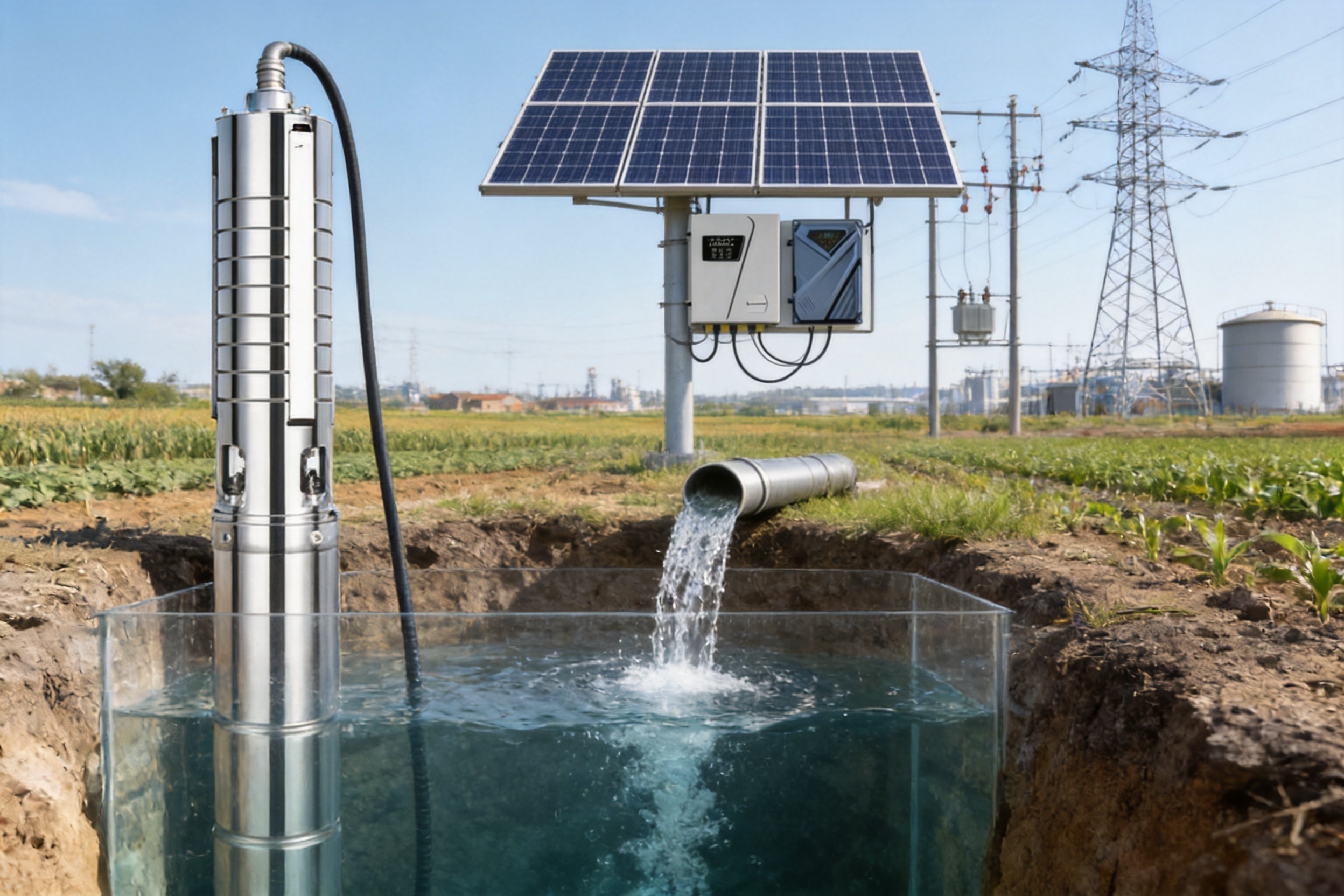
Unlike a conventional pump designed for only one power source, this AC/DC hybrid submersible solar pump can work with solar-generated DC power and AC mains electricity. This gives system designers greater flexibility when planning installations in remote areas, locations with unstable grid service, or projects that require dependable water delivery throughout the day and night.
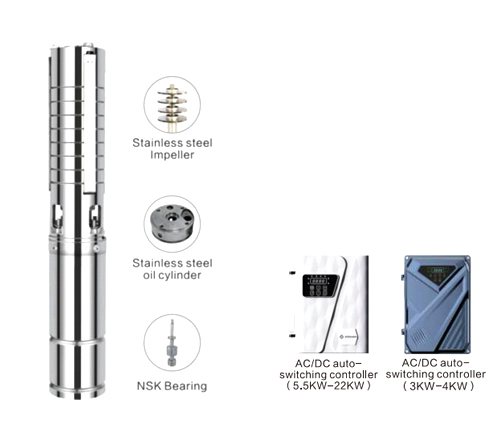
4ADSC AC/DC Brushless Motor Stainless Steel Impeller Deep Well Pump
The 4ADSC series is a high-performance deep well pump equipped with an AC/DC hybrid brushless motor and stainless steel impeller. Its operating concept is straightforward: solar panels can provide power during periods of strong sunlight, while AC electricity can be used when solar energy is insufficient or when continuous operation is required.
The pump is specified for AC380 V and DC520 V operation, with an optimum DC input range of 520 V to 650 V. Solar panel open-circuit voltage must remain below 900 V, and the recommended solar array power is at least 1.3 times the rated pump power. These electrical parameters are particularly important for system planning because they help installers select a suitable solar array, controller, protection system, and electrical connection method.
The series covers rated motor powers from 3,000 W to 7,500 W. Depending on the selected hydraulic configuration, maximum flow ranges from 6 m³/h to 30 m³/h, while maximum head ranges from 52 m to 420 m. This wide performance range allows one product family to serve both high-head deep well applications and higher-volume water transfer duties.
The pump outlet sizes include 1.25-inch and 2-inch configurations. Each listed model is supplied with a 2-meter cable, while the hydraulic design varies according to the required flow and head. The result is a selection of pump models that can be matched more precisely to the depth of the well, the required delivery rate, the pipe system, and the final water-use point.
Power availability is one of the most important factors in water pumping. A solar-powered pump may operate efficiently during bright daylight but experience reduced output in cloudy conditions or stop at night. A grid-powered pump can provide consistent operation but may be impractical or expensive in remote areas. The 4ADSC hybrid design combines the advantages of both approaches.
During periods of adequate sunlight, the pump can be powered by a solar array through a compatible controller. The solar system converts sunlight into electrical energy, and the controller manages the input supplied to the pump motor. This reduces reliance on grid electricity and can significantly improve the practicality of pumping in agricultural fields, remote settlements, ranches, and off-grid projects.
The specified solar input range is designed for high-voltage DC operation. The recommended solar array should provide at least 1.3 times the pump power. For example, a 3,000 W pump should generally be paired with a solar array rated at no less than approximately 3,900 W, subject to the final system design and local operating conditions. Oversizing the array helps compensate for real-world losses caused by temperature, dust, cable resistance, atmospheric conditions, and changes in solar irradiance.
When sunlight is insufficient, AC power can be used to maintain water delivery. This is valuable for domestic water supply, livestock systems, industrial processes, irrigation schedules, and applications where water must be available outside daylight hours. The hybrid configuration also provides a practical backup arrangement: if solar output is temporarily reduced, the system can use the electrical grid rather than leaving the installation without water.
The transition between power sources should be managed by an appropriate hybrid controller and installed according to local electrical regulations. The pump itself provides the motor platform, while the complete installation should include suitable switching equipment, protection devices, grounding, and control logic.
A single-source solar pump may require a separate backup pump or generator when solar production falls. A conventional AC pump may require grid infrastructure that is unavailable or expensive to install. The AC/DC hybrid approach reduces the need for duplicated pumping equipment and gives project owners more options when operating conditions change.
This flexibility can lower the total complexity of a pumping system. Instead of designing separate solar and grid pumping stations, the project can use one pump platform with a suitable hybrid control arrangement. This can save space, simplify spare-parts planning, and make future system expansion easier.
The brushless motor is one of the central features of the 4ADSC series. Traditional brushed motors use mechanical brushes and commutators to transfer electrical current. These components gradually wear and may produce friction, electrical arcing, heat, and maintenance requirements. A brushless motor eliminates this mechanical brush arrangement and uses electronic commutation instead.
For a submersible pump installed deep inside a well, reduced maintenance is especially valuable. Removing brush wear points can improve operational stability and reduce the frequency of service interventions. This is important because extracting a deep well pump for maintenance may require lifting equipment, labor, production downtime, and access to the wellhead.
Brushless motor technology can provide efficient power conversion and smooth rotational performance. In a solar application, efficient motor operation is directly related to the amount of water delivered from a limited energy source. Better use of available electrical power can help the system produce useful output during periods of moderate sunlight.
The motor is also designed for low-noise operation. Because the pump is installed underwater, operating noise is naturally reduced compared with many surface-mounted pumping systems. The absence of brush contact further supports smooth and quiet operation.
A long service life depends on more than the motor type. Correct sizing, adequate water submergence, clean installation, proper voltage, suitable protection, and compliance with the operating envelope are all essential. Nevertheless, the brushless design provides a strong foundation for reduced mechanical wear, particularly in installations where continuous or frequent operation is expected.
The 4ADSC series also uses NSK bearings and a sealed housing. These components are intended to support smooth shaft rotation and protect internal motor parts from water ingress and environmental contamination. In deep well service, bearing quality and housing integrity are important because the pump may be exposed to water pressure, suspended particles, and long operating cycles.
The impeller is a critical hydraulic component. It transfers energy from the motor to the water and influences flow, head, efficiency, and resistance to wear. The 4ADSC pump uses a stainless steel impeller to provide strength, corrosion resistance, and stable hydraulic performance.
Stainless steel is suitable for demanding water environments because it offers strong resistance to corrosion compared with many conventional materials. This makes the pump appropriate for underground wells, agricultural water sources, outdoor installations, and utility applications where moisture exposure is continuous.
Deep wells can contain suspended sand or other small particles. Although water quality varies from one site to another, pump materials must be selected with the possibility of abrasive exposure in mind. A stainless steel impeller provides a durable working surface and helps maintain its geometry during long-term operation.
Impeller wear can reduce pump efficiency and alter the relationship between power consumption, flow, and head. By using a robust impeller material, the 4ADSC design helps support consistent water delivery over the operating life of the equipment. The installation should still include appropriate well development, filtration, or sand-control measures where required.
The impeller and pump stages are selected according to the model’s intended flow and head range. High-head models are designed to generate substantial pressure for deep wells and elevated delivery points, while higher-flow models are configured for moving larger volumes of water at more moderate heads.
This range is important because pump selection should be based on the complete hydraulic duty rather than on maximum flow alone. A pump with a very high nominal flow may not provide the required pressure, while a high-head pump may be unnecessarily costly or inefficient for a low-lift transfer application. The 4ADSC product family gives system designers multiple options within a consistent platform.
The available models are divided into several flow groups. The 6 m³/h models provide maximum heads of 300 m, 360 m, and 420 m, making them suitable for demanding deep well or high-elevation applications. The 9.5 m³/h and 10 m³/h models provide maximum heads between 220 m and 313 m.
The 11 m³/h group reaches a maximum head of 339 m at 7,500 W. The 18 m³/h models cover heads from 137 m to 235 m. The 20 m³/h to 22 m³/h models provide heads between 82 m and 169 m, while the 30 m³/h group offers heads from 52 m to 155 m.
| Model Group | Rated Power Range | Maximum Flow | Maximum Head Range | Outlet |
|---|---|---|---|---|
| 4ADSC6 | 3,000–5,500 W | 6 m³/h | 300–420 m | 1.25 inches |
| 4ADSC9.5 | 3,000–4,000 W | 9.5 m³/h | 220–275 m | 2 inches |
| 4ADSC10 | 5,500 W | 10 m³/h | 313 m | 2 inches |
| 4ADSC11 | 7,500 W | 11 m³/h | 339 m | 2 inches |
| 4ADSC18 | 3,000–7,500 W | 18 m³/h | 137–235 m | 2 inches |
| 4ADSC20–22 | 3,000–7,500 W | 20–22 m³/h | 82–169 m | 2 inches |
| 4ADSC30 | 3,000–7,500 W | 30 m³/h | 52–155 m | 2 inches |
The figures in the table represent maximum listed values. Actual operating flow and head will depend on the selected model, water level, pipe diameter, friction losses, vertical lift, fittings, discharge pressure, solar conditions, and control settings. A professional system calculation should therefore be completed before ordering.
The 4ADSC6 models are particularly suitable where the required delivery head is high and the desired flow is moderate. A maximum listed head of up to 420 m provides a substantial pressure capability for deep boreholes, mountainous terrain, elevated storage tanks, and long-distance water transfer.
High-head applications require careful consideration of static water level, dynamic water level, pipe pressure rating, check valves, surge conditions, and the final discharge elevation. The pump should never be selected solely from the well depth. The total dynamic head must include all vertical and friction losses.
The 18 m³/h, 22 m³/h, and 30 m³/h models are designed for applications requiring greater water volume. These may include farm irrigation, industrial transfer, construction-site water management, large storage tanks, and livestock watering systems.
Higher-flow models usually operate at lower maximum heads than the most specialized high-head models. This is a normal hydraulic trade-off. Selecting the correct model means balancing required flow, total head, motor power, pipeline size, and available energy.
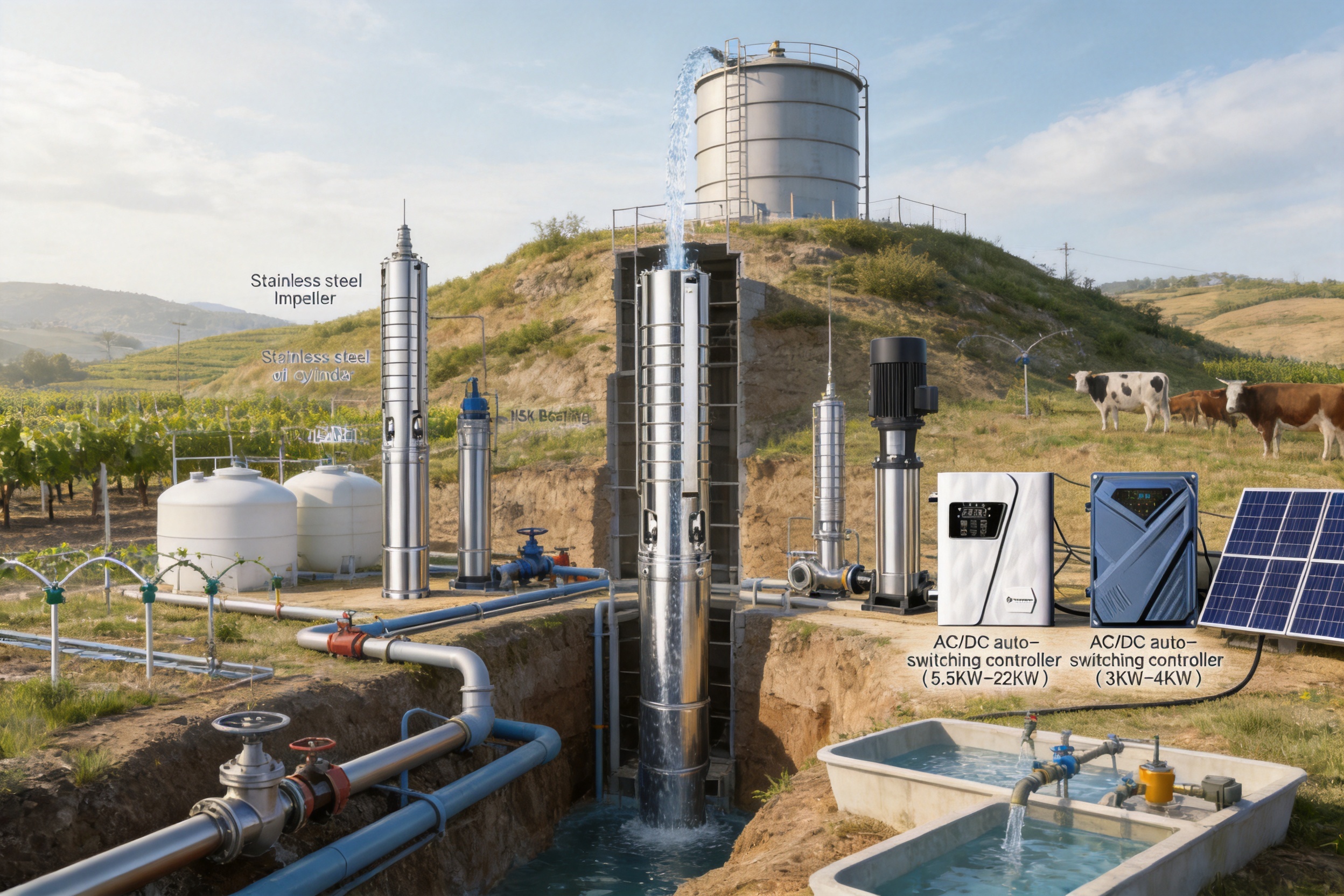
The 4ADSC pump is compatible with MPPT solar controllers. Maximum Power Point Tracking technology helps a solar pumping system use available photovoltaic energy more effectively by adjusting the operating point of the solar array as irradiance changes.
Solar panels do not produce a fixed amount of power under all conditions. Their voltage and current vary according to sunlight intensity, cell temperature, shading, dust, and panel characteristics. An MPPT controller can help extract useful power from the array and regulate the voltage and current supplied to the motor system.
A suitable controller should also provide functions such as overvoltage protection, undervoltage protection, overload protection, dry-run protection, over-temperature protection, phase-related protection where applicable, and controlled starting and stopping. The exact functions depend on the selected controller and system design.
Protection is especially important for solar pumps because available power can change rapidly. A passing cloud may cause a temporary voltage or power reduction, while an open-circuit condition or incorrect array configuration may create an excessive voltage. The specified solar open-circuit voltage limit of less than 900 V must be observed during system design.
Electronic control can help manage motor acceleration and deceleration. Controlled starting may reduce electrical stress and limit sudden hydraulic changes in the pipe system. In deep well installations, this can help reduce water hammer and mechanical shock compared with abrupt switching, although a complete system may still require suitable non-return valves, pressure control, and surge protection.
Many pumps in the market are effective within their intended operating range. The advantages of the 4ADSC series are primarily related to its combination of features rather than to a single specification.
Compared with a pump designed only for AC mains power, the 4ADSC series can be incorporated into a solar-based energy strategy. Compared with a solar-only pump, it can support AC backup for more dependable operation. This dual-power capability is valuable for users who want to reduce energy costs without sacrificing water availability.
Some pump ranges focus on either high flow or high head. The 4ADSC family covers both categories, from 6 m³/h at very high head to 30 m³/h at moderate head. This makes it easier for distributors, engineering contractors, and project owners to select a model matched to actual duty conditions.
The brushless motor avoids the routine replacement of mechanical brushes. This is a meaningful advantage over brushed motor designs, particularly when the pump is installed at a depth that makes removal difficult. Reduced maintenance can also be beneficial for remote installations where service personnel and spare parts are not readily available.
The stainless steel impeller supports corrosion resistance and mechanical durability. Compared with less robust impeller materials, stainless steel is better suited to long-term exposure to water and demanding operating conditions, provided the water chemistry and application remain within suitable limits.
The product family includes commonly used outlet sizes, standardized electrical information, and consistent solar input requirements. This helps engineering teams prepare system designs and helps distributors maintain a coherent product range. A consistent platform can also simplify user training and after-sales support.
The pump is manufactured by Taizhou Edwin Electric Co., Ltd., an integrated enterprise established in 2008. The company combines independent research and development, mass production, and global export. This business structure provides an important foundation for producing specialized pumps at commercial scale while maintaining control over product development and manufacturing coordination.
Independent research and development allows the manufacturer to design products around changing market needs rather than relying exclusively on standard off-the-shelf designs. The development of solar pumps and intelligent booster pumps since 2018 demonstrates a focus on new-energy applications and intelligent water technology.
For the 4ADSC series, this development orientation is reflected in the integration of high-voltage DC input, AC compatibility, brushless motor operation, MPPT controller compatibility, and a broad hydraulic range. These features require coordination between motor design, controller requirements, pump hydraulics, sealing, bearings, and system protection.
Mass production capability is important for commercial buyers because product availability, repeatability, and delivery planning influence the success of large projects. A manufacturer with established production capacity can support recurring orders, distributor programs, agricultural projects, and engineering contracts more effectively than a small workshop focused only on individual units.
Mass production should also be supported by process control. Motor assembly, bearing installation, impeller fitting, sealing, cable connection, housing assembly, and final testing must be carried out consistently. Although detailed internal factory procedures are not provided here, the company’s integrated manufacturing model is intended to support coordinated production from product development through finished-pump delivery.
The company has developed a professional procurement, order-tracking, cross-border delivery, and foreign-trade service structure through associated companies established in 2012. This is valuable for overseas buyers who may require assistance with model selection, documentation, production scheduling, shipping coordination, and repeat purchasing.
International customers often need more than a pump. They may require technical communication, packaging coordination, spare-parts planning, electrical compatibility review, and delivery support. An established export service structure can help reduce the administrative burden for importers and project contractors.
The manufacturer’s product lines include deep well pumps, submersible pumps, domestic booster pumps, circulation pumps, solar water pumps, and intelligent booster pumps. This broad portfolio can benefit customers who are designing complete water systems and prefer to source several pump categories from one supplier.
A wider product range also improves application knowledge. Experience with irrigation, municipal engineering, mining, construction, HVAC, household water supply, and renewable-energy projects gives the manufacturer exposure to different duty conditions and system requirements. Such experience can support more practical product recommendations.
The 4ADSC series can supply water for farms, orchards, greenhouses, and irrigation reservoirs. Solar operation is particularly suitable for agricultural sites where fields are located far from the electrical grid. During daylight, the pump can use solar energy to fill storage tanks or supply irrigation networks. AC power can provide backup when required.
The correct pump should be selected according to crop water demand, irrigation method, pipeline length, elevation, sprinkler or drip pressure, and available solar energy. A storage tank may be used to separate pumping time from irrigation time, allowing water to be collected during the day and distributed according to the farm schedule.
Remote homes and rural communities often depend on boreholes or deep wells. The hybrid configuration can provide a more dependable water source than a solar-only installation, especially when household demand extends into the evening or when several cloudy days occur.
For domestic water supply, the pump should be combined with suitable filtration, a pressure tank or elevated storage tank, non-return protection, and a hygienic distribution system. Water quality should be tested before selecting materials and designing the treatment arrangement.
Ranches and livestock farms may have watering points located far from buildings and grid connections. A solar-powered deep well pump can fill troughs or storage tanks in remote areas. The high-head models may be useful where the water source is deep or the delivery point is elevated.
Automatic level controls can stop the pump when a tank is full and restart it when the water level falls. The control system should include dry-run protection to avoid operating the pump when the well water level becomes too low.
Industrial facilities and construction sites may use the pump for water transfer, utility supply, temporary service, or deep well dewatering. The 3,000 W to 7,500 W power range allows the equipment to serve medium-duty and higher-capacity applications.
Construction projects should account for changing water levels, sediment, temporary pipework, and harsh handling conditions. Where water contains significant abrasive material, additional filtration or sediment management may be necessary.
The product is well suited to projects that combine solar generation with grid power. Solar energy can reduce daytime operating costs, while the grid provides supplementary power when water demand exceeds solar production. This approach can increase energy resilience without requiring a separate pumping system.
Correct installation is essential for achieving the expected performance of any deep well pump. The pump should be selected using the total dynamic head, not simply the well depth. Total dynamic head includes the vertical distance from the pumping water level to the delivery point, pipe friction, fittings, valves, filters, and required outlet pressure.
The pump must remain adequately submerged during operation. The well should provide sufficient water inflow, and the pump should not be operated continuously under dry or low-water conditions. A level sensor or controller with dry-run protection is recommended for installations where the water level may fluctuate.
The discharge pipe must be rated for the maximum pressure generated by the selected pump. This is particularly important for the 6 m³/h high-head models, which can produce substantial pressure. Pipe joints, valves, fittings, and storage tanks must be selected accordingly.
The electrical system should be designed by qualified personnel. The AC380 V input, DC520 V nominal input, optimum DC range of 520 V to 650 V, and solar open-circuit voltage limit below 900 V must all be respected. The solar array should be configured to deliver the required voltage without exceeding the maximum allowable open-circuit voltage under the lowest expected temperature.
Proper grounding, overcurrent protection, surge protection, isolation, and cable sizing are essential. The 2-meter supplied cable may need to be extended or connected according to approved procedures. Cable joints must be properly sealed for submersible service.
The pump should be lowered and supported using appropriate well equipment. The power cable should not be used as a lifting rope. A suitable safety rope, pipe support, and wellhead arrangement should be provided so that the pump remains securely positioned.
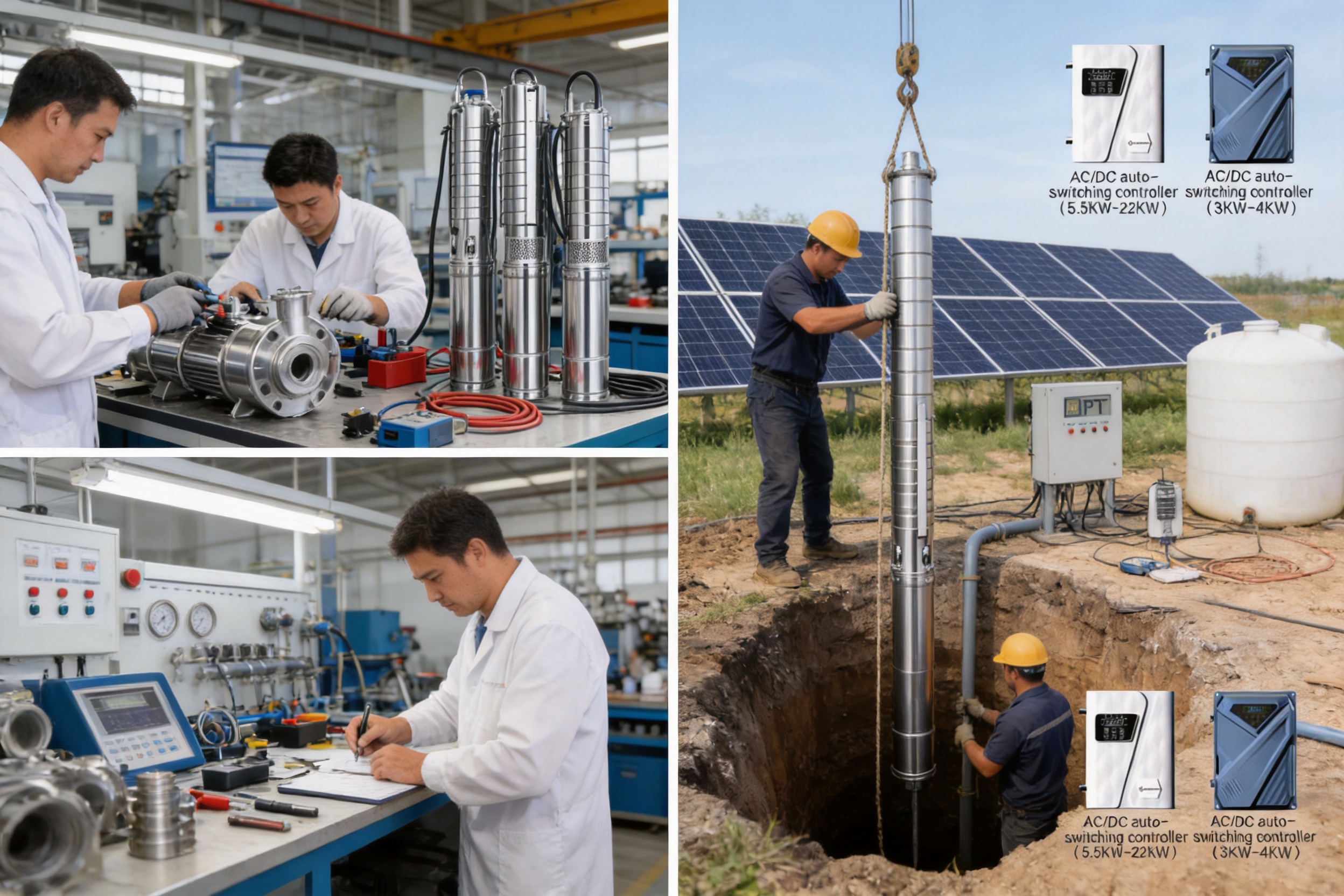
One advantage of the brushless motor design is reduced routine motor maintenance, but the overall system still requires inspection. Operators should monitor flow, pressure, current, voltage, running time, water quality, and unusual vibration or noise.
Solar panels should be kept reasonably clean and free from shading. Dust, leaves, bird deposits, and nearby construction debris can reduce energy production. The controller should be checked for fault indications and adequate ventilation.
Where sand is present, the well should be evaluated and managed. Excessive sand can cause abrasion, reduce hydraulic performance, and affect valves and downstream equipment. A pump should not be expected to compensate for a poorly developed or unstable well.
Seasonal inspection is recommended for agricultural and outdoor systems. Before periods of high demand, operators should verify electrical connections, pipework, valves, water levels, controller settings, and storage capacity. Preventive inspection is normally less disruptive than emergency pump removal.
Step one is to determine the required flow rate. This may be based on irrigation demand, tank filling time, household consumption, livestock requirements, industrial process needs, or dewatering volume.
Step two is to calculate the total dynamic head. Include the static lift, drawdown, elevation, pipe friction, fittings, filters, valves, and final pressure requirement.
Step three is to select a model whose operating curve satisfies both flow and head requirements. Maximum listed flow and maximum listed head are not normally achieved simultaneously. The pump curve and actual system curve must be reviewed together.
Step four is to design the electrical supply. Confirm whether the project will use solar power, AC power, or both. For solar systems, calculate array voltage, current, power, temperature effects, cable losses, and controller compatibility.
Step five is to specify protection and control. Include dry-run protection, water-level sensing, overload protection, voltage protection, appropriate switching, and tank-level control where needed.
Step six is to verify mechanical compatibility. Check outlet size, pipe diameter, pressure rating, well casing diameter, installation depth, cable length, lifting equipment, and access for future service.
The 4ADSC is an AC/DC hybrid submersible deep well pump with a brushless motor and stainless steel impeller. It is designed for deep wells, boreholes, solar pumping systems, water transfer, irrigation, and related applications.
Yes. The pump is designed for AC380 V and DC520 V operation. A compatible controller and properly designed switching or hybrid control system are required to manage the two power sources safely.
The listed optimum DC input range is 520 V to 650 V. The solar panel open-circuit voltage must remain below 900 V. The complete photovoltaic system must be designed according to the controller and local electrical requirements.
The listed recommendation is solar panel power of at least 1.3 times the pump power. The final array size may need to be increased depending on local sunlight, temperature, shading, cable losses, operating schedule, and water demand.
The listed maximum flow rates range from 6 m³/h to 30 m³/h. The actual flow depends on the selected model and the total dynamic head of the system.
The highest listed maximum head is 420 m, provided by the 4ADSC6-420-380/520-5500 model. Actual operating head must be confirmed using the pump curve and the complete system calculation.
A brushless motor eliminates mechanical brushes, reducing brush wear and related maintenance. This is especially useful when the pump is installed deep underground and removal is difficult or costly.
The stainless steel impeller provides strength, corrosion resistance, wear resistance, and stable hydraulic performance. It is well suited to long-term water pumping, although water chemistry and sand content must still be evaluated.
It may be used as part of a domestic water supply system, but water quality must be tested and any required filtration or treatment must be installed. The complete installation should meet applicable local health and electrical regulations.
The product information identifies compatibility with MPPT solar controllers but does not state that a controller is included with every pump. Buyers should confirm the supply scope, controller model, protection functions, and accessories before ordering.
The listed cable length is 2 meters. Additional cable requirements and submersible cable connections should be confirmed for the planned installation.
A water-level sensor, well probe, controller dry-run function, or another suitable protection method should be used. The correct option depends on the well design and control system.
Yes. It is suitable for farms, orchards, greenhouses, and other agricultural irrigation systems when the model is selected according to the required flow, pressure, water source, and irrigation method.
The combination of solar compatibility, AC backup, brushless operation, durable stainless steel hydraulic components, and multiple flow-head configurations makes the product suitable for remote and off-grid water systems.
Useful information includes required flow, well depth, static and dynamic water levels, delivery elevation, pipe length and diameter, water quality, solar conditions, AC availability, desired operating schedule, and destination country.
The 4ADSC AC/DC Brushless Motor Stainless Steel Impeller Deep Well Pump is designed for water systems that require both hydraulic capability and power-source flexibility. Its AC/DC hybrid operation allows users to combine solar energy with mains electricity, while the brushless motor supports efficient, low-maintenance operation. The stainless steel impeller and corrosion-resistant construction provide durability for deep well, agricultural, rural, industrial, and outdoor applications.
The series offers a broad performance range, from 6 m³/h high-head models reaching up to 420 m to 30 m³/h models for larger-volume water transfer. MPPT controller compatibility supports intelligent solar energy management, while NSK bearings and sealed housing contribute to long-term mechanical protection.
Its competitive value comes from the integration of several functions into one product family: renewable-energy compatibility, AC backup, brushless motor technology, durable hydraulic materials, intelligent control compatibility, and multiple hydraulic configurations. These characteristics can reduce system complexity and provide a stronger foundation for dependable water supply.
Supported by an integrated manufacturer with experience in research and development, mass production, global export, and new-energy pump technology, the 4ADSC series is positioned as a practical solution for commercial and industrial water projects. Proper model selection, electrical design, well preparation, installation, and maintenance remain essential to achieving the best results.
1. Product technical information for the 4ADSC AC/DC Brushless Motor Stainless Steel Impeller Deep Well Pump.
2. Manufacturer-provided product features, applications, model list, electrical specifications, and performance data.
3. General principles of centrifugal pump selection, total dynamic head calculation, and system curve analysis.
4. General engineering guidance for photovoltaic water pumping systems and maximum power point tracking control.
5. General practices for submersible pump installation, dry-run protection, grounding, cable sealing, and well maintenance.
6. General principles of stainless steel material selection for water-handling equipment.
edwina@edwin-pump.com
+86-13586290903 (WhatsApp)
Xuri Gongliang Cutting Tool Entrepreneurship Park, Wenqiao Town, Wenling City, Taizhou City, Zhejiang Province, China

High Performance Smart Pump Factory


 English