edwina@edwin-pump.com

View All Products
en
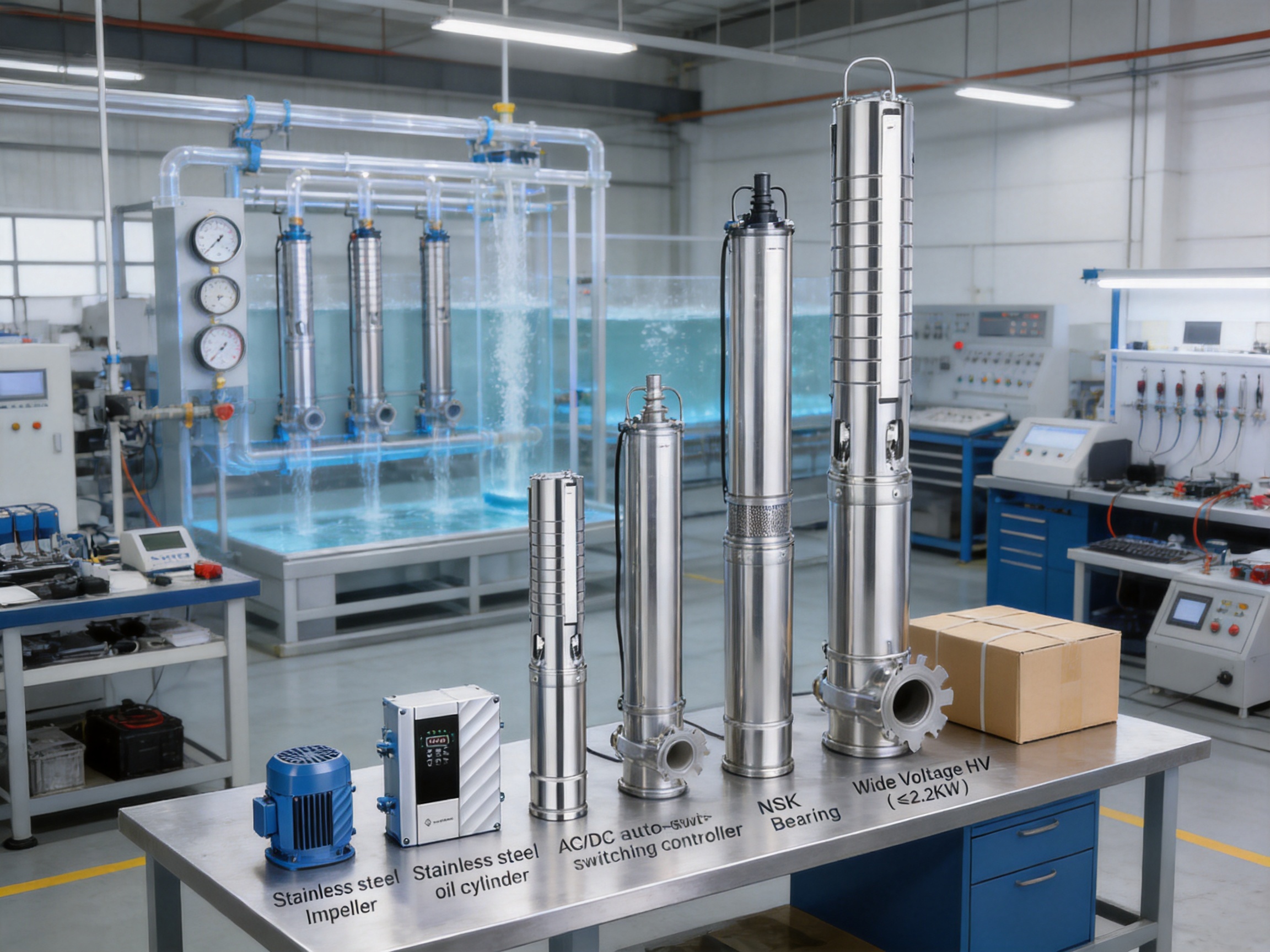
Reliable access to water is essential for rural communities, agricultural operations, household water systems, livestock facilities, and many off-grid development projects. In locations where grid electricity is unavailable, unstable, or expensive to extend, solar-powered pumping provides a practical alternative. However, not every solar pump is designed to deliver stable performance under changing sunlight, deep-water conditions, and continuous operating demands. A suitable solution must combine electrical flexibility, efficient motor technology, corrosion resistance, intelligent control, and dependable hydraulic performance.
The 4ADSCW Brushless AC/DC Water-Filled Solar Deep Well Pump with stainless steel construction is designed to meet these requirements. It is an AC/DC hybrid submersible solar pump intended for deep wells, water transfer systems, irrigation projects, household supply, and off-grid applications. Its operating concept combines direct solar DC power with AC electricity, allowing users to take advantage of renewable energy while retaining an alternative power source when sunlight is limited.
The pump family covers a broad range of operating points. Available configurations include models rated from 750 W to 2,200 W, maximum flow rates from 4.8 m³/h to 30 m³/h, and maximum heads from 26 m to 255 m. This range allows system designers to select a pump according to well depth, required pressure, daily water demand, storage-tank elevation, and irrigation layout.
More than a conventional submersible pump, the 4ADSCW series is a coordinated water-lifting system. Its brushless water-filled motor, water-cooled structure, corrosion-resistant materials, ceramic-coated shaft, thrust bearing, Japanese NSK bearings, and intelligent controller work together to improve operating reliability. The result is a pump platform suitable for users who need dependable water delivery with reduced maintenance and greater energy flexibility.
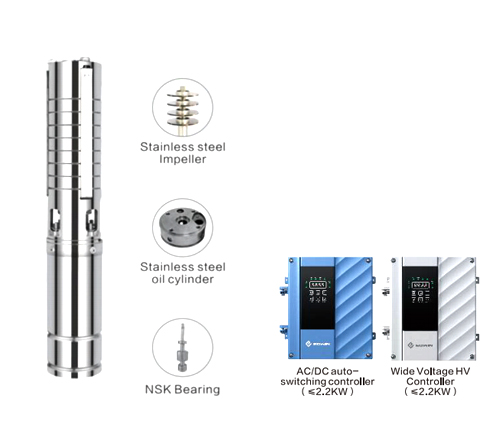
4ADSCW Brushless AC/DC Water Filled Solar Deep Well Pump with SS Impeller
The 4ADSCW series belongs to the AC/DC Hybrid Submersible Solar Pump category. It is designed for installation in deep wells and other submerged water sources where a compact, efficient, and dependable pump is required. The four-inch housing format makes it suitable for many standard deep-well installations while providing sufficient hydraulic capability for a wide range of applications.
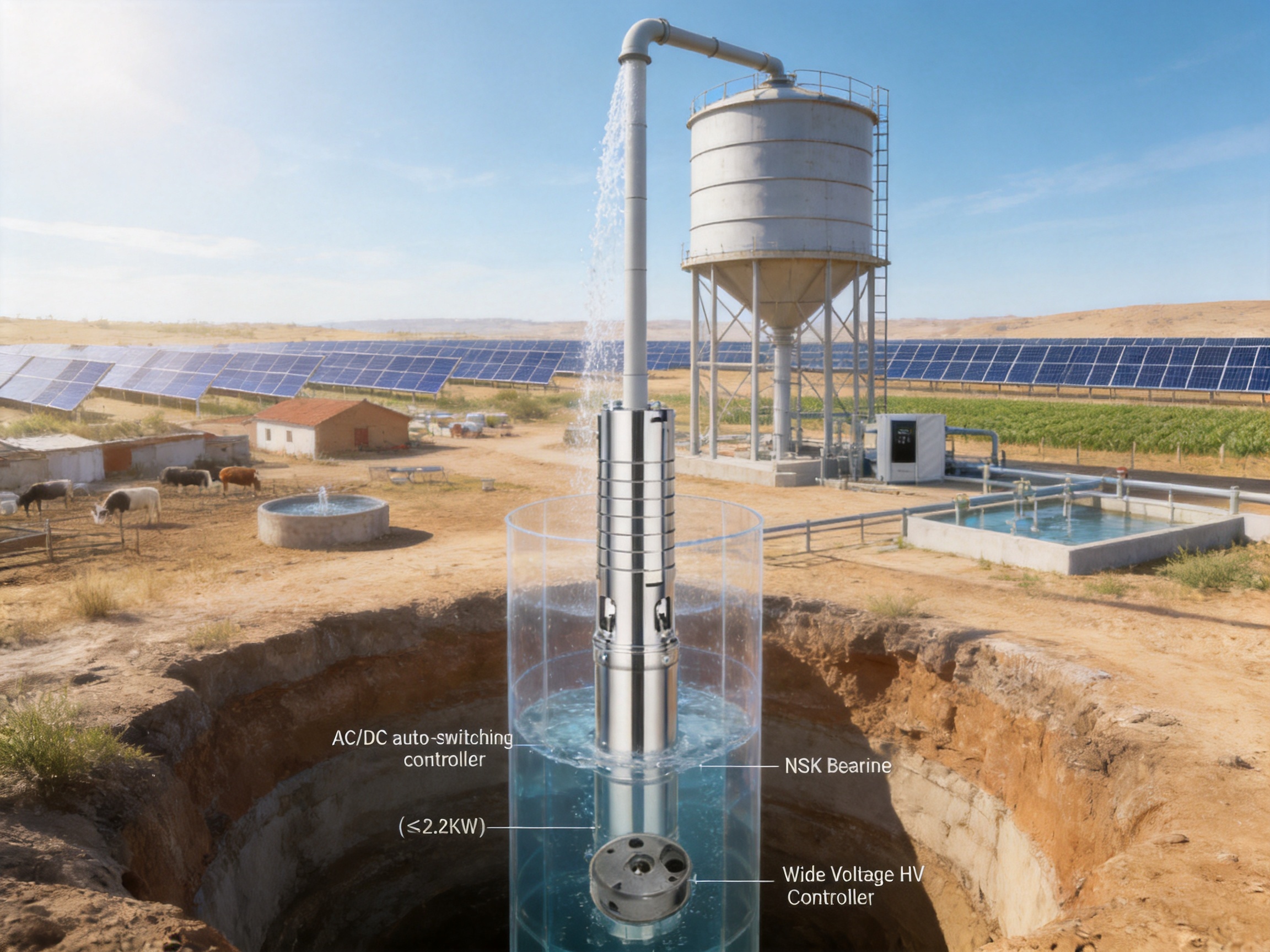
Its main function is to lift clean or relatively clean water from a well, borehole, reservoir, or underground source and deliver it to a storage tank, distribution network, irrigation system, or household water installation. Because the pump can operate from solar DC power as well as AC electricity, it can support both fully off-grid projects and hybrid systems that combine renewable energy with a conventional electrical supply.
Rural communities often face challenges caused by long distances from electrical infrastructure, unreliable utility service, or high operating costs. A solar deep well pump can draw water during daylight hours and send it to an elevated storage tank. The stored water can then be distributed by gravity or through a booster system when required.
The 4ADSCW series is suitable for this type of arrangement because its intelligent controller can manage automatic start and stop functions, helping the pump respond to system requirements. A properly designed installation may use float switches, pressure controls, water-level sensors, or other external protection devices to prevent unnecessary operation when a tank is full or a well is at risk of running dry.
Individual homes, small residential developments, schools, clinics, and community facilities may require a reliable water supply from a borehole. The pump can be selected according to the required head and flow. Lower-capacity configurations may be suitable for household storage tanks, while higher-head models can serve systems where the well is deep or the delivery point is located at a significant elevation.
The AC input capability adds practical flexibility. During periods of strong sunlight, the pump can utilize available solar power. During extended cloudy weather, nighttime operation, commissioning, or emergency conditions, an AC source may be used when available. This reduces dependence on a single energy source and can improve water availability throughout the year.
Small- and medium-scale farms often need water during daylight hours, which aligns naturally with solar pumping. The 4ADSCW series can support drip irrigation, sprinkler systems, greenhouse watering, orchard irrigation, and water transfer to farm reservoirs. The correct model should be selected after calculating the required flow, total dynamic head, pipe friction, elevation difference, and irrigation pressure.
Solar pumping is particularly attractive for agricultural users because the highest solar energy availability often occurs during the same part of the day when irrigation demand is greatest. By pumping water into a storage tank or directly into an irrigation network, the system can reduce fuel consumption and limit dependence on grid electricity.
The pump can be used to transfer water from a borehole or lower reservoir to an elevated tank, pond, cistern, or secondary reservoir. Water storage allows the pump to run when solar energy is available while the stored water is used later. This approach can reduce the need for battery storage, which is often one of the most expensive and maintenance-sensitive components in an off-grid energy system.
Remote construction sites, telecommunications facilities, livestock areas, ecological projects, and emergency water installations may not have reliable access to grid electricity. An AC/DC hybrid pump can be integrated into a solar array and controlled as part of a wider water-management system. Where an AC generator or utility connection exists, it can serve as backup power.
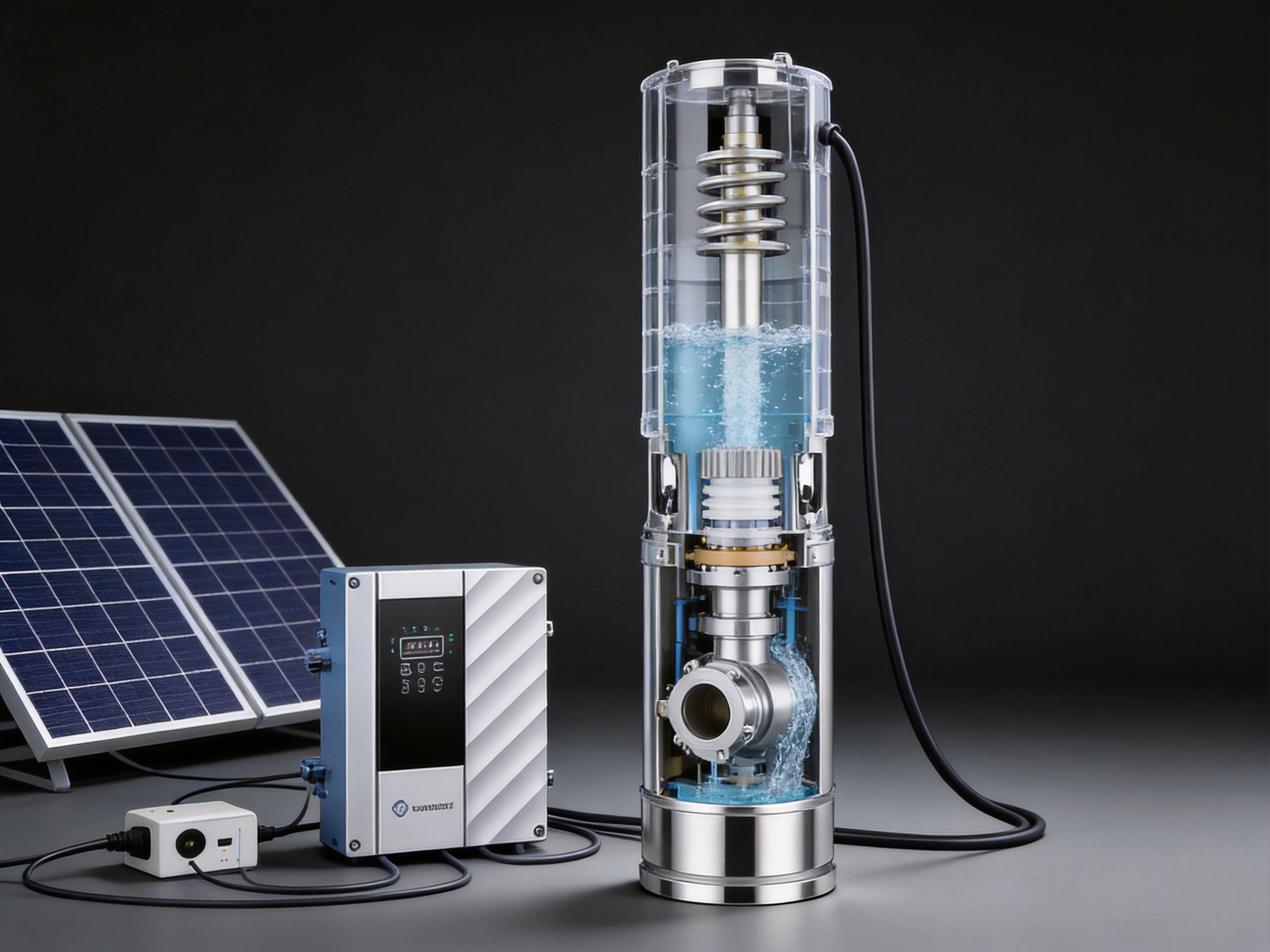
The pump is built around a submersible hydraulic assembly and a brushless water-filled motor. When installed below the water level, the motor drives the impeller assembly, creating pressure that moves water upward through the discharge pipe. The pump controller manages electrical input, motor starting, operating speed, and the transition between AC and DC sources.
A solar array supplies DC electricity within the specified input range. The controller adjusts the motor operation according to the available solar power and the selected operating mode. In AC mode, the controller accepts the specified utility or generator input. The hybrid arrangement makes it possible to design a system that prioritizes solar energy while preserving operational continuity through AC backup.
The pump’s four-inch diameter housing is intended for deep-well use. Its compact form helps simplify installation in suitably sized wells, but the borehole must always be checked for internal diameter, straightness, water quality, available submergence, and clearance around the pump. Correct installation is important for cooling, hydraulic stability, cable protection, and service life.
The brushless motor eliminates the wear associated with conventional mechanical brushes. In a brushed motor, brushes and commutators gradually wear during operation and may create maintenance requirements, electrical noise, and performance degradation. A brushless motor uses electronic commutation controlled by the system electronics, providing a more efficient and durable operating concept.
The water-filled design uses the surrounding or internal water environment to support cooling. Water-filled submersible motors are widely used because water can remove heat effectively when the pump is correctly submerged and operated within its design conditions. The absence of an oil-filled chamber can also be advantageous for applications where environmental protection and clean water handling are important.
Because the motor is water-filled, commissioning procedures are significant. The pump should not be operated outside the manufacturer’s permitted conditions, and installation personnel should follow the recommended procedures for filling, electrical testing, submersion, and startup. Adequate water flow around the motor is also necessary to prevent overheating.
The water-cooled structure helps transfer heat away from the motor during operation. Efficient thermal control is especially important in solar pumping systems because the available input power can fluctuate as clouds pass over the solar array. A well-managed motor temperature supports stable operation and reduces thermal stress on electrical and mechanical components.
The supplied product information also emphasizes the reduction of leakage risks associated with mechanical seals. The water-filled, water-cooled design is intended to avoid potential problems connected with traditional mechanical seal arrangements. This does not remove the need for proper installation and inspection, but it provides a structural advantage in a demanding submerged environment.
Deep-well pumps operate in conditions that can expose components to moisture, minerals, sediment, pressure, and long operating cycles. Material selection therefore has a direct influence on service life. The 4ADSCW series uses corrosion-resistant components, including an environmentally friendly, oil-free 304 stainless steel cylinder for the core housing structure.
304 stainless steel is widely used in water equipment because it offers a useful balance of corrosion resistance, mechanical strength, availability, and manufacturing practicality. It is suitable for many freshwater environments, although water chemistry must always be assessed. Highly aggressive water containing elevated chloride, acidity, or unusual contaminants may require additional material review before installation.
The product title identifies a stainless steel impeller configuration, while the supplied technical description also refers to a durable plastic impeller. This indicates that configuration details may vary by model or production specification. Buyers should confirm the exact impeller material, hydraulic stage design, and wetted-component specification before placing an order, particularly when the pump will be used with abrasive water or demanding chemical conditions.
The rotor shaft is a central mechanical component that transfers torque from the motor to the hydraulic assembly. Shaft wear, corrosion, misalignment, and excessive axial loading can affect vibration, noise, efficiency, and service life. The 4ADSCW design uses an enhanced rotor shaft with a ceramic coating intended to improve surface wear resistance.
A ceramic-coated surface can provide a hard, durable interface for components that experience repeated rotation and contact. This is especially useful in water-filled motor environments where conventional lubrication arrangements may be limited. The shaft design works together with the bearing system to maintain stable rotation and reduce the risk of premature mechanical degradation.
Submersible pumps experience axial forces generated by the hydraulic assembly. These forces must be supported by an appropriate thrust-bearing arrangement. The thrust bearing in the 4ADSCW series is designed to provide stable support for axial loading, helping maintain rotor alignment and hydraulic consistency.
Reliable thrust support is important in high-head models because the hydraulic load may be greater than in low-head transfer applications. The product range includes configurations with maximum heads up to 255 m, making the mechanical support system an important part of the pump’s overall design.
The use of Japanese NSK bearings is identified as a key product feature. NSK is recognized internationally for bearing engineering and manufacturing. In this pump design, the bearings are intended to provide wear resistance, smooth rotation, and extended service life during continuous or frequent operation.
Bearings can be affected by contamination, inadequate cooling, excessive loading, voltage-related motor stress, and poor alignment. The selected bearing quality is therefore valuable, but it must be supported by correct installation, clean water conditions, appropriate electrical input, and operation within the published performance range.
The intelligent controller is one of the main differences between a basic solar pump and a modern hybrid pumping system. It manages the relationship between the power source, motor, solar availability, and operating requirements. According to the supplied information, the controller includes automatic start and stop, soft start, AC/DC switching, and MPPT solar mode.
Automatic start and stop functions help reduce the need for manual supervision. When connected to appropriate control signals, the system can start when water is required and stop when a storage tank reaches its operating level or another shutdown condition is detected. This can reduce dry running, unnecessary energy consumption, and excessive cycling caused by manual operation.
Automatic control should be integrated with suitable level sensors, float switches, pressure controls, or protection devices. The exact control method depends on the installation. A professional installer should verify sensor compatibility and ensure that the control logic matches the water source and delivery system.
Motor starting can create a high instantaneous current demand. A soft-start function gradually increases motor speed, reducing mechanical shock and electrical stress. This is particularly useful in solar systems, where the available power may be limited and where sudden starting demand could cause the controller to shut down or the solar input voltage to collapse.
Soft starting can also reduce pressure surges in the discharge pipe. By allowing the hydraulic system to build pressure progressively, it may reduce stress on pipes, valves, fittings, and water-hammer-sensitive equipment.
AC/DC switching allows the pump to use different energy sources according to system conditions. Solar DC power can be prioritized during suitable daylight periods, while AC power can support operation when solar availability is insufficient. This flexibility is useful for farms, homes, and community projects that need reliable water delivery rather than solar operation alone.
The stated input ranges are 85 V to 280 V AC and 80 V to 430 V DC, depending on the applicable model and system configuration. The solar array must be designed so that its open-circuit voltage remains below the specified maximum. The supplied performance data identifies a solar panel open-circuit voltage below 430 V for the listed models. Electrical design should consider cold-weather voltage rise, series-panel configuration, cable losses, disconnects, grounding, overcurrent protection, and local electrical regulations.
Maximum Power Point Tracking, commonly called MPPT, enables the controller to adjust the operating point of the solar array so that the system can capture available photovoltaic power more effectively as sunlight changes. Solar panels do not produce a fixed output under all conditions. Their voltage and current vary with irradiance, temperature, shading, and array configuration.
By using MPPT control, the pump can respond to changing solar conditions more intelligently than a simple fixed-voltage system. The supplied information states that the controller’s efficiency can exceed 99 percent. Actual system efficiency will also depend on the solar modules, wiring, controller loading, motor operating point, hydraulic conditions, and installation quality.
The 4ADSCW family includes several combinations of flow, head, outlet size, and power. The maximum values shown in the product data are reference points rather than guarantees that maximum flow and maximum head occur at the same operating condition. Pump selection should be based on the complete performance curve and the calculated system duty point.
| Model | Power | Maximum Flow | Maximum Head | Outlet | AC Input | DC Input |
|---|---|---|---|---|---|---|
| 4ADSCW5.2-67-110-750 | 750 W | 5.2 m³/h | 67 m | 1.25 in | 85–280 V | 80–430 V |
| 4ADSCW4.8-203-200-1500 | 1,500 W | 4.8 m³/h | 203 m | 1.25 in | 85–280 V | 80–430 V |
| 4ADSCW5.2-101-150-1100 | 1,100 W | 5.2 m³/h | 101 m | 1.25 in | 85–280 V | 80–430 V |
| 4ADSCW5.2-146-200-1300 | 1,300 W | 5.2 m³/h | 146 m | 1.25 in | 85–280 V | 80–430 V |
| 4ADSCW7.5-80-150-1300 | 1,300 W | 7.5 m³/h | 80 m | 1.25 in | 85–280 V | 80–430 V |
| 4ADSCW7.5-100-200-1500 | 1,500 W | 7.5 m³/h | 100 m | 1.25 in | 85–280 V | 80–430 V |
| 4ADSCW11-60-200-1500 | 1,500 W | 11 m³/h | 60 m | 2 in | 85–280 V | 80–430 V |
| 4ADSCW19-35-200-1500 | 1,500 W | 19 m³/h | 35 m | 2 in | 85–280 V | 80–430 V |
| 4ADSCW25-26-200-1500 | 1,500 W | 25 m³/h | 26 m | 2 in | 85–280 V | 80–430 V |
The performance range demonstrates that the series is not limited to one application type. High-head models are appropriate for deep wells and elevated delivery points, while high-flow, lower-head models may be better suited to reservoir transfer or irrigation distribution. The 750 W configuration can serve smaller water requirements, while 1,100 W, 1,300 W, and 1,500 W models provide additional capacity for larger systems.
The 4ADSCW4.8-203-200-1500 model provides a maximum head of 203 m with a maximum flow of 4.8 m³/h. This type of configuration can be considered for deep wells, steep elevation changes, or installations that require substantial pressure. The 4ADSCW5.2-146-200-1300 and 4ADSCW5.2-101-150-1100 models provide alternative combinations of head and power for systems with different hydraulic requirements.
When selecting a high-head pump, users should account for the static water level, dynamic drawdown, vertical elevation, pipe friction, valves, filters, and the pressure required at the outlet. The physical well depth alone does not define the total head. The pump must be selected according to the total dynamic head at the desired flow rate.
The 4ADSCW11-60-200-1500 model reaches a maximum flow of 11 m³/h at a maximum head of 60 m. The 4ADSCW19-35-200-1500 and 4ADSCW25-26-200-1500 models are designed for progressively higher flow at lower maximum head. These models may be useful for water transfer, agricultural reservoirs, and applications where the main objective is to move a substantial volume over a relatively modest elevation.
The 2-inch outlet sizes on these higher-flow models can help reduce flow restrictions compared with a smaller discharge connection. Nevertheless, the connected pipe should be sized according to the actual duty point, pipe length, acceptable velocity, friction losses, and the requirements of valves and downstream equipment.
The second group of listed configurations includes 2,200 W models in the 4HVSCW range. These models provide maximum heads from 36 m to 255 m and maximum flows from 5.2 m³/h to 30 m³/h. The 4HVSCW5.2-255-300-2200 model is intended for very high head requirements, while the 4HVSCW30-36-300-2200 model emphasizes high flow at a lower head.
| Model | Power | Maximum Flow | Maximum Head | Outlet | Cable Length | Recommended Minimum Solar Power |
|---|---|---|---|---|---|---|
| 4HVSCW5.2-255-300-2200 | 2,200 W | 5.2 m³/h | 255 m | 1.25 in | 2 m | At least 1.3 × pump power |
| 4HVSCW7.5-150-300-2200 | 2,200 W | 7.5 m³/h | 150 m | 1.25 in | 2 m | At least 1.3 × pump power |
| 4HVSCW11-120-300-2200 | 2,200 W | 11 m³/h | 120 m | 2 in | 2 m | At least 1.3 × pump power |
| 4HVSCW19-60-300-2200 | 2,200 W | 19 m³/h | 60 m | 2 in | 2 m | At least 1.3 × pump power |
| 4HVSCW30-36-300-2200 | 2,200 W | 30 m³/h | 36 m | 2 in | 2 m | At least 1.3 × pump power |
The solar array power recommendation is at least 1.3 times the pump power. For example, a 1,500 W pump should generally be paired with solar capacity of at least 1,950 W according to the supplied specification. Actual array sizing may need to be higher when the project has high ambient temperatures, seasonal cloud cover, shading, suboptimal orientation, long cable runs, or a requirement for extended daily pumping hours.
A conventional DC-only solar pump may stop whenever solar conditions become insufficient. A conventional AC-only pump depends on grid power or a generator. The AC/DC hybrid design offers a broader operating strategy by allowing the user to combine solar generation with AC backup. This can improve water security and reduce the risk associated with relying on one energy source.
The brushless water-filled motor eliminates brush replacement and reduces dependence on mechanical seals. The ceramic-coated rotor shaft, thrust bearing, and NSK bearings further support a low-maintenance operating concept. Compared with older pump designs that use more wear-sensitive components, this architecture can provide advantages for installations where regular service visits are difficult.
MPPT control helps the system respond to changing solar input. Rather than operating at a fixed point that may not match the panel output, the controller seeks a more useful electrical operating condition. This improves the possibility of extracting available solar energy throughout the day and can increase the practical water yield from a given solar array.
The four-inch format offers a balance between installation compatibility and pumping capacity. A compact pump can be installed in appropriately sized boreholes while still supporting high-head and high-flow configurations. This is useful where drilling costs, casing diameter, or well construction limit the available installation space.
The model range includes low-power household-oriented options, high-head deep-well configurations, and high-flow water-transfer models. This is more flexible than a one-size-fits-all product because the user can select a pump closer to the required duty point. Correct matching can improve energy efficiency, reduce throttling, and prevent oversized equipment from operating inefficiently.
The 304 stainless steel cylinder and corrosion-resistant internal components are intended to provide durable service in wet environments. Oil-free construction is also attractive where environmental protection and water cleanliness are important. While water testing remains necessary, the materials provide a strong foundation for reliable operation in ordinary freshwater installations.
Taizhou Edwin Electric Co., Ltd. was founded in 2008 and operates as an integrated manufacturing enterprise focused on research and development, mass production, and global export. Its product portfolio includes deep well pumps, submersible pumps, domestic booster pumps, circulation pumps, solar water pumps, and intelligent booster pumps.
An integrated manufacturing structure can provide advantages throughout the product lifecycle. Product design, component selection, assembly, testing, packaging, and export coordination can be managed within a coordinated organization. This supports more consistent communication between engineering and production teams and can help the manufacturer respond to different market requirements.
Independent research and development is important for advanced solar pumping equipment because the pump, motor, controller, and hydraulic system must operate as a coordinated unit. The performance of one component affects the others. A controller must be matched to the motor’s electrical characteristics, while the hydraulic design must be matched to the motor’s torque and speed range.
The development of brushless water-filled motors and intelligent AC/DC controllers demonstrates a focus on integrated system engineering rather than simple component assembly. Features such as soft start, MPPT operation, automatic control, and AC/DC switching require electrical and mechanical compatibility throughout the product.
Mass production capability is valuable for distributors, engineering contractors, agricultural projects, and original equipment customers that require repeatable supply. A stable production process can support consistent dimensions, repeatable assembly procedures, controlled component sourcing, and more predictable delivery schedules.
For international buyers, production capacity also helps support multiple model configurations. The 4ADSCW range includes different power ratings, hydraulic duties, outlet sizes, and head-flow combinations. A manufacturer capable of organized mass production is better positioned to manage such a broad product family without compromising model identification and order coordination.
The company has developed a professional structure
edwina@edwin-pump.com
+86-13586290903 (WhatsApp)
Xuri Gongliang Cutting Tool Entrepreneurship Park, Wenqiao Town, Wenling City, Taizhou City, Zhejiang Province, China

High Performance Smart Pump Factory


 English