
edwina@edwin-pump.com

View All Products
en
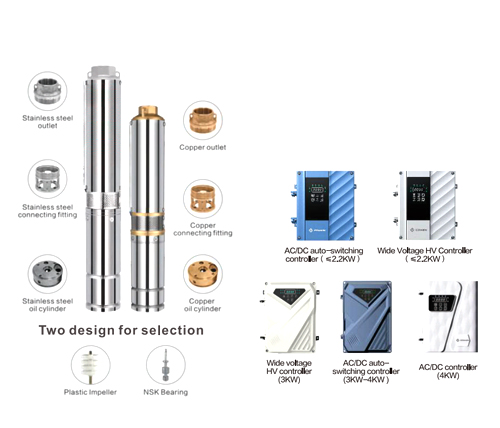
Water-based solar pumping systems are increasingly used in off-grid irrigation, livestock supply, and remote water delivery. A Water Filled Solar Pump relies on water surrounding the motor chamber or hydraulic section to stabilize temperature and support continuous operation under variable solar input. Unlike oil-filled designs, thermal exchange is directly tied to surrounding fluid conditions, which makes temperature spikes a critical operational factor.
Field troubleshooting data shows that unstable solar input combined with hydraulic imbalance can trigger intermittent shutdowns, reduced flow, or protection mode activation rather than immediate mechanical failure.
Solar radiation does not increase linearly during the day. Short-term irradiance surges—caused by cloud breaks or reflective ground conditions—can cause rapid power fluctuations in photovoltaic supply. In solar pumps, this translates into unstable motor torque and inconsistent hydraulic output.
Key thermal stress mechanisms include:
Motor overheating is one of the most common failure pathways in water-based pumping systems, especially when flow drops below design threshold. Excess heat directly affects insulation durability and mechanical seal stability.
Heat surges rarely originate from temperature alone. Instead, hydraulic instability amplifies thermal stress.
Common contributors:
Restricted flow increases friction losses inside the pump assembly. Even minor flow reduction forces the motor to operate at higher electrical load per unit output, which accelerates temperature rise.
A pump operating near dry-run conditions can experience rapid thermal escalation due to loss of cooling medium around critical components.
Solar pump controllers continuously adjust output based on available photovoltaic power. During sudden irradiance spikes, the controller may increase frequency output rapidly, which changes motor speed almost instantly.
This response creates three operational patterns:
These oscillations are not always mechanical faults. They often reflect control-loop reaction delay between solar input, motor speed adjustment, and water column response.
In deep-well or high-lift installations, hydraulic inertia amplifies this delay, making the system appear unstable even under normal operation conditions.
Water-filled motor housings depend heavily on continuous circulation for cooling. Unlike sealed oil environments, water temperature is directly influenced by external conditions and pump workload.
Thermal challenges include:
Once circulation weakens, internal temperature distribution becomes uneven, creating stress points that accelerate insulation aging.
Performance studies of pump systems indicate that inadequate cooling and electrical imbalance can significantly shorten motor life by accelerating thermal degradation processes.
Not all overheating originates from solar intensity alone. Structural and hydraulic design choices strongly influence thermal stability.
Common design-related contributors:
A mismatch between pump capacity and system resistance creates cyclical stress, where the motor repeatedly compensates for fluctuating hydraulic load. This behavior increases heat accumulation over time.
Solar pump systems operate under combined electrical and environmental stress conditions. Heat surge events are often intensified by external factors such as ambient temperature and voltage instability.
Key influences:
Each factor contributes incrementally, but combined effects can push system temperature beyond stable operating range.
Typical field indicators include:
These symptoms often appear before any permanent damage occurs, making early detection critical for system longevity.
Heat surge behavior in water filled solar pumping systems is not a single-point failure but a multi-variable interaction between solar input, hydraulic resistance, and thermal transfer efficiency. Stability depends on maintaining continuous water movement, balanced electrical input, and consistent control feedback.
Properly balanced systems should maintain steady temperature distribution even under variable irradiance, with gradual response curves rather than abrupt thermal spikes.
serieswatershortageprotectionvoltagestabilizationstainlesssteelverticalmultistagepump.jpg "EVR(S) Series Water Shortage Protection Voltage Stabilization Stainless Steel Vertical Multistage Pump")
edwina@edwin-pump.com
+86-13586290903 (WhatsApp)
Xuri Gongliang Cutting Tool Entrepreneurship Park, Wenqiao Town, Wenling City, Taizhou City, Zhejiang Province, China

High Performance Smart Pump Factory


 English