
edwina@edwin-pump.com

View All Products
en
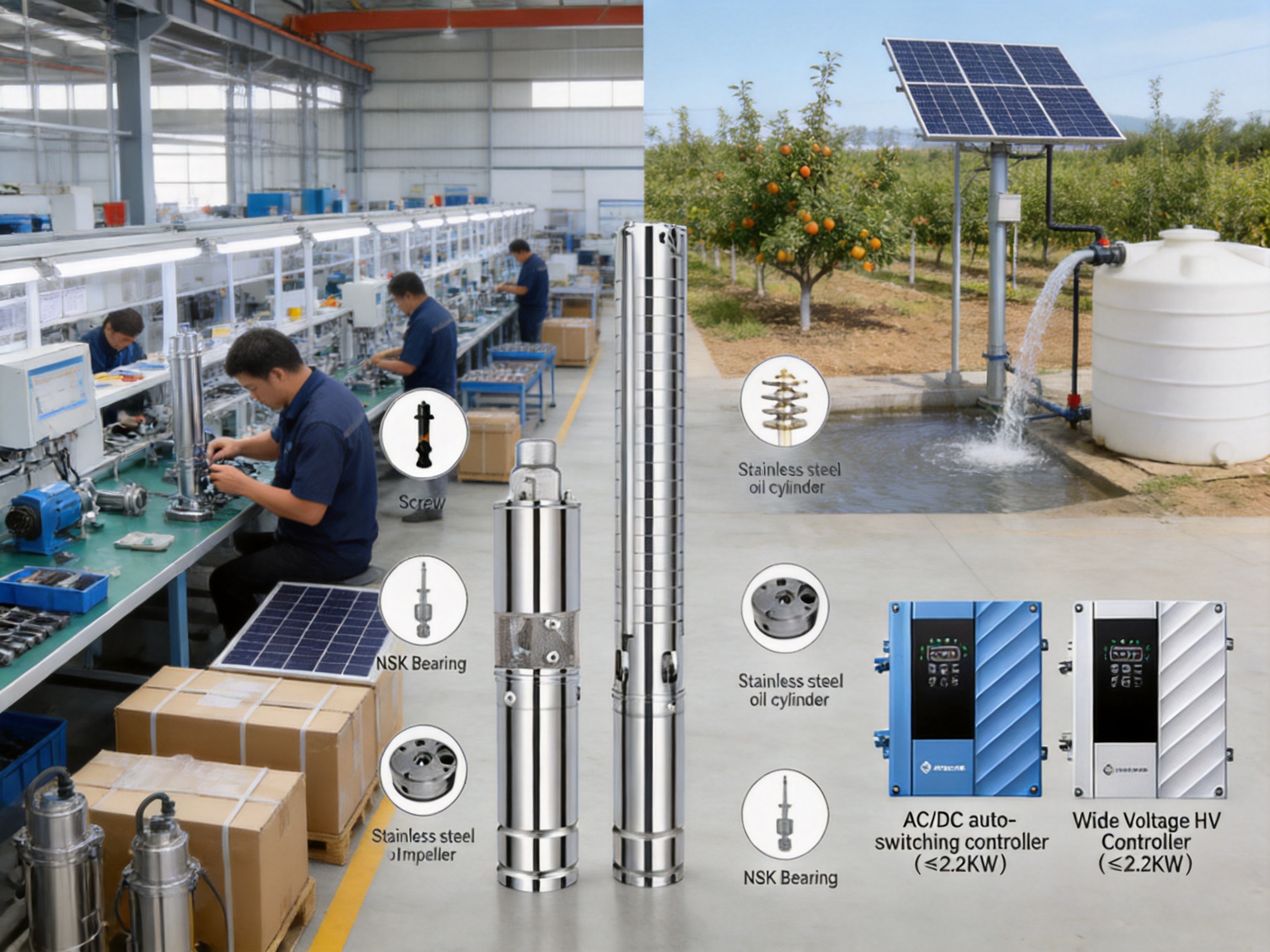
Reliable access to water is one of the most important requirements for rural communities, agricultural properties, remote facilities, and off-grid homes. In many of these locations, the available water source is located below ground, while access to grid electricity is limited, expensive, or completely unavailable. Solar-powered deep well pumps provide a practical solution by converting sunlight into useful pumping energy without depending on diesel fuel or conventional utility power.
The 3HVSC Wide Voltage Stainless Steel Impeller Solar Deep Well Pump is designed for these demanding conditions. It combines a compact three-inch pump body, a wide-voltage brushless DC motor, stainless steel hydraulic components, NSK bearings, and high-temperature copper wire. Together, these features create a pumping system intended for small wells, low-flow irrigation, rural drinking water supply, storage tank filling, and other solar-powered water transfer applications.
Compared with basic solar pumps that use plastic impellers, narrow-voltage motors, or less durable internal components, this model focuses on long-term reliability and operating flexibility. Its stainless steel impeller improves resistance to wear and corrosion, while the wide-voltage design allows the pump to work across varying solar input conditions. These advantages are particularly valuable in locations where sunlight changes throughout the day and where maintenance access is difficult.
This article examines the pump’s construction, operating principles, performance range, application value, competitive advantages, selection considerations, and the manufacturing capabilities behind its production.
A deep well pump must overcome more than the vertical distance between the water level and the discharge point. It must also handle friction inside pipes, changes in water demand, variations in sunlight, and the quality of the surrounding water. A suitable pump therefore needs a balanced combination of hydraulic performance, electrical flexibility, mechanical strength, and serviceability.
Solar pumping systems are especially useful in areas where water is available underground but electrical infrastructure is weak. A solar array supplies direct-current power to the pump system, allowing water to be lifted from a well and delivered to a tank, irrigation network, livestock trough, or household distribution system. In many installations, water storage is more economical than electrical battery storage because the tank can hold water for use after sunset.
The use of a brushless DC motor is an important part of this arrangement. Brushless motors avoid the physical brushes and commutators found in traditional brushed motors. This reduces mechanical wear in the motor’s electrical switching system and supports a longer service life when the pump operates for extended periods. It also allows electronic control systems to manage changing solar input more effectively.
However, a solar pump is only as dependable as its hydraulic components. The impeller is continuously exposed to water and may encounter suspended particles, mineral deposits, or chemically aggressive conditions. If the impeller is too soft or poorly suited to the water environment, its performance may gradually decline. The stainless steel impeller used in the 3HVSC series is intended to provide a stronger and more corrosion-resistant alternative to conventional plastic impellers.
The 3HVSC Wide Voltage Stainless Steel Impeller Solar Deep Well Pump is a three-inch DC submersible solar pump designed for compact well installations. Its narrow pump diameter makes it suitable for small-diameter boreholes where larger submersible pumps cannot be installed.
The pump is available in several combinations of flow rate, head, and motor power. The listed models use 750-watt, 1,100-watt, or 1,500-watt motors. Maximum flow ratings range from 4.8 cubic meters per hour to 6 cubic meters per hour, while maximum head ratings range from 60 meters to 135 meters depending on the model.
The electrical input range is a central characteristic of this series. Models rated for 750 watts and 1,100 watts have an optimum DC input voltage range of 110 to 350 volts. The 1,500-watt models have an optimum DC input range of 150 to 350 volts. The stated open-circuit voltage of the solar panel array must remain below 450 volts.
These specifications provide useful flexibility for system designers. The pump can be matched with different solar array configurations while remaining within the required voltage limits. Nevertheless, correct system design remains essential. The pump should not be connected to a solar array whose open-circuit voltage exceeds the stated limit, and the solar array must provide sufficient power for the selected motor.
The product information specifies a solar panel power requirement of at least 1.3 times the pump power. This means that a 750-watt pump should be paired with a solar array of at least approximately 975 watts under the stated design principle. A 1,100-watt model requires at least approximately 1,430 watts of panel power, while a 1,500-watt model requires at least approximately 1,950 watts.
In actual projects, the final solar array size may need to be increased further depending on local solar radiation, temperature, shading, cable length, seasonal conditions, and the desired daily water volume. The 1.3-times guideline is a minimum reference for system planning rather than a guarantee of identical output in every climate.
The wide-voltage brushless DC motor is one of the most significant features of the 3HVSC pump. Solar energy does not provide a fixed electrical supply. Panel voltage and available current change according to sunlight intensity, cloud cover, temperature, panel orientation, and time of day.
A narrow-voltage pump may stop frequently when solar conditions move outside a limited operating window. By contrast, a wide-voltage motor can accept a broader range of DC input conditions within its specified limits. This helps the pump continue operating during more parts of the day and makes it easier for installers to design solar arrays with practical series and parallel configurations.
The wide-voltage approach is particularly advantageous in locations with variable weather or partial seasonal changes. Morning and late-afternoon conditions may provide less available power than midday conditions, but the pump can still make productive use of suitable solar input rather than requiring a highly stable grid-like supply.
It is important to distinguish wide-voltage operation from unlimited-voltage operation. The pump still has defined minimum and maximum ranges. An installation must remain within the appropriate input voltage range for the selected model, and the solar array’s open-circuit voltage must remain below 450 volts. Proper electrical protection and professional installation are therefore necessary.
Brushless motor technology supports reduced maintenance because there are no conventional carbon brushes to replace. The motor’s electronic control system performs the switching function normally handled by mechanical commutation components. This is useful in remote installations where service visits are expensive or difficult to arrange.
The brushless design also supports smooth operation and efficient conversion of electrical energy into motor rotation. When combined with an appropriately selected solar controller, the motor can respond to changing input conditions while maintaining useful pumping performance.
For a deep well application, reduced internal wear is valuable. A pump may operate for many hours during periods of strong sunlight, and repeated starts and stops may occur when clouds pass over the solar array. The brushless motor architecture is suited to this variable operating environment.
The impeller is the rotating hydraulic component that transfers energy from the motor to the water. The 3HVSC series uses a stainless steel impeller rather than a conventional plastic impeller. This construction is intended to improve resistance to corrosion, abrasion, and long-term mechanical stress.
Stainless steel is particularly useful where water contains minerals or where the pump may be exposed to conditions that accelerate material degradation. It can also provide greater dimensional stability than lower-cost plastic components when the pump operates under changing temperatures and pressures.
Compared with a basic plastic impeller, the stainless steel design offers a stronger solution for users who prioritize durability. Plastic impellers can be appropriate in clean and mild water conditions, but they may be less suitable for installations where abrasion, mineral deposits, or prolonged operation create additional stress. The stainless steel impeller gives the 3HVSC series a clear material advantage in these applications.
Material selection does not eliminate the need for water-quality assessment. Extremely abrasive sand, aggressive chemicals, or heavy sediment can affect any pump. A well should be properly developed, and filtration or sediment control should be considered where necessary.
The stainless steel cylinder and robust pump body reinforce the product’s suitability for submerged operation. A submersible pump is installed in an environment where access may be limited and where the pump is continuously surrounded by water. Corrosion-resistant external components help protect the pump from premature deterioration.
The cylinder also contributes to the compact form of the pump. With a three-inch diameter, the unit can be installed in smaller wells and boreholes. This provides an advantage over larger pumps when the available well casing is narrow or when a new small-diameter borehole is being developed.
A durable external body is important during installation and maintenance as well. The pump must be lowered into the well, connected to discharge piping, and positioned at a suitable depth. Robust construction helps reduce the risk of damage from normal handling when proper installation procedures are followed.
The 3HVSC pump uses NSK bearings to support stable motor operation. Bearings reduce friction between moving components and help maintain accurate shaft rotation. High-quality bearings are especially important in a pump because the motor may operate for long periods and must transfer rotational energy efficiently.
Reduced friction can help limit heat generation and mechanical losses. It also supports smoother operation, which may reduce stress on the shaft, impeller, and motor housing. Bearing quality is often less visible than external pump design, but it has a direct influence on service life and operating stability.
The use of recognized bearing components also reflects a broader manufacturing approach: critical internal parts should be selected for predictable performance rather than only for low initial cost.
The motor winding uses high-temperature copper wire. Copper provides strong electrical conductivity, while high-temperature insulation helps the winding withstand the heat generated during operation. Deep well pumps may work in demanding conditions, and motor temperature management is essential for long-term reliability.
High-temperature copper wire supports stable motor performance when the pump is operating under load. It is also valuable in solar applications because the pump may experience changing input conditions and extended operation during peak sunlight periods.
Motor winding quality is a key differentiator between a dependable pump and a low-cost pump with uncertain durability. A well-made winding system can help reduce electrical losses, maintain consistent performance, and protect the motor from premature insulation failure.
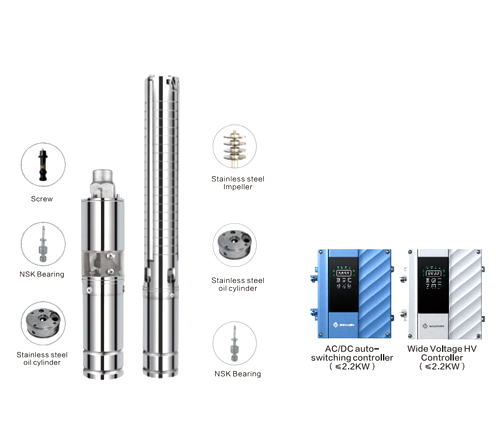
3HVSC Wide Voltage Stainless Steel Impeller Solar Deep Well Pump
The 3HVSC series includes six listed models. They are divided into three principal power levels and several combinations of flow and head. The maximum flow and maximum head values should be understood as separate hydraulic limits rather than performance values that occur simultaneously.
| Model | Power | Optimum DC Input Voltage | Maximum Flow | Maximum Head | Outlet | Panel Open-Circuit Voltage | Minimum Panel Power |
|---|---|---|---|---|---|---|---|
| 3HVSC4.8-95-110-750 | 750 W | 110–350 V | 4.8 m³/h | 95 m | 1.25 inches | Below 450 V | At least 1.3 times pump power |
| 3HVSC5-112-110-1100 | 1,100 W | 110–350 V | 5 m³/h | 112 m | 1.25 inches | Below 450 V | At least 1.3 times pump power |
| 3HVSC5-135-150-1500 | 1,500 W | 150–350 V | 5 m³/h | 135 m | 1.25 inches | Below 450 V | At least 1.3 times pump power |
| 3HVSC6-60-110-750 | 750 W | 110–350 V | 6 m³/h | 60 m | 1.25 inches | Below 450 V | At least 1.3 times pump power |
| 3HVSC6-85-110-1100 | 1,100 W | 110–350 V | 6 m³/h | 85 m | 1.25 inches | Below 450 V | At least 1.3 times pump power |
| 3HVSC6-115-150-1500 | 1,500 W | 150–350 V | 6 m³/h | 115 m | 1.25 inches | Below 450 V | At least 1.3 times pump power |
The model names provide a useful indication of the performance grouping. The 4.8 and 5 cubic-meter-per-hour versions are designed for applications requiring greater lifting height within their respective power classes. The six-cubic-meter-per-hour versions provide higher maximum flow at lower maximum head than some of the comparable models.
Selection should begin with the actual water requirement rather than the maximum advertised rating. The installer should determine the static water level, pumping water level, vertical delivery height, horizontal pipe distance, pipe diameter, fittings, storage tank elevation, and required daily volume.
Total dynamic head is more useful than well depth alone. It includes the vertical lift from the pumping water level to the discharge point, plus friction losses and any pressure required at the outlet. A pump selected only by well depth may be too small if the water must travel through a long pipeline or rise to an elevated tank.
Similarly, maximum flow is not always the desired target. A small household or orchard system may need a moderate, steady supply rather than the highest possible flow. Operating the pump near the appropriate point on its performance curve can improve efficiency and support more reliable system operation.
Traditional AC deep well pumps depend on grid electricity or a generator. In remote locations, extending the electrical grid can be expensive, while generators require fuel transportation, regular servicing, and noise management. A solar DC pump can operate directly from a properly designed photovoltaic system, reducing dependence on fuel and utility infrastructure.
The 3HVSC pump is particularly suitable where the water demand is predictable during daylight hours or where water can be stored in a tank. This approach can reduce the need for battery banks, which are often among the most expensive and maintenance-sensitive parts of an off-grid energy system.
AC pumps can remain appropriate where reliable grid power already exists or where high-volume operation is required around the clock. However, for many rural and remote installations, a direct solar pumping system offers a simpler energy pathway.
Some solar pumps operate within a limited voltage window. These pumps may require a specific panel arrangement and may stop when sunlight conditions change significantly. A wide-voltage design gives installers more flexibility in configuring the solar array and can extend the useful operating period during the day.
The 3HVSC models accept optimum DC input ranges from 110 to 350 volts or from 150 to 350 volts depending on the power rating. This broad operating range helps accommodate different project layouts while maintaining defined electrical limits.
Wide-voltage operation is also useful when a system must be adapted to seasonal changes or when the panel array is designed with future expansion in mind. Any expansion must still be checked against the maximum allowable open-circuit voltage and the controller’s requirements.
Plastic impellers may reduce manufacturing cost and can perform well in clean, low-stress water conditions. However, stainless steel provides a more robust option when wear resistance and corrosion resistance are important. The stainless steel impeller in the 3HVSC series is an attractive feature for users who expect long operating hours or who are concerned about material deterioration.
The stainless steel impeller also complements the stainless steel cylinder and pump body. Instead of relying on a low-cost hydraulic component inside a durable outer shell, the pump uses corrosion-resistant materials in key areas exposed to water and mechanical stress.
A three-inch diameter is a practical advantage for small wells. A larger pump may offer higher capacity, but it cannot be installed if the well casing is too narrow. The compact 3HVSC design gives property owners and contractors more options when working with small-diameter boreholes.
Small wells are common in rural properties, remote homes, orchards, and specialized irrigation systems. In these locations, the objective may be dependable water delivery rather than maximum industrial output. A compact pump can meet the required duty while reducing installation constraints.
Remote equipment must be designed with service access in mind. The brushless DC motor avoids brush replacement, while durable bearings and high-temperature copper wire support stable operation. Stainless steel hydraulic components further reduce the risk of premature deterioration caused by ordinary water exposure.
No pump is maintenance-free, but the 3HVSC design is intended to reduce the frequency of common maintenance issues. Preventive inspection should still include checking the solar array, controller, cable connections, well condition, discharge pipe, water quality, and pump performance.
The pump can be used to lift groundwater for rural drinking water systems when the water source has been properly tested and treated as required. A typical arrangement may include the submersible pump, a solar array, a controller, a storage tank, filtration equipment, and a distribution network.
Water quality must always be evaluated independently of pump selection. A stainless steel pump does not make contaminated water safe to drink. Groundwater should be tested for bacteria, minerals, metals, salinity, and other local concerns, and suitable treatment equipment should be installed where necessary.
Low-flow agricultural irrigation is a strong application for this product series. Orchards, vineyards, gardens, and small farms often require water to be delivered to a storage tank or drip irrigation header during daylight hours. The pump can transfer water without the fuel expense and noise associated with a generator.
Drip irrigation systems benefit from controlled water delivery. In many cases, it is preferable to pump water into a tank and allow the irrigation system to operate through a pressure-regulated network. This arrangement separates the solar pumping schedule from the irrigation schedule and provides a reserve of water for periods of cloud cover.
Tank filling is one of the simplest and most practical uses for a solar deep well pump. A float switch or level control can stop the pump when the tank is full, preventing unnecessary operation. The tank then serves as a form of energy storage because it holds water that can be used later.
For a reliable system, the tank should be sized according to daily demand, expected solar conditions, and the available well yield. The pump’s flow should not exceed the sustainable recharge rate of the well. Over-pumping can lower the water level, introduce sediment, or cause the well to recover slowly.
Remote farms, construction sites, field stations, and small infrastructure projects may need water transferred from a borehole to a distant location. The wide-voltage solar pump can be considered where grid connection is impractical and where the daily water requirement matches the available solar resource.
Long pipe runs require careful hydraulic calculations. Pipe diameter, elevation changes, bends, valves, and filtration equipment can significantly increase total dynamic head. A suitable pump model should be selected according to the actual operating point rather than the maximum head printed in a product table.
The performance of a pump depends not only on its advertised design but also on how consistently it is manufactured. Taizhou Edwin Electric Co., Ltd., operating as Edwin Pump, was founded in 2008 and has developed an integrated business covering independent research and development, mass production, and global export.
This integrated structure is valuable for a technical product such as a solar deep well pump. Research and development teams can refine hydraulic components, motor systems, materials, and control compatibility. Production teams can then manufacture the design at scale while maintaining standardized processes. Export and service teams can support customers with product selection, order coordination, and international delivery.
The company’s product portfolio includes deep well pumps, submersible pumps, domestic booster pumps, circulation pumps, solar water pumps, intelligent booster pumps, and related water equipment. This broad product knowledge helps the manufacturer understand different water-system requirements rather than treating each pump as an isolated product.
Since 2018, the company has invested in new energy and intelligent technology. The 3HVSC series reflects this direction by combining solar compatibility with wide-voltage brushless motor technology. The product is designed not merely as a conventional pump connected to a solar panel, but as part of an energy-conscious water supply system.
Manufacturing strength also comes from component selection. Stainless steel hydraulic parts, NSK bearings, and high-temperature copper wire indicate attention to the components that most directly influence service life. Consistent winding quality, accurate shaft alignment, reliable sealing, and proper assembly are essential to the final product.
Mass production can provide additional advantages when it is supported by standardized inspection and process control. Repeatable assembly procedures help maintain consistency between batches. Electrical testing can verify motor characteristics, while hydraulic testing can confirm flow and head behavior against design expectations.
For international customers, an integrated export capability is equally important. Pump projects often involve multiple models, solar requirements, cables, controllers, pipes, valves, and delivery schedules. The company’s related import and export organizations were established to provide procurement planning, order tracking, cross-border delivery, and foreign trade services.
This one-stop approach can simplify purchasing for distributors, engineering contractors, agricultural suppliers, and project developers. Instead of coordinating every component and shipment independently, customers can work with a manufacturer familiar with the product range and the requirements of international orders.
Advanced manufacturing does not mean that every installation will perform identically. Site conditions remain decisive. However, a manufacturer with established product development, production, and export capabilities is better positioned to provide consistent equipment and technical coordination than an informal supplier with limited specialization.
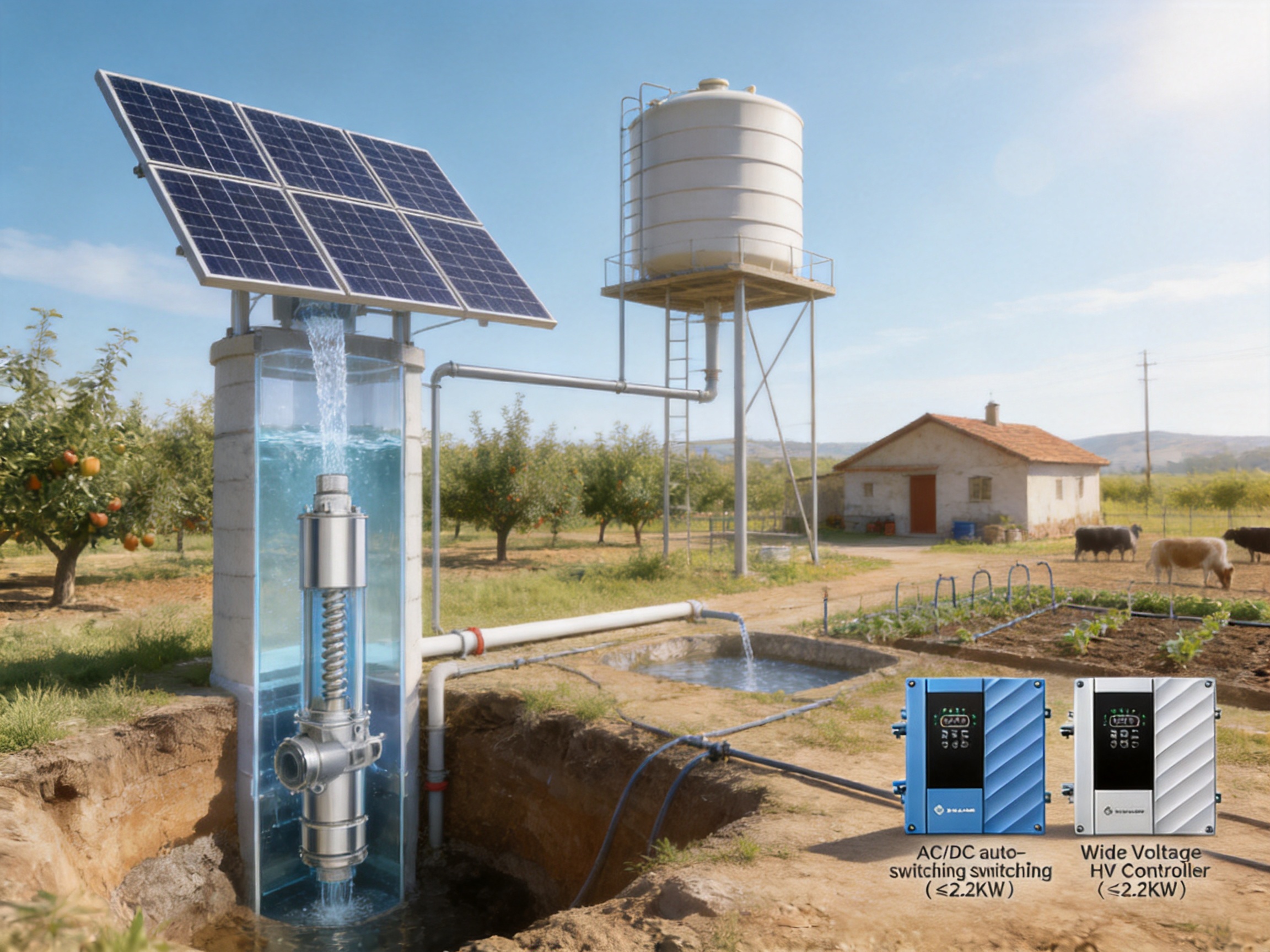
The solar array must be designed within the pump’s voltage limits. The selected 750-watt and 1,100-watt models specify an optimum DC input range of 110 to 350 volts. The 1,500-watt models specify an optimum range of 150 to 350 volts. The solar panel array’s open-circuit voltage must remain below 450 volts.
Open-circuit voltage can rise in cold weather, so installers should not calculate the array only from its nominal operating voltage. The temperature coefficient of the selected panels must be considered. Wiring arrangements should be checked under the lowest expected temperature and highest possible open-circuit condition.
The listed requirement is at least 1.3 times the pump power. This reserve helps compensate for normal system losses and changing solar conditions. For example, a 750-watt pump requires at least approximately 975 watts of solar panel power according to this guideline.
In areas with weak sunlight, frequent cloud cover, high temperatures, or seasonal water demand, additional panel capacity may be beneficial. The final design should consider the desired daily water volume, not only the pump’s electrical rating.
A suitable solar pump controller is required to manage the DC power supplied to the brushless motor. The controller should be compatible with the selected pump voltage and power rating. It may also provide functions such as dry-run protection, overload protection, under-voltage protection, over-voltage protection, and soft starting, depending on the system configuration.
Protection against dry running is particularly important. If the well water level falls below the pump inlet, the pump may lose cooling and lubrication. A water-level sensor, float control, or controller-based dry-run function can help protect the equipment.
Surge protection and proper grounding should be included in the installation. Solar arrays can be exposed to lightning-related surges, and long cable runs can increase electrical risk. The pump cable, connectors, switches, and protective devices should be rated for the operating voltage and environmental conditions.
The listed pump cable length is two meters. Additional submersible cable may be required depending on the well depth and the location of the controller. The cable must be suitable for submerged operation, correctly sized for the current and distance, and protected from mechanical damage.
The pump should be suspended securely and should not rest directly on the bottom of the well. The final installation depth must maintain adequate submergence while avoiding zones with excessive sand or sediment. The well yield and recovery rate should be verified before continuous operation.
Maximum head describes the greatest vertical pressure capability under specified test conditions, while maximum flow describes the greatest flow under conditions of low or limited head. In practical operation, the pump operates at an intermediate point on its performance curve.
For example, the 3HVSC6-60-110-750 model is listed with a maximum flow of 6 cubic meters per hour and a maximum head of 60 meters. This does not mean that it will deliver 6 cubic meters per hour at 60 meters of head. The actual flow at a particular head must be determined from the performance curve and the system resistance.
System resistance increases when water must travel through narrow pipes, long pipelines, elbows, check valves, filters, or pressure regulators. Selecting a larger pipe can reduce friction losses and improve the useful flow delivered to the tank or irrigation network.
The pump’s outlet is listed as 1.25 inches. The discharge pipe should be selected according to the flow rate, distance, and desired friction loss. A pipe that is too small may restrict output and increase the energy required for pumping.
Well depth alone is not enough to select a pump. The pumping water level may fall below the static water level while the pump operates. This drawdown must be included in the total lift calculation. In addition, the delivery point may be substantially higher than the ground surface near the well.
Before installation, the well should be inspected for depth, diameter, water quality, yield, sediment, and electrical requirements. The pump should be matched to the well casing and should have sufficient clearance for installation and cooling water movement.
All pipe connections should be sealed correctly, and a suitable check valve should be used where required by the system design. The discharge pipe should be supported independently when necessary so that excessive load is not transferred to the pump outlet or cable.
The solar array should be installed in an unshaded location with appropriate orientation and tilt. Even partial shading can reduce the output of a series-connected array. Panels should be kept clean, and loose or corroded electrical connections should be corrected promptly.
Routine maintenance should include observing the delivered water volume, listening for unusual noise, checking for repeated controller faults, inspecting the solar array, and monitoring changes in the well water level. A gradual reduction in flow may indicate sediment, pipe blockage, impeller wear, a falling water level, or a change in solar array performance.
If the water contains sand, a well-development program or suitable filtration system may be required. Excessive sand can accelerate wear on hydraulic components regardless of whether the impeller is stainless steel or plastic.
The pump should not be operated outside its specified electrical range. Over-voltage, incorrect polarity, inadequate cable sizing, and poor grounding can damage the motor or controller and may create a safety hazard.
The purchase price of a pump is only one part of the cost of a water system. Solar panels, controllers, cables, mounting structures, pipes, tanks, valves, filters, installation labor, and maintenance must also be considered.
A durable pump can improve total cost of ownership by reducing replacement frequency and service interruptions. The stainless steel impeller and cylinder are intended to resist the deterioration that can shorten the life of less durable components. The brushless motor can reduce maintenance associated with brush replacement, while the wide-voltage design may improve the usefulness of the available solar resource.
Fuel savings are another important consideration. A solar pump does not require regular diesel or gasoline purchases, and it produces no direct exhaust emissions during operation. This can be particularly valuable for remote agricultural sites where fuel delivery is inconvenient or costly.
Water storage can further improve economic value. By pumping during sunlight hours and storing water for later use, the system can avoid the expense of a large battery bank. Batteries may still be appropriate for certain control or backup functions, but they are not always necessary for a water supply system based on daytime pumping.
The best economic result comes from proper sizing. An oversized pump may require unnecessary solar capacity and may draw down the well too quickly. An undersized pump may fail to supply enough water during the available solar window. A correctly matched model provides a better balance between capital cost, daily output, and long-term reliability.
International water projects often involve different well standards, local solar conditions, language requirements, shipping arrangements, and application expectations. A product family with several power, flow, and head combinations gives distributors and engineering companies more flexibility when serving different markets.
The 3HVSC series offers a consistent three-inch platform with multiple performance options. This can simplify product training, spare-parts planning, and dealer communication. Customers can select the appropriate hydraulic rating without changing to a completely different pump family.
Taizhou Edwin Electric Co., Ltd. has experience in global export and serves applications in new energy, agricultural irrigation, municipal engineering, mining, construction, HVAC systems, and household water supply. This range of applications supports a practical understanding of the different conditions encountered by international customers.
The company’s associated procurement and foreign trade services can also support customers that require consolidated purchasing. A project may need pumps, valves, accessories, related water products, and coordinated shipping. A manufacturer with an established export team can help organize these requirements more efficiently.
For distributors, product reliability and supplier responsiveness are both important. A technically capable pump is more valuable when the supplier can provide clear specifications, model selection assistance, production coordination, and after-sales communication.
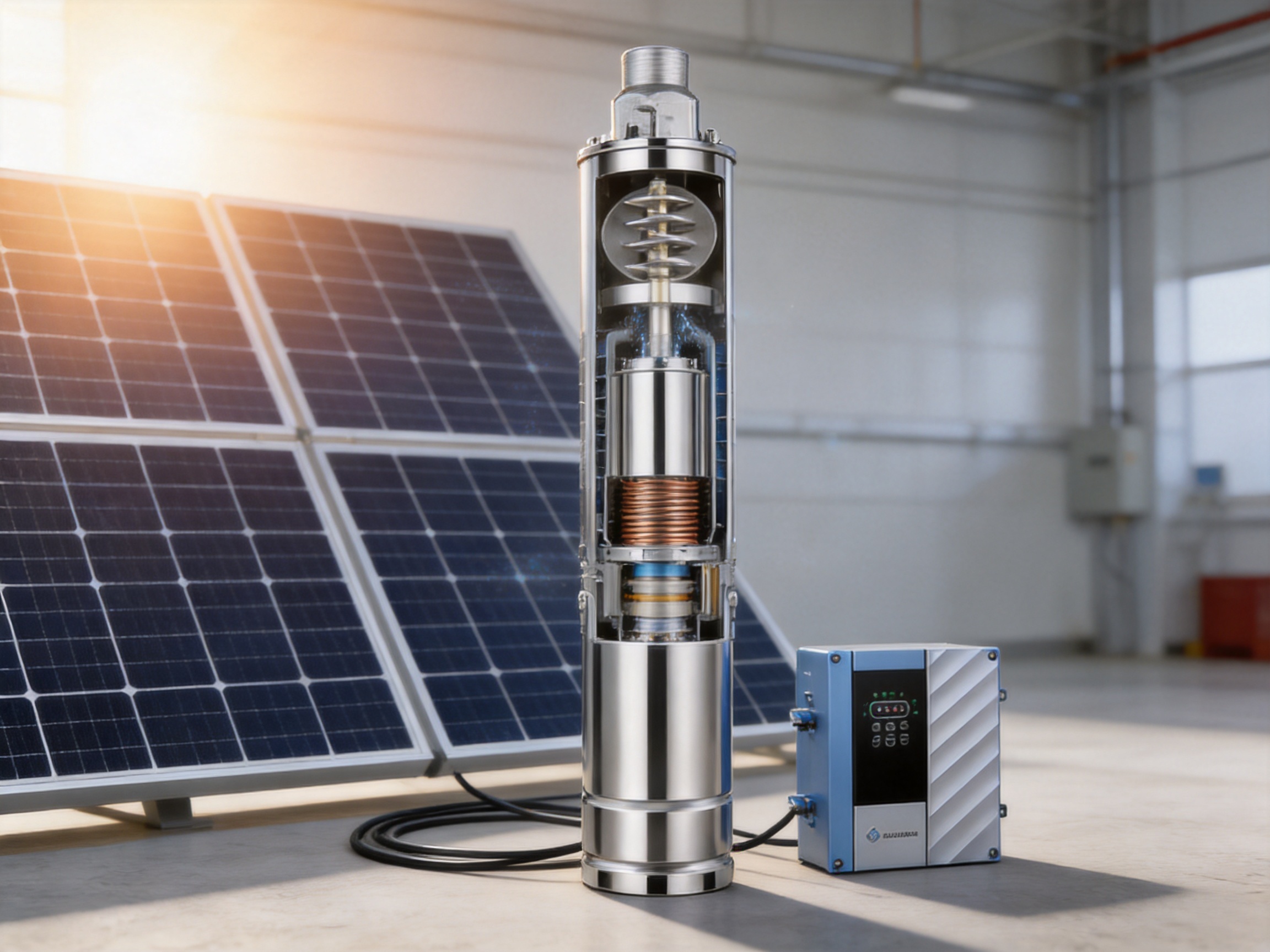
The 3HVSC series is a DC submersible solar deep well pump. It is designed to be installed below the water level in a well and powered by a suitable solar photovoltaic system.
The three-inch designation refers to the compact pump diameter and indicates that the pump is suitable for small-diameter wells or boreholes. The actual well casing should be checked to ensure adequate clearance for installation.
The listed models are DC solar pump models. Their optimum input voltage is specified as DC, and the AC voltage field is shown as not applicable.
The stainless steel impeller is designed to provide stronger resistance to corrosion, wear, and mechanical stress than a conventional plastic impeller. It is especially useful for users who prioritize durability in demanding water environments.
No. The solar array must be configured within the voltage limits of the selected model. The optimum DC input range is 110 to 350 volts for the listed 750-watt and 1,100-watt models, and 150 to 350 volts for the listed 1,500-watt models. The panel open-circuit voltage must remain below 450 volts.
The product information specifies solar panel power of at least 1.3 times the pump power. The final array size may need to be larger depending on local sunlight, temperature, shading, cable losses, and daily water requirements.
No. Maximum flow and maximum head are separate limits. The actual operating point depends on the performance curve and the total dynamic head of the water system.
Selection should be based on the required flow, total dynamic head, well yield, daily water volume, and available solar energy. The static water level, pumping water level, discharge elevation, pipe friction, and outlet pressure should all be calculated before choosing a model.
A battery is not necessarily required for a water pumping system. Many solar pumping installations operate during daylight and store water in a tank for later use. A battery may be added if the project requires nighttime pumping, control backup, or a hybrid energy arrangement.
It can be considered for groundwater supply, but the water must be tested and treated according to local health requirements. The pump itself does not purify contaminated water.
Maintenance should include checking solar panels, electrical connections, controller status, water output, pipework, well conditions, and signs of sediment or blockage. The brushless motor reduces brush-related maintenance, but the entire system still requires periodic inspection.
Solar voltage and available power vary during the day. A wide-voltage motor can operate across a broader specified input range, helping the pump make better use of changing solar conditions and giving installers more flexibility in array design.
The 3HVSC Wide Voltage Stainless Steel Impeller Solar Deep Well Pump is designed for customers who need dependable groundwater pumping in compact wells and off-grid environments. Its key strengths include a three-inch form factor, wide-voltage brushless DC motor, stainless steel impeller, stainless steel cylinder, NSK bearings, and high-temperature copper wire.
These features provide practical advantages over basic narrow-voltage or plastic-impeller solar pumps. The wide-voltage motor supports flexible solar system design, while the stainless steel hydraulic components improve resistance to wear and corrosion. The brushless motor and selected internal components are intended to reduce maintenance demands and support long-term operation.
The range includes 750-watt, 1,100-watt, and 1,500-watt options with maximum flow ratings from 4.8 to 6 cubic meters per hour and maximum head ratings from 60 to 135 meters. This range allows the product to serve rural drinking water systems, small farms, orchards, gardens, drip irrigation networks, storage tanks, and remote water transfer projects.
Correct design remains essential. Solar array voltage, open-circuit voltage, panel power, well yield, total dynamic head, pipe friction, sediment, and water quality must all be evaluated. When properly selected and installed, the pump can form the core of an efficient, low-maintenance, solar-powered water supply system.
Behind the product is an integrated manufacturing and export organization with experience in pump research and development, mass production, global trade, and related water equipment. Taizhou Edwin Electric Co., Ltd. combines this manufacturing background with investment in new energy and intelligent pump technology, making the 3HVSC series a practical option for international customers seeking durable solar pumping equipment.
1. Taizhou Edwin Electric Co., Ltd. Product information for the 3HVSC Wide Voltage Stainless Steel Impeller Solar Deep Well Pump.
2. Taizhou Edwin Electric Co., Ltd. Company profile and manufacturing capability information.
3. Solar photovoltaic system design principles for direct-current water pumping applications.
4. General engineering guidance for submersible pump selection, total dynamic head calculation, and well yield assessment.
5. General technical references concerning brushless DC motors, stainless steel hydraulic components, electric motor windings, and bearing-supported rotating equipment.
serieswatershortageprotectionvoltagestabilizationstainlesssteelverticalmultistagepump.jpg "EVR(S) Series Water Shortage Protection Voltage Stabilization Stainless Steel Vertical Multistage Pump")
edwina@edwin-pump.com
+86-13586290903 (WhatsApp)
Xuri Gongliang Cutting Tool Entrepreneurship Park, Wenqiao Town, Wenling City, Taizhou City, Zhejiang Province, China

High Performance Smart Pump Factory


 English