
edwina@edwin-pump.com

View All Products
en
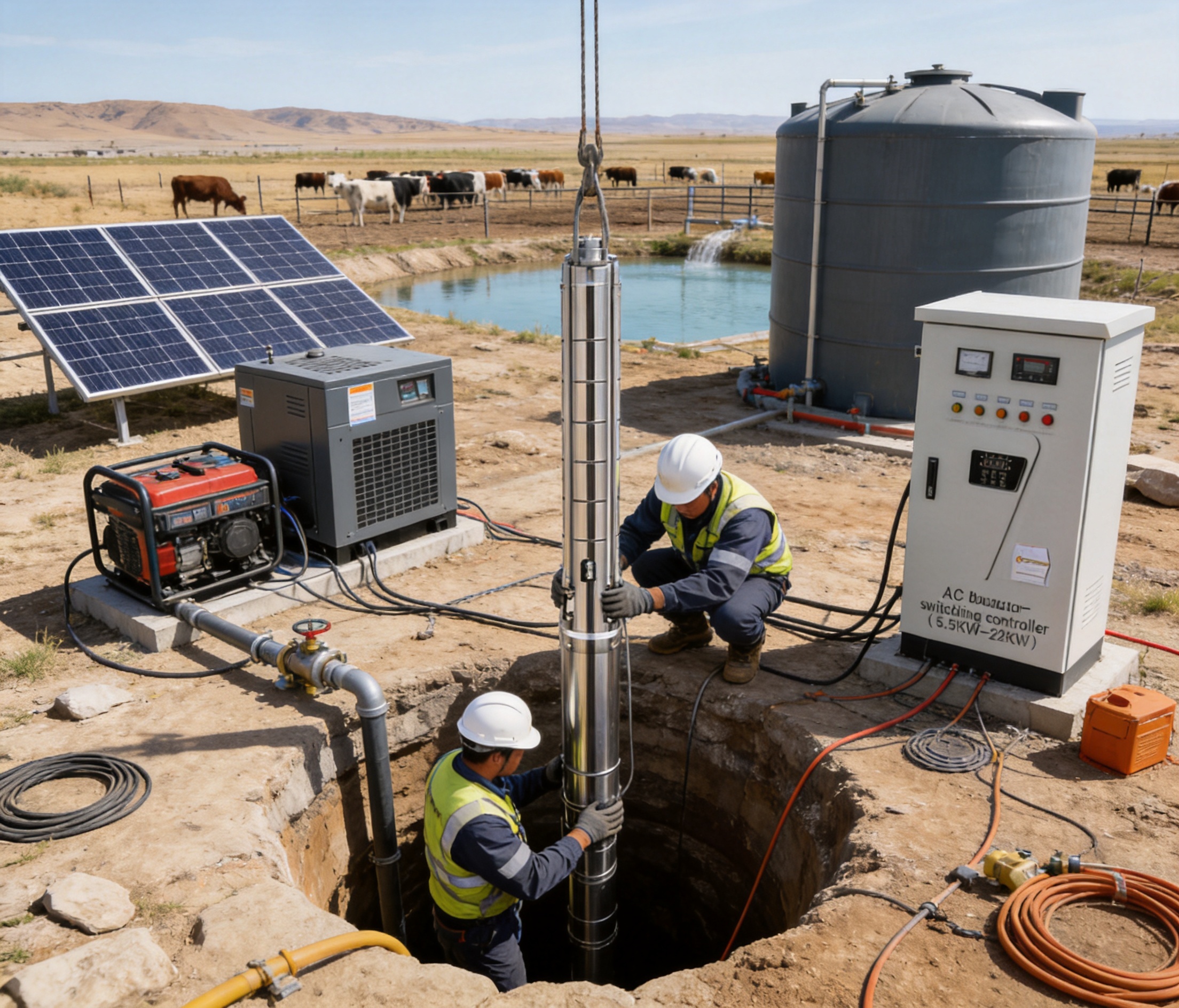
Reliable access to water is essential for agriculture, livestock production, rural communities, industrial facilities, and remote installations. However, many water sources are located far from electrical grids, while conventional pumping systems can involve high energy costs, complicated infrastructure, and frequent maintenance. Solar pumping technology offers an effective alternative, but users often need a system that can continue operating when sunlight is limited or when solar production changes throughout the day. The 8ADSC Stainless Steel Cylinder AC/DC Hybrid Solar Deep Well Pump is designed to address these requirements through a combination of solar energy utilization, conventional AC compatibility, deep-well performance, and durable stainless steel construction.
This AC/DC hybrid submersible solar pump is intended for demanding water-supply applications. It can operate with DC power from a solar array and AC electricity from a conventional source, giving users greater flexibility than a solar-only pump. During periods of strong sunlight, the pump can use renewable solar energy to reduce electricity consumption. When solar power is insufficient, an appropriate AC supply can help maintain water delivery. This operating concept is particularly valuable for irrigation systems, livestock farms, rural water projects, storage tanks, and other installations where water availability must remain dependable.
The 8ADSC series is available in configurations rated at 11,000 watts and 22,000 watts. Both models provide a maximum flow of 150 cubic meters per hour, while the maximum head is 37 meters for the 11,000-watt version and 77 meters for the 22,000-watt version. These specifications position the pump for large-volume water transfer and high-capacity deep-well applications rather than small domestic water systems.
Behind the product is Taizhou Edwin Electric Co., Ltd., a Chinese pump manufacturer with experience in research and development, mass production, export services, and integrated water-pump manufacturing. Founded in 2008, the company has developed product lines covering deep-well pumps, submersible pumps, booster pumps, circulation pumps, and solar water-pumping equipment. Its manufacturing and service capabilities support customers that require coordinated product selection, order management, international delivery, and technical communication.
A solar-only pump can be highly efficient when sunlight is available, but its output is naturally influenced by weather, season, solar-array size, and daily irradiance. In locations that require uninterrupted water delivery, this dependence can create practical limitations. A hybrid AC/DC pump provides an additional energy pathway, allowing the system to use grid or generator-based AC power when solar conditions are inadequate.
The hybrid design is especially useful for agricultural operations. Irrigation schedules may be determined by crop requirements rather than by the availability of sunlight at a particular moment. If a cloudy day reduces solar production, the operator can use AC power to maintain essential irrigation. In another operating mode, the pump can use solar energy during the daytime and switch to conventional power when needed. This flexibility reduces dependence on a single energy source and can improve the overall utilization of the pumping installation.
Remote communities and off-grid users can also benefit from this approach. A site may have a solar array as its primary energy source but retain a generator or local electrical connection for backup. The 8ADSC pump can support a system architecture in which renewable energy handles regular operation while AC power provides additional reliability during emergencies, maintenance periods, or seasonal changes.
Compared with an AC-only pump, a solar hybrid pump can reduce operating costs when solar radiation is favorable. Compared with a DC-only solar pump, it can provide greater continuity and operational resilience. This balance is one of the principal advantages of the 8ADSC design over systems restricted to one type of input power.
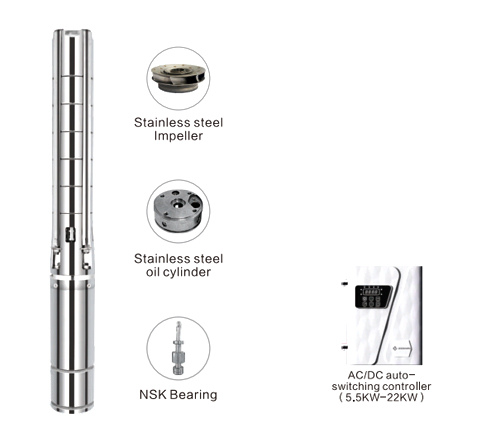
8ADSC Stainless Steel Cylinder AC/DC Hybrid Solar Deep Well Pump
The 8ADSC Stainless Steel Cylinder AC/DC Hybrid Solar Deep Well Pump is a submersible pump designed to operate in deep-well and water-supply environments. Its motor and hydraulic assembly are installed below the water level, allowing the pump to push water upward through the discharge pipeline. This configuration is suitable for wells and other water sources where surface suction equipment would be less effective or where the required lifting distance is substantial.
The product uses a stainless steel cylinder to protect the pump structure in challenging water conditions. Stainless steel is valued for its resistance to corrosion, mechanical durability, and ability to withstand long-term exposure to moisture. These characteristics are important for submersible equipment because the pump body remains in contact with water for extended periods. The stainless steel construction can also support a cleaner appearance and a longer service life when the pump is correctly selected, installed, and maintained.
The pump is described as using a high-efficiency brushless motor. Brushless motor technology eliminates the mechanical brushes and commutators found in traditional brushed motors. As a result, there are fewer wear components inside the motor, which can help reduce maintenance requirements and improve operational stability. A brushless design is particularly beneficial in remote installations where service access may be difficult and downtime may have a direct impact on crop production or water availability.
The hydraulic system is designed to deliver strong water movement for high-volume applications. The listed maximum flow of 150 cubic meters per hour indicates that the pump can support substantial water-transfer requirements when operating at suitable system conditions. Actual flow will depend on well characteristics, pipe diameter, vertical lift, friction loss, water level, power availability, and the complete operating point of the pump.
Two principal configurations are listed. Model 8ADSC150-37-380/520-11000 has a rated power of 11,000 watts and a maximum head of 37 meters. Model 8ADSC150-77-380/520-22000 has a rated power of 22,000 watts and a maximum head of 77 meters. Both versions are listed with a 5-inch outlet and a two-meter cable.
| Specification | 8ADSC150-37-380/520-11000 | 8ADSC150-77-380/520-22000 |
| Product type | AC/DC hybrid submersible solar pump | AC/DC hybrid submersible solar pump |
| Voltage | AC380/DC520V | AC380/DC520V |
| Optimum DC input voltage | 520V–650V | 520V–650V |
| Rated power | 11,000W | 22,000W |
| Maximum flow | 150m³/h | 150m³/h |
| Maximum head | 37m | 77m |
| Outlet size | 5 inches | 5 inches |
| Cable length | 2m | 2m |
| Solar panel open-circuit voltage | Less than 780V | Less than 780V |
| Recommended solar-panel power | At least 1.3 times pump power | At least 1.3 times pump power |
The voltage information should be considered carefully during system design. The AC voltage is listed as 380V, while the DC designation is 520V. The optimum DC input range is stated as 520V to 650V, and the solar panel open-circuit voltage must remain below 780V. These values mean that the solar array, control equipment, wiring, protective devices, and pump must be matched by qualified technical personnel. The open-circuit voltage is not the same as the operating voltage under load, so both conditions must be evaluated during design.
The recommended solar-panel power is at least 1.3 times the pump power. Based on the listed rating, the 11,000-watt model requires a solar array of at least approximately 14,300 watts under the stated guideline, while the 22,000-watt model requires at least approximately 28,600 watts. Actual array sizing may need to be increased depending on local solar conditions, temperature, system losses, seasonal performance, and the required daily volume of water.
The stainless steel cylinder is one of the most important physical features of the 8ADSC pump. Submersible pumps operate in environments where water, sediment, dissolved minerals, and changing temperatures can place stress on the equipment. A corrosion-resistant metal housing helps protect the internal motor and hydraulic components from the surrounding conditions.
Compared with ordinary painted steel, stainless steel provides a more durable barrier against corrosion and surface deterioration. Coatings can be damaged during transport, installation, or operation, exposing the underlying metal. Stainless steel does not depend solely on a surface coating for its basic corrosion resistance. This makes it a strong choice for agricultural wells, rural water systems, and other applications where long-term contact with water is unavoidable.
The material also contributes to mechanical strength. During installation, the pump may be lowered into a well, connected to a discharge pipe, and exposed to vibration caused by starting, stopping, or changing hydraulic conditions. A robust cylinder helps the pump withstand these physical demands when the installation follows the recommended procedures.
Material selection should always be considered together with water chemistry. Stainless steel improves resistance to many common corrosive conditions, but no material is immune to every chemical environment. Users should evaluate salinity, acidity, dissolved minerals, temperature, sand concentration, and other characteristics before final selection. Proper water analysis can help confirm whether the pump materials are suitable for the intended well.
The motor is the driving force behind the pump, and its efficiency influences both water output and energy consumption. The 8ADSC series uses a brushless motor concept intended to provide stable operation with reduced mechanical wear. Without brushes rubbing against a commutator, the motor has fewer components that require routine replacement.
Reduced wear is particularly valuable in deep-well installations. Removing a submersible pump from a well can require lifting equipment, skilled labor, and significant downtime. A motor that minimizes routine wear can help reduce the frequency of such interventions. Although all pumps require inspection and correct operation, brushless construction can support a lower-maintenance operating strategy.
Motor efficiency also has a direct relationship with solar-system economics. Solar panels, mounting structures, cables, controllers, and protection equipment represent a substantial investment. When the motor converts electrical input into useful hydraulic output efficiently, the available solar energy can be used more effectively. This may help reduce the required size of the solar array for a defined operating target, although final sizing must always account for local conditions and the pump curve.
A high-efficiency motor can also reduce heat generation. Lower electrical losses may contribute to more stable operation and can be beneficial when the pump is operating for long periods. In agricultural and commercial applications, extended daily run times are common, so stable thermal behavior is an important consideration.
Users should distinguish between a pump’s rated power and its actual operating power. The listed 11,000-watt and 22,000-watt ratings describe the product configurations, but the electrical demand may vary with operating conditions. Water level, head, flow, voltage, pipe resistance, and control strategy all influence power consumption. Proper commissioning should verify that the pump operates within its intended electrical and hydraulic range.
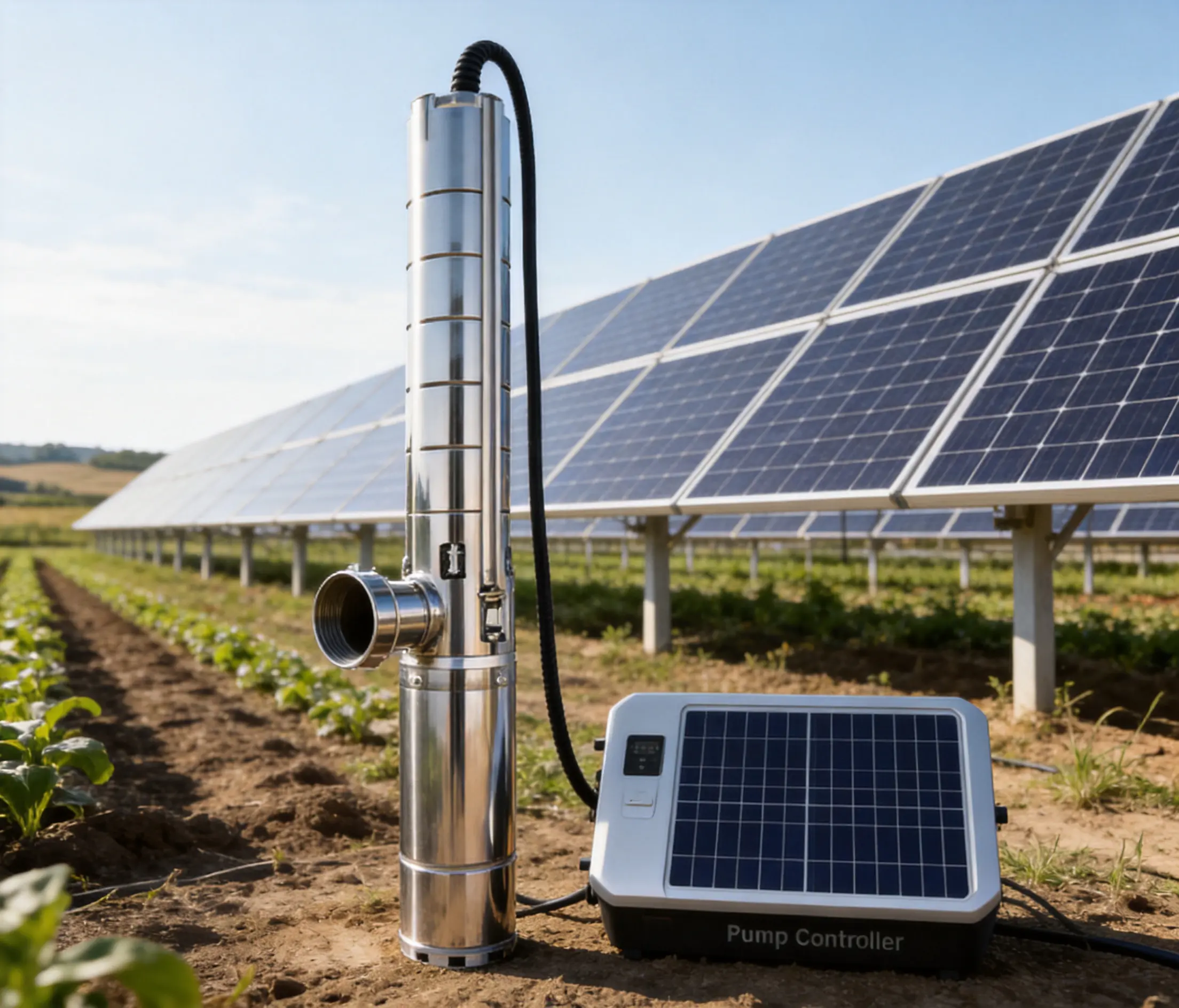
Deep-well pumping requires more than simply placing a motor in water. The pump must be capable of transferring water through a vertical lift and a discharge system while overcoming friction losses. The 8ADSC series is designed for this type of duty, offering a submersible configuration and model options for different head requirements.
The 11,000-watt model has a listed maximum head of 37 meters, making it suitable for installations requiring high-volume transfer over a moderate lifting distance. The 22,000-watt model has a listed maximum head of 77 meters, providing a greater lifting capability for deeper or more demanding systems. These values should be treated as maximum reference points rather than guaranteed flow at every head. At maximum head, the actual flow may be lower than the maximum flow rating.
Hydraulic selection should be based on the total dynamic head. This includes the vertical distance from the pumping water level to the discharge point, pressure requirements at the destination, and friction loss through pipes, valves, elbows, filters, and other components. For example, a system delivering water to an elevated tank must account for the tank elevation and all pipeline losses. A system irrigating through sprinklers must also include the pressure needed by the irrigation equipment.
The 5-inch outlet is intended for large-volume water movement. A correctly sized discharge pipe can help limit friction losses and support efficient operation. Reducing the pipe diameter too much may increase resistance and reduce the flow available at the final delivery point. A qualified installer should consider pipe material, length, elevation, fittings, filtration, valves, and expected flow when designing the complete system.
Well conditions are equally important. The well must provide sufficient water yield to prevent excessive drawdown, and the pump should remain adequately submerged during operation. A pump that is too large for the well may lower the water level faster than the well can recover. Therefore, pump selection must be based not only on the desired flow but also on the sustainable yield and recovery characteristics of the water source.
The most obvious advantage of the 8ADSC system is its ability to use solar energy. Solar power can reduce dependence on grid electricity and diesel fuel, especially in regions with strong solar resources. For agricultural users, the pump can operate during daylight hours when irrigation is often convenient and when solar energy is available directly.
Solar operation can also reduce exposure to fluctuating energy prices. Once the photovoltaic system is installed, the energy source does not require fuel deliveries. This can be particularly important for remote farms, construction sites, rural communities, and water projects where transporting diesel or extending the electrical grid would be expensive.
Unlike a solar-only pump, the AC/DC hybrid design offers an additional power option. This can improve continuity during cloudy weather, seasonal changes, or temporary reductions in solar output. It also allows users to design a system around their available infrastructure, which may include grid power, a generator, or another AC source.
Hybrid capability can reduce the need to oversize the solar array solely for rare low-sunlight conditions. Instead, the user may combine a properly sized solar array with AC backup. The best balance depends on the site’s water demand, energy prices, available grid capacity, and the consequences of interrupted pumping.
The brushless motor and stainless steel body support a lower-maintenance approach than some conventional designs. Fewer motor wear components can reduce the need for routine replacement, while the stainless steel cylinder helps resist corrosion. These features are valuable where service access is limited or where the cost of pump removal is high.
With a listed maximum flow of 150 cubic meters per hour, the 8ADSC series is designed for substantial water movement. This capacity can help shorten irrigation filling times, improve storage-tank replenishment, and support large agricultural or commercial water requirements. High flow should always be evaluated against the available well yield and system head, but the rating demonstrates the product’s focus on high-capacity pumping.
Solar operation can reduce the emissions associated with diesel-powered pumping and lower the consumption of grid electricity generated from fossil fuels. The environmental benefit depends on the electricity mix, system life, maintenance, and recycling practices, but renewable operation provides a practical path toward cleaner water infrastructure.
Agricultural irrigation is one of the primary applications for the 8ADSC pump. Farms, orchards, greenhouses, and plantations often require large quantities of water delivered over a defined schedule. A solar pumping system can draw water from a deep well and transfer it to irrigation networks, reservoirs, elevated tanks, or field distribution points.
For orchards, reliable pumping helps support trees during dry periods, especially when water must be distributed over a broad area. For greenhouse production, stable water supply is important for drip irrigation, fertigation, and climate-controlled growing conditions. In open-field agriculture, the pump can support sprinklers, drip systems, or storage-based irrigation depending on the hydraulic design.
The AC/DC hybrid function is useful for farms that cannot afford long interruptions. Solar energy may provide the main daytime power source, while AC power can be used during periods of reduced solar production. This allows the farm to maintain a more predictable irrigation schedule without abandoning the cost-saving benefits of solar energy.
When using the pump for irrigation, operators should account for filtration and water quality. Well water may contain sand or suspended particles that can affect valves, emitters, sprinklers, and downstream equipment. A suitable filtration system may be needed, and the pump should be protected from excessive abrasive solids. The pump’s operating conditions should be confirmed before use in wells with high sand content.
Livestock farms require dependable water for drinking, cleaning, cooling, and general facility operation. A failure in the water system can quickly affect animal health and production. The 8ADSC pump can support water transfer from deep wells to storage tanks, pressure systems, troughs, or distribution networks.
Remote livestock facilities can benefit from solar operation because extending grid power to isolated pasture or farm locations may be costly. A solar array and submersible pump can provide a practical water source, while the AC input creates a backup option where a generator or electrical connection is available.
For poultry operations, water demand may vary by flock size, climate, and production stage. A high-capacity pump can replenish storage tanks or supply a larger distribution system. However, the downstream pressure and flow should be regulated to match the drinking equipment. A pump should not be selected solely according to its maximum flow; the complete water-delivery system must be designed to provide stable pressure without unnecessary energy consumption.
Water quality is also critical in animal applications. The well should be tested for minerals, bacteria, salinity, and other factors that could affect animal health or equipment life. The stainless steel pump body can support durability, but water treatment and sanitation remain important responsibilities for the system operator.
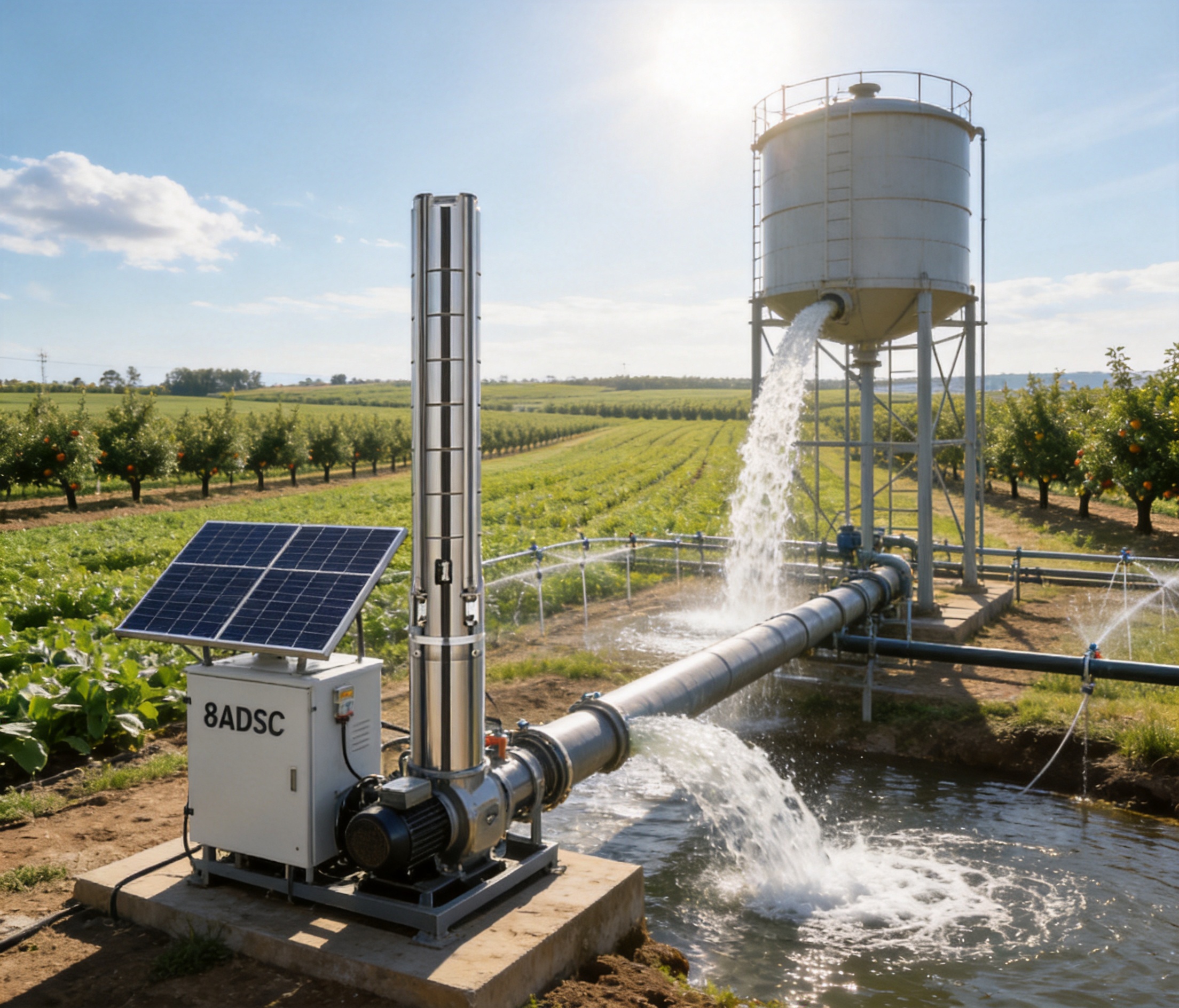
Many rural communities depend on wells for household water, sanitation, small-scale farming, and public facilities. In areas where grid electricity is unreliable or unavailable, solar pumping can improve access to water without requiring continuous fuel delivery. The 8ADSC pump can be used to transfer groundwater into elevated storage tanks, from which water can be distributed by gravity or a secondary pressure system.
Storage is an important part of an off-grid design. Instead of requiring the pump to run continuously whenever water is needed, solar energy can be used during the day to fill a tank. The stored water can then serve users during the evening or during short periods of cloud cover. The hybrid AC input provides additional flexibility for periods when the storage level is low and solar energy is insufficient.
For community systems, pump sizing should consider population, daily consumption, seasonal demand, fire protection requirements, livestock use, and future expansion. A high-capacity pump may fill a reservoir quickly, but the well yield and storage volume must be coordinated to prevent over-pumping. The pump should be integrated with appropriate level sensors, electrical protection, non-return valves, isolation valves, and control equipment.
In household or small-scale systems, the 8ADSC models may be larger than necessary unless the property has high water demand or a significant lifting requirement. Product selection should always be based on the actual flow and head required. The listed models are particularly suited to commercial, agricultural, municipal, and large rural applications.
The pump can also support filling and replenishing storage tanks. Storage tanks help balance water demand and solar availability. During sunny hours, the pump can transfer water from the well to the tank. A float switch or level-control system can stop the pump when the tank is full and restart it when the level falls.
Tank-based systems can be configured for irrigation, livestock, process water, emergency reserves, or general rural supply. The tank capacity should reflect daily demand, expected solar production, well recovery, and the desired backup period. Oversized storage may increase cost, while insufficient storage can reduce the value of the solar system during cloudy periods.
Water features and large decorative installations may also use a submersible pump, although such applications require careful hydraulic design. The pump must be operated within the appropriate flow and head range, and the water should be properly filtered if the system is recirculating. The pump’s high capacity means that it may require throttling or a bypass arrangement in applications that need lower flow.
Taizhou Edwin Electric Co., Ltd. operates as an integrated manufacturing enterprise with activities covering independent research and development, mass production, and global export. This structure is important for customers purchasing industrial pumps because product performance depends not only on the design but also on repeatable manufacturing, quality control, component coordination, and after-sales support.
The company was founded in 2008 and has developed a portfolio that includes deep-well pumps, submersible pumps, domestic booster pumps, circulation pumps, solar water pumps, and intelligent booster pumps. A broad product range gives the manufacturer experience across different hydraulic applications, motor types, control requirements, and installation environments.
Advanced manufacturing begins with product engineering. Before a pump reaches production, engineers must consider hydraulic geometry, motor performance, materials, sealing, cable configuration, electrical compatibility, vibration, thermal behavior, and installation requirements. For an AC/DC hybrid product, the design process must also consider the relationship between solar-array voltage, AC input, controller behavior, and motor operation.
Mass production provides an opportunity to standardize processes and improve consistency. Repeated manufacturing operations can be supported by defined work instructions, component inspection, assembly controls, electrical testing, and performance verification. Standardization helps reduce variation between units and supports more predictable product quality for international customers.
Material control is especially important for a stainless steel submersible pump. The cylinder, fasteners, shafts, seals, cable connections, and internal hydraulic components must be compatible with the intended operating environment. Correct material selection and careful assembly help reduce the risk of premature corrosion, leakage, or mechanical failure.
Quality assurance should also cover motor winding, insulation, electrical safety, rotation, vibration, noise, current draw, and hydraulic output. Each of these factors can influence field performance. A pump that meets its electrical rating but fails to deliver the required hydraulic output is not a successful product, so electrical and hydraulic verification should be considered together.
Since 2018, Edwin Pump has invested in new energy and intelligent technology. This direction is relevant to the 8ADSC product because solar pumping requires more than a conventional motor. It requires an understanding of variable energy input, voltage management, operating-point changes, system protection, and the practical needs of remote users.
Research and development in solar pumping can focus on improving motor efficiency, adapting pump operation to changing solar conditions, protecting the motor from abnormal voltage, and coordinating the pump with solar controllers. These improvements can help the system use available energy more effectively while reducing the risk of unstable operation.
Intelligent pump technology can also support more convenient operation. Depending on the complete system configuration, intelligent controls may be used for automatic start and stop, tank-level management, dry-run protection, fault monitoring, and energy optimization. The precise control functions available will depend on the selected controller and installation design, so customers should confirm the required features before ordering.
The combination of manufacturing experience and new-energy development allows the company to address both traditional water-pumping requirements and modern renewable-energy applications. This is an important advantage over manufacturers that focus only on conventional AC pumps or only on small solar products.
International pump projects often involve more than the purchase of a single product. Buyers may need assistance with model selection, technical documentation, packaging, order tracking, delivery coordination, and communication between the factory and the installation team. Edwin Pump has established related import and export companies to support procurement planning, order management, cross-border delivery, and foreign-trade services.
The company established Taizhou Haipai Import & Export Co., Ltd. and Golden Falcon Industrial Co., Ltd. in 2012. These organizations help create a broader service structure for customers seeking one-stop procurement. For overseas buyers, this can simplify communication and reduce the number of separate parties involved in a project.
A coordinated supplier can be particularly valuable for agricultural and municipal projects. Such projects may include pumps, pipes, valves, control equipment, accessories, and related water-treatment products. A manufacturer with a wider product portfolio can help customers evaluate the complete system rather than selecting a pump in isolation.
However, every project should still include technical confirmation. Buyers should provide information about water source, water quality, well depth, static and dynamic water levels, desired flow, total head, pipe length, power availability, solar conditions, and operating schedule. The more complete the project data, the more accurately the supplier can recommend a suitable model and system configuration.
Correct installation is essential for obtaining reliable performance from the 8ADSC pump. Before installation, the well should be inspected to confirm its diameter, depth, water level, yield, casing condition, and cleanliness. The pump should fit safely within the well while maintaining adequate clearance for installation and operation.
The discharge pipe must be selected to handle the expected flow and pressure. Because the outlet is listed as 5 inches, the connected piping should be designed to avoid unnecessary restrictions. Pipe supports should prevent excessive loading on the pump discharge connection, and the system should include appropriate check valves and isolation valves.
The cable must be protected from abrasion, sharp edges, excessive tension, and chemical exposure. Electrical connections should be sealed and installed by qualified personnel. The solar array and AC supply must include suitable overcurrent protection, disconnects, grounding, surge protection, and control equipment according to applicable electrical standards.
The pump should never be operated dry. Dry running can cause overheating, seal damage, or premature wear. Water-level sensors, current monitoring, or controller-based dry-run protection can help reduce this risk. A low-water cutoff is especially important in wells with variable yield or significant seasonal changes.
Before normal operation, the installer should verify the direction of rotation where applicable, measure voltage and current, check for abnormal vibration, inspect the discharge flow, and confirm that the system reaches the intended storage tank or irrigation point. Initial commissioning records can provide a useful reference for future maintenance.
The solar array must be designed around the specified DC input range. The listed optimum input voltage is 520V to 650V, while the solar panel open-circuit voltage must remain below 780V. The array configuration should be calculated using the voltage characteristics of the selected modules at the lowest and highest expected temperatures.
Solar panels generally produce a higher open-circuit voltage in cold conditions and a lower operating voltage in hot conditions. Therefore, an array that appears suitable under standard test conditions may exceed the permitted voltage on a cold morning or fall below the preferred operating range during high temperatures. Professional electrical design is recommended to evaluate these variations.
The solar-panel power guideline of at least 1.3 times the pump power provides a starting point for array sizing. The 11,000-watt model therefore corresponds to a recommended minimum array of approximately 14.3 kilowatts, while the 22,000-watt model corresponds to approximately 28.6 kilowatts. These figures do not replace a complete energy assessment. Additional capacity may be required where the system must operate during winter, rainy seasons, high temperatures, or limited sunlight.
The AC input should be connected only to a compatible supply. The product information lists AC380/DC520V, so the buyer must confirm phase arrangement, frequency, grounding, controller compatibility, and protection requirements before installation. AC and DC sources should never be connected in a way that bypasses the intended control architecture.
Electrical design should also account for voltage drop. Long cable runs between the solar array, controller, and pump can reduce available voltage and increase losses. Correct cable sizing, careful routing, secure terminals, and suitable enclosures help maintain stable operation. The control system should be installed where it is protected from rain, dust, flooding, and excessive heat.
Although the 8ADSC pump is designed for low-maintenance operation, regular system inspection remains important. Operators should monitor flow, pressure, current, voltage, water quality, well level, and unusual noise or vibration. A gradual reduction in flow may indicate a change in water level, pipe blockage, filter contamination, valve problems, wear, or a change in the electrical supply.
The solar array should be kept reasonably clean and free from shading. Dust, bird deposits, leaves, and nearby vegetation can reduce solar output. The mounting structure and cable connections should be inspected periodically, especially after storms or severe weather. Damaged cables or loose connections should be repaired by qualified personnel.
The well should be monitored for sand and sediment. Excessive sand can damage hydraulic components and reduce service life. If the water source changes over time, operators should evaluate whether additional filtration, a revised pump position, or a different operating schedule is necessary.
Storage tanks, valves, non-return devices, and irrigation equipment should also be checked. A pump may appear to have reduced performance when the actual problem is a blocked filter, a closed valve, an air leak, or a damaged pipe. Systematic troubleshooting can prevent unnecessary removal of the submersible unit.
Maintenance records should include installation date, operating readings, repairs, water-level measurements, and changes in system configuration. These records help identify trends and support timely corrective action. In commercial and agricultural applications, preventative maintenance is usually less expensive than an emergency shutdown during a critical irrigation or production period.
The choice between the 11,000-watt and 22,000-watt configurations should be based on total dynamic head, required flow, well yield, energy availability, and operating schedule. The 11,000-watt model provides a maximum head of 37 meters, while the 22,000-watt model provides a maximum head of 77 meters. If the system requires greater elevation or pressure, the higher-head model may be more appropriate.
Flow requirements must be considered together with head. A project requiring 150 cubic meters per hour at a low head may have different needs from a project requiring a smaller flow at a high head. The pump curve and project duty point should be reviewed before purchase. Maximum flow and maximum head are not normally achieved simultaneously.
Well yield is another decisive factor. The pump should not extract water faster than the well can sustainably provide. If the well yield is limited, a smaller pump, a control strategy, or a storage-based operating schedule may be more suitable even when the end user wants a high instantaneous flow.
The available energy source also influences model selection. A larger pump requires a larger solar array, higher electrical capacity, suitable cable sizing, and potentially stronger control equipment. Buyers should evaluate the total project cost rather than comparing pump prices alone.
High-voltage AC and DC systems can be hazardous. The listed voltage levels require professional installation, correct isolation procedures, grounding, protective devices, and compliance with applicable electrical regulations. Only qualified personnel should install, inspect, or service the electrical system.
The pump should be disconnected from all energy sources before maintenance. Solar panels can continue producing voltage in daylight even when AC power has been switched off. Proper lockout and verification procedures are necessary before opening electrical equipment or handling cables.
Mechanical safety is also important. The pump, cable, and discharge pipe should be supported correctly during installation. Personnel should not stand beneath suspended equipment, and lifting tools must be rated for the complete assembly weight. The well opening should be protected to prevent people, tools, or debris from falling into it.
Safe operation also includes water hygiene. If the pump supplies drinking water, the complete system must use appropriate materials and treatment procedures. The product should be evaluated for the intended water-contact application, and local regulations should be followed.
The 8ADSC is an AC/DC hybrid submersible solar pump designed for deep-well and high-capacity water-supply applications. It can operate with solar DC power and conventional AC electricity when connected to a compatible control and power system.
The listed maximum flow is 150 cubic meters per hour for both configurations. Actual flow depends on head, pipe resistance, water level, voltage, system design, and the selected operating point.
The 8ADSC150-37-380/520-11000 model is rated at 11,000 watts and has a maximum head of 37 meters. The 8ADSC150-77-380/520-22000 model is rated at 22,000 watts and has a maximum head of 77 meters. Both are listed with a 5-inch outlet and a maximum flow of 150 cubic meters per hour.
The product is designed for hybrid operation and can use compatible AC electricity as well as solar DC power. The AC supply, voltage, control equipment, and installation arrangement must be confirmed before operation.
The listed guideline is at least 1.3 times the pump power. This corresponds to approximately 14.3 kilowatts of solar-panel power for the 11,000-watt model and approximately 28.6 kilowatts for the 22,000-watt model. Final sizing should consider local solar conditions, seasonal demand, system losses, and required operating hours.
The optimum DC input voltage is listed as 520V to 650V, and the solar-panel open-circuit voltage should remain below 780V. A qualified designer should calculate the array configuration under both hot and cold temperature conditions.
Stainless steel provides corrosion resistance and mechanical durability in wet environments. It can help protect the pump body during long-term submersible operation, although water chemistry and abrasive solids should still be evaluated before installation.
The 8ADSC models are primarily intended for large agricultural, commercial, rural, municipal, and off-grid applications. Their high power and high flow may be excessive for a small household. A smaller pump should be considered when domestic demand is limited.
Yes. Typical applications include irrigation for farms, orchards, greenhouses, and plantations. The irrigation system must be designed around the pump’s actual duty point, the well’s sustainable yield, required pressure, filtration needs, and pipe network.
Useful information includes well depth, well diameter, static and dynamic water levels, desired flow, total head, pipe length and diameter, water quality, daily operating hours, solar conditions, available AC power, and the required delivery location. These details help determine the appropriate model and system configuration.
The 8ADSC Stainless Steel Cylinder AC/DC Hybrid Solar Deep Well Pump combines high-capacity submersible pumping with flexible energy operation. Its ability to use both solar DC power and conventional AC electricity provides a practical advantage over single-input systems. Solar operation can reduce energy costs and support cleaner water infrastructure, while AC compatibility helps maintain continuity when sunlight is insufficient.
The stainless steel cylinder is suited to demanding wet environments, and the brushless high-efficiency motor is designed to reduce mechanical wear and maintenance requirements. With models rated at 11,000 watts and 22,000 watts, a maximum flow of 150 cubic meters per hour, and maximum heads of 37 and 77 meters, the series is positioned for agricultural irrigation, livestock water supply, rural water projects, storage tanks, and commercial off-grid applications.
Its performance depends on correct system design. Solar-array voltage, open-circuit voltage, array power, AC compatibility, total dynamic head, pipe sizing, well yield, water chemistry, and safety equipment must all be evaluated before installation. When properly matched and installed, the pump can provide an efficient and durable solution for large-volume water transfer.
Taizhou Edwin Electric Co., Ltd. strengthens the product offering through integrated research and development, mass production, export experience, and a broad portfolio of water-pumping products. Its investment in solar and intelligent pump technology, combined with procurement and international service capabilities, supports customers seeking a complete and dependable pumping solution rather than a standalone component.
For farms, remote communities, livestock operations, and commercial water projects that need both renewable-energy savings and dependable backup power, the 8ADSC hybrid solar deep well pump represents a flexible and technically capable option.
1. Product technical information for the 8ADSC Stainless Steel Cylinder AC/DC Hybrid Solar Deep Well Pump, including model ratings, voltage requirements, flow, head, outlet size, cable length, and solar-array recommendations.
2. Manufacturer company information concerning research and development, mass production, product categories, export services, and intelligent solar-pumping technology.
3. General principles of centrifugal and submersible pump selection, including total dynamic head, flow-rate evaluation, pipe friction, and duty-point analysis.
4. General photovoltaic system-design principles concerning open-circuit voltage, operating voltage, temperature variation, array sizing, cable losses, and electrical protection.
5. General engineering guidance for stainless steel material selection in submerged, humid, and water-contact applications.
6. General agricultural irrigation and rural water-supply planning practices concerning well yield, water storage, filtration, level control, and preventative maintenance.
edwina@edwin-pump.com
+86-13586290903 (WhatsApp)
Xuri Gongliang Cutting Tool Entrepreneurship Park, Wenqiao Town, Wenling City, Taizhou City, Zhejiang Province, China

High Performance Smart Pump Factory


 English
