edwina@edwin-pump.com

View All Products
en
Reliable dissolved oxygen management is one of the most important requirements in fish farming, shrimp farming, and ecological aquaculture. Oxygen levels influence animal health, feed conversion, growth rate, water quality, and the overall stability of a pond ecosystem. When oxygen concentration falls too low, aquatic organisms become stressed, biological filtration becomes less effective, and the risk of disease or sudden mortality increases. For this reason, aquaculture operators need aeration equipment that can operate efficiently, circulate water effectively, and remain dependable under demanding outdoor conditions.
The ESIA Series Brushless DC Motor Solar Impeller Aerator is designed for this purpose. It combines a high-speed impeller, brushless DC motor technology, and a solar power supply system to create an efficient aeration solution for fish ponds, shrimp ponds, and ecological aquaculture farms. Rather than depending entirely on grid electricity or fossil-fuel generators, the system is designed to use renewable solar energy for long-term pond operation.
Its impeller-type operating principle allows the aerator to push water upward and generate bubbles at the surface. At the same time, the movement of water promotes circulation between upper and lower pond layers. This makes the system suitable for applications where water circulation and deeper-water oxygen distribution are as important as surface agitation.
The product range includes three power configurations: ESIA-48-750, ESIA-72-1100, and ESIA-110-1500. These models provide power outputs from 750 W to 1,500 W, oxygenation rates from at least 1.1 kg/h to at least 2.3 kg/h, and recommended coverage areas from 666 square meters to 4,000 square meters, depending on the model and operating conditions.
Dissolved oxygen is the amount of oxygen available in water for fish, shrimp, microorganisms, and other aquatic organisms. It is not the same as the oxygen found in the atmosphere. Although water is in contact with air, oxygen enters water relatively slowly unless circulation, turbulence, or mechanical aeration increases the transfer rate.
In a managed pond, oxygen is consumed continuously. Fish and shrimp use oxygen for respiration, while bacteria consume oxygen as they break down organic matter, uneaten feed, and animal waste. Aquatic plants and algae may produce oxygen during daylight, but they also consume oxygen at night. As a result, oxygen levels can change significantly between afternoon and early morning.
Warm water generally holds less dissolved oxygen than cold water. High stocking densities, heavy feeding, cloudy weather, algal die-off, and accumulated organic matter can further increase oxygen demand. Without effective aeration, the lower water layers may become oxygen-deficient, especially in deep ponds or ponds with limited natural movement.
A mechanical aerator helps address these risks in two ways. First, it increases contact between water and air, allowing more oxygen to enter the water. Second, it moves water through the pond, reducing stratification and helping distribute oxygen throughout a larger volume. The ESIA Series is designed around both functions rather than focusing only on surface disturbance.
The ESIA Series uses a brushless DC motor to drive an impeller at high speed. The rotating impeller moves water upward and creates bubbles and surface turbulence. This action increases the water-air contact area, which supports oxygen transfer into the pond.
The impeller also produces a vertical circulation effect. Water from lower levels is drawn into movement and transported upward, while oxygen-rich surface water can move toward deeper areas. This circulation helps reduce differences in temperature, oxygen concentration, and water quality between the upper and lower layers of the pond.
Compared with an aeration device that only agitates the immediate surface, an impeller aerator can provide a broader circulation effect. This characteristic is particularly valuable in deep water, where oxygen depletion may occur below the surface and where surface-only agitation may not sufficiently influence the lower layers.
The brushless motor is an important part of the design. Unlike a conventional brushed motor, a brushless motor does not use mechanical carbon brushes that continuously contact a commutator. The elimination of these wear components can reduce maintenance requirements, improve operating life, and support more efficient electrical performance.
The motor is powered by a direct-current solar power system. The performance data specifies the recommended best input voltage range for each model, as well as the maximum open-circuit voltage of the connected solar panel system. Correct matching of the solar array and aerator is essential for stable operation and for protecting the electrical components.
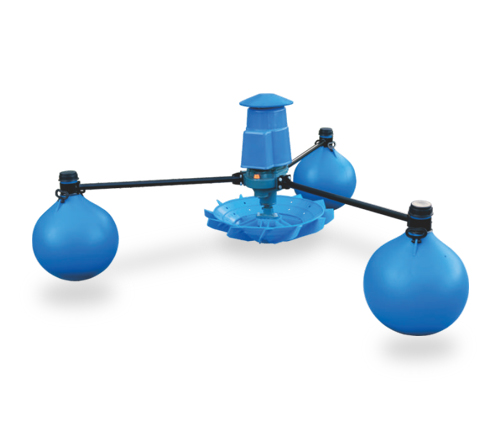
ESIA Series Brushless DC Motor Solar Impeller Aerator
One of the most significant advantages of the ESIA Series is its ability to operate with a solar power supply. Aquaculture ponds are often located in rural areas, agricultural zones, or remote regions where grid access is limited, expensive, or unreliable. A solar-powered aerator can reduce dependence on utility electricity and eliminate the need to transport fuel for routine operation.
Solar energy is especially appropriate for daytime aeration because sunlight is available during the same period when solar panels produce electricity. During sunny weather, the aerator can operate without direct fuel consumption. This can help reduce daily operating costs and make aeration more practical for farms with large or geographically dispersed pond areas.
Solar operation also supports environmental objectives. The system does not require direct combustion at the pond site, and it can be incorporated into a broader renewable-energy strategy. For farms seeking to reduce their carbon footprint or improve the sustainability of their production model, solar aeration is a practical equipment choice.
The brushless DC motor is designed to reduce energy losses associated with traditional brushed motor construction. Because the motor uses electronic commutation rather than mechanical brushes, it can operate with fewer friction-related wear points. This design can also provide more consistent performance over an extended operating period.
Lower mechanical wear is valuable in aquaculture, where equipment may be exposed to humidity, splash water, mud, floating debris, and long operating cycles. Reduced brush replacement requirements can simplify maintenance planning and reduce interruptions during important production periods.
When combined with a properly sized solar array, a brushless DC motor can make better use of available solar power. This is particularly important in applications where sunlight intensity changes throughout the day. Efficient electrical conversion helps the system continue operating more effectively across a wider range of solar conditions.
Impeller aerators are suitable for applications that require more than simple surface splashing. The ESIA Series drives water upward at high speed, creating turbulence and bubbles while also supporting vertical movement within the pond. This makes it suitable for deeper water and larger pond environments.
The circulation effect can help prevent stagnant zones. In a poorly mixed pond, the surface may appear healthy while the lower layers contain insufficient oxygen or excessive organic material. Bringing lower water upward exposes it to the atmosphere and allows the aerator to influence water quality beyond the immediate operating point.
Water circulation can also help distribute temperature more evenly. Large temperature differences between upper and lower layers may contribute to stratification and sudden mixing events. Regular mechanical circulation can reduce these differences and provide a more stable environment for aquatic organisms.
Traditional electric aerators may require long power cables, electrical distribution equipment, or a nearby utility connection. These requirements can increase installation cost, particularly when ponds are located far from buildings or public infrastructure. A solar aerator can be installed as part of a local power system near the pond.
This flexibility is useful for new aquaculture projects, farm expansion, and remote ponds. It may also reduce the operational impact of power interruptions. While actual performance depends on sunlight and system design, a properly planned solar installation can provide a dependable source of daytime aeration without relying solely on the grid.
The ESIA Series is available in three configurations to accommodate different pond sizes and oxygenation requirements. Operators can select a model according to the required coverage area, pond layout, stocking density, and available solar resources.
| Model | Rated Voltage | Best Input Voltage | Power | Minimum Oxygenation Rate | Recommended Coverage Area | Solar Panel Open-Circuit Voltage | Recommended Solar Panel Power |
|---|---|---|---|---|---|---|---|
| ESIA-48-750 | 48 V | 60–90 V DC | 750 W | At least 1.1 kg/h | 666–2,000 m² | Below 120 V | At least 1.3 times pump power |
| ESIA-72-1100 | 72 V | 90–120 V DC | 1,100 W | At least 1.6 kg/h | 2,000–2,665 m² | Below 170 V | At least 1.3 times pump power |
| ESIA-110-1500 | 110 V | 110–150 V DC | 1,500 W | At least 2.3 kg/h | 2,000–4,000 m² | Below 220 V | At least 1.3 times pump power |
The coverage figures are reference ranges rather than universal guarantees. Actual results depend on pond depth, water temperature, stocking density, water quality, weather, solar radiation, impeller installation, and operating schedule. Nevertheless, the range of models gives farm operators a practical starting point for selecting equipment.
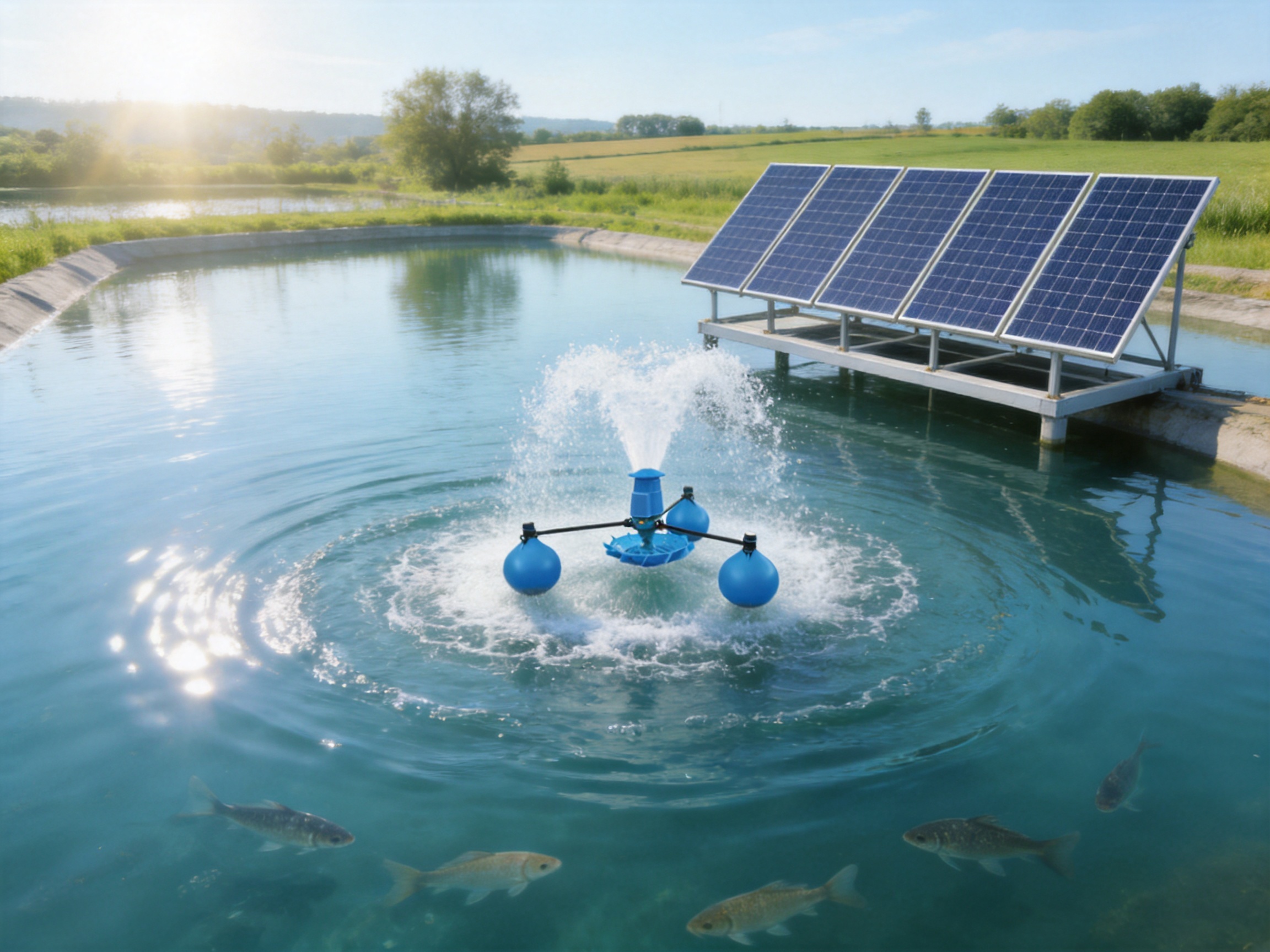
Paddle-wheel aerators are widely used in aquaculture and remain an effective option in many shallow pond applications. Their rotating paddles create surface splashing and are particularly common in shrimp farming. However, the operating characteristics of a paddle-wheel unit differ from those of an impeller-type aerator.
A paddle wheel primarily agitates water at the surface and pushes water horizontally. This produces strong local circulation, but the depth and direction of circulation may be influenced by pond shape, paddle arrangement, and installation position. In deeper ponds, surface movement may not provide the same vertical circulation effect as an impeller designed to move water upward.
An impeller aerator is designed to create upward water movement, bubbles, and vertical circulation. This can be advantageous where the pond has a greater depth or where the operator wants to influence the relationship between upper and lower water layers. The system is therefore not simply a replacement for every paddle-wheel application; it is an alternative technology with particular benefits for deeper-water aeration and circulation.
The brushless DC motor also provides a different maintenance profile. A conventional motor with brushes may require periodic inspection or replacement of worn components. The ESIA design reduces dependence on those wear parts, which can be useful for remote installations where maintenance access is limited.
Another difference is energy source. Many paddle-wheel systems are powered by grid electricity or internal-combustion engines. The ESIA Series is configured for solar DC input, helping operators reduce energy infrastructure requirements. The most suitable option depends on farm conditions, but solar impeller aeration can provide a strong combination of renewable power, vertical circulation, and reduced mechanical wear.
The ESIA-48-750 has a rated voltage of 48 V and a power rating of 750 W. Its best input voltage range is 60–90 V DC. The model provides an oxygenation rate of at least 1.1 kg/h and is listed for a coverage area of approximately 666–2,000 square meters.
This model can be considered for smaller ponds, separate pond compartments, nursery areas, or installations where the operator wants to distribute several moderate-capacity aerators across a larger site. Multiple units may provide more flexible circulation than a single large unit when a pond has irregular geometry or several oxygen-demand zones.
The solar panel system for this model should have an open-circuit voltage below 120 V, and the recommended solar power is at least 1.3 times the pump power. Since the aerator is rated at 750 W, a solar array of at least approximately 975 W is indicated by the stated sizing rule. System designers should also consider temperature effects, wiring losses, controller specifications, and local solar conditions.
The ESIA-72-1100 operates at a rated voltage of 72 V and has a power rating of 1,100 W. Its recommended best input voltage range is 90–120 V DC. With an oxygenation rate of at least 1.6 kg/h, it is intended for medium-sized coverage requirements of approximately 2,000–2,665 square meters.
This model provides a balance between capacity and installation flexibility. It may be suitable for a medium-sized aquaculture pond where one unit can support the main circulation zone, or for larger farms that use several units in a planned network. The 72 V configuration can also help designers select a solar array that matches the available space and desired operating voltage.
The solar array should have an open-circuit voltage below 170 V. Based on the 1.3-times sizing recommendation, the solar panel power should be at least approximately 1,430 W. This value is a minimum reference based on the published product data and should not replace a complete engineering review.
The ESIA-110-1500 is the highest-capacity model in the series. It has a rated voltage of 110 V, a power rating of 1,500 W, and a best input voltage range of 110–150 V DC. Its oxygenation rate is at least 2.3 kg/h, with a listed coverage area of approximately 2,000–4,000 square meters.
This model is intended for larger ponds and applications that require stronger aeration and circulation. It may be particularly appropriate for deep water, larger production areas, or situations where high biological oxygen demand requires a higher-capacity aeration unit.
The solar panel open-circuit voltage should remain below 220 V. Applying the stated solar sizing rule results in a recommended solar array capacity of at least approximately 1,950 W. The actual array may need to be larger depending on seasonal sunlight, operating hours, and the desired ability to maintain output during less favorable weather.
Proper solar system design is essential for the safe and effective operation of any direct-current aerator. The published voltage ranges should be treated as important selection limits. The best input voltage range indicates the range in which the product is intended to receive power for effective operation, while the open-circuit voltage limit helps prevent excessive voltage from reaching the equipment.
Solar panels do not produce a fixed voltage under all conditions. Voltage and current vary with sunlight intensity, panel temperature, wiring, and electrical load. The open-circuit voltage can be higher in certain conditions than the operating voltage measured under load. For this reason, the maximum specified open-circuit voltage must not be exceeded when panels are connected in series.
The solar array should be selected together with the appropriate controller, protection devices, cables, connectors, and mounting structure. Wiring should be sized to reduce voltage drop over the distance between the solar panels and the aerator. Outdoor electrical components should be suitable for sunlight, humidity, rain, and temperature changes.
The recommended solar panel power of at least 1.3 times pump power provides a useful design margin. Solar output is affected by clouds, dust, panel angle, shading, and seasonal changes. An array that is only equal to the motor rating may not consistently provide the desired power during less-than-ideal conditions. The additional capacity helps compensate for normal variations.
Battery storage is not specified in the product information, so it should not be assumed to be included. Operators who require nighttime aeration may need to design a separate battery-storage system or use another nighttime power source. The aerator can be integrated into a larger solar-plus-storage arrangement, but battery capacity, charging control, protection, and operating strategy must be evaluated separately.
Fish ponds require stable oxygen conditions, particularly when stocking density is high or feeding levels are intensive. The ESIA Series can provide both oxygen transfer and water movement in ponds used for freshwater fish production.
In a fish pond, the aerator may be positioned to encourage circulation along the longest practical flow path. This can help distribute oxygen-rich water and reduce isolated areas with limited movement. The ideal placement depends on pond geometry, depth, inlet and outlet locations, prevailing wind, and the location of feeding zones.
For larger ponds, several aerators can be arranged to create overlapping circulation patterns. A distributed arrangement may provide more uniform conditions than placing every unit in one location. Operators should avoid creating excessive turbulence in areas where young fish are present and should consider the swimming ability and behavior of the cultured species.
During hot weather or periods of increased feeding, oxygen demand may rise. Solar aeration can provide active daytime support when photosynthesis and water temperature changes affect pond conditions. Monitoring dissolved oxygen remains important, because aerator selection should be based on actual farm conditions rather than equipment capacity alone.
Shrimp ponds often have high organic loading because of feed, biological activity, and sediment accumulation. Maintaining adequate oxygen near the water surface and in lower areas is essential for shrimp health and pond stability.
The ESIA Series can support shrimp farming by generating bubbles and promoting circulation. The upward movement of water can help expose more water to the atmosphere, while circulation may reduce stagnant areas. In larger shrimp ponds, the operator may combine impeller aerators with other water-management equipment according to production requirements.
Installation must take into account shrimp behavior, pond depth, bottom conditions, and the distribution of sludge or organic matter. The aerator should be installed securely so that it remains stable under operating vibration and changing water levels. Cables and solar structures should be routed and protected to avoid damage from farm vehicles, livestock, weather, and routine maintenance work.
Because solar output changes during the day, shrimp farms may choose to use direct daytime operation, battery-assisted operation, or a hybrid power arrangement. The appropriate approach depends on local climate, required aeration hours, and the farm’s risk-management plan.
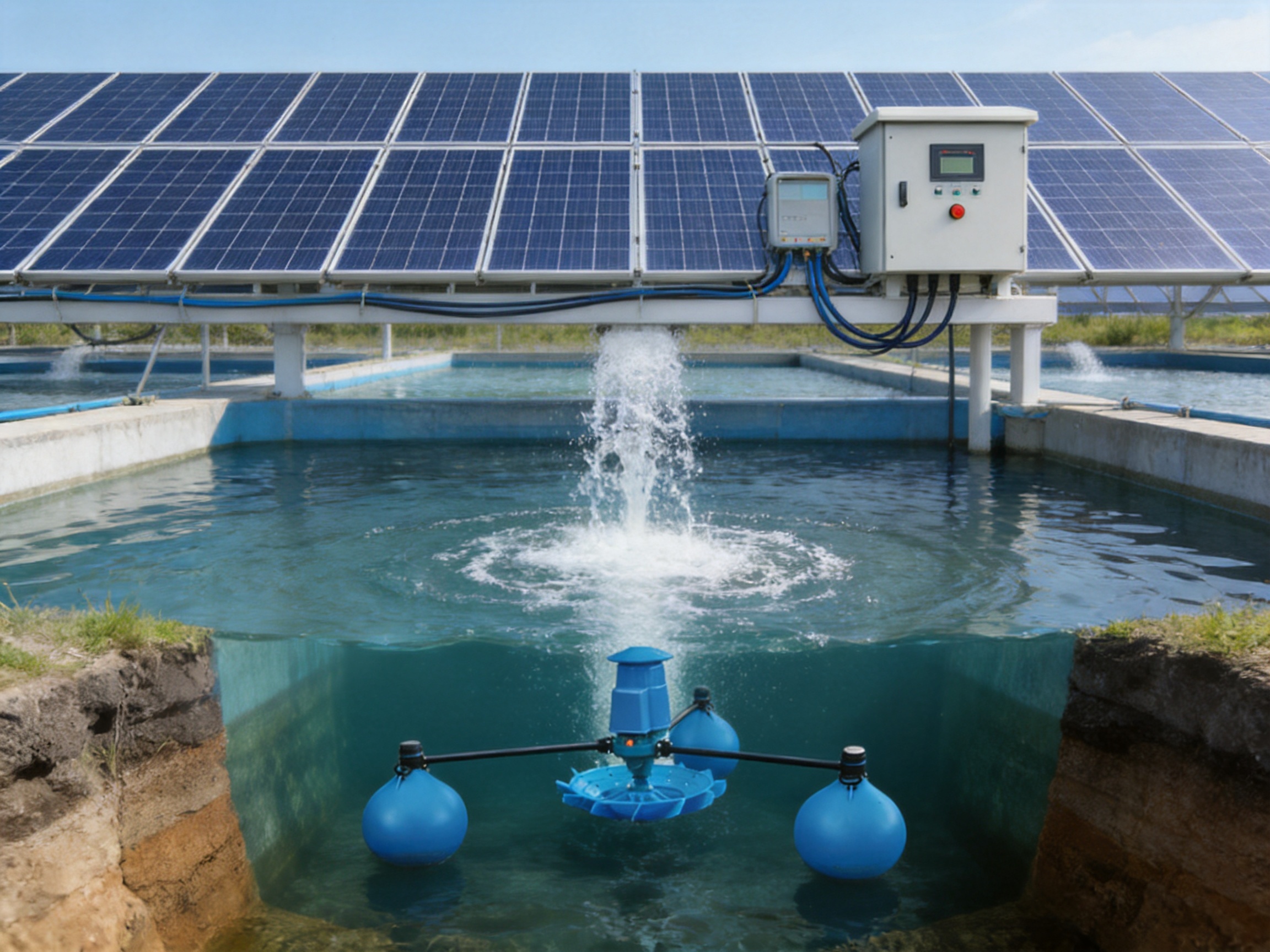
Ecological aquaculture farms often seek to balance production with water conservation, renewable energy use, and responsible resource management. A solar impeller aerator can support these goals by using renewable electricity while improving pond circulation.
Better circulation may assist natural biological processes by distributing oxygen and reducing localized stagnation. Aeration can support aerobic microorganisms that help break down organic matter, although the aerator itself should not be considered a complete water-treatment system. Water exchange, solids management, biological filtration, feeding control, and stocking density remain important parts of a complete ecological aquaculture strategy.
The equipment can also be considered for farm demonstration projects, rural development programs, and aquaculture installations where environmental impact and energy independence are important selection criteria. Its brushless construction and solar input are aligned with the long-term operating requirements of farms that want to reduce routine mechanical and energy costs.
The ESIA Series is produced by Taizhou Edwin Electric Co., Ltd., an integrated manufacturing enterprise established in 2008. The company’s stated capabilities include independent research and development, mass production, and global export. These three capabilities are important for a specialized product such as a solar aerator because successful delivery requires more than a motor and impeller design.
Independent research and development allows the manufacturer to develop products around specific application requirements. Solar pumps, intelligent booster pumps, deep well pumps, submersible pumps, circulation pumps, and aeration products each require different electrical, hydraulic, and mechanical considerations. Experience across these categories can support broader technical understanding of motors, pumps, controllers, water movement, and outdoor operation.
Mass-production capability supports consistency between units. For commercial aquaculture projects, operators need equipment that can be supplied in repeatable configurations and maintained with standardized parts and procedures. Consistent assembly, inspection, electrical testing, and packaging are important when products are shipped to different regions and installed by different teams.
The company’s product portfolio also indicates experience in both household and industrial water applications. Its products are used in new energy projects, agricultural irrigation, municipal engineering, mining, construction, HVAC systems, and household water supply. These fields expose equipment to different requirements involving reliability, pressure, flow, temperature, installation conditions, and duty cycles.
Since 2018, the company has invested in new energy and intelligent technology, including solar water pumps and intelligent booster pumps. This direction is relevant to the ESIA Series because the aerator combines renewable energy input with electronically controlled motor technology. Product development in solar pumping and intelligent systems can help support the electrical and control knowledge required for solar aeration equipment.
The organization also established related import and export companies to support procurement planning, order tracking, cross-border delivery, and foreign-trade services. For international buyers, these capabilities can simplify communication, order coordination, documentation, and shipment management. A strong export-support structure is especially valuable when a project involves multiple models, solar components, replacement parts, and technical requirements.
A reliable aerator depends on the quality of each major subsystem. The motor must operate efficiently and withstand repeated starts and stops. The impeller must maintain balanced rotation and resist deformation. Electrical connections must remain secure under vibration and humidity. The frame and supporting parts must tolerate outdoor exposure.
Manufacturing quality begins with incoming material control. Components such as motor housings, shafts, bearings, impellers, cables, connectors, and fasteners should be checked against defined specifications. Dimensional consistency is important because small deviations can affect alignment, vibration, noise, and efficiency.
Motor assembly requires attention to winding quality, rotor balance, bearing installation, sealing, and electrical insulation. Brushless DC motors also require accurate electronic commutation and compatibility between the motor and its controller. A well-matched motor-control system can improve starting performance and reduce unnecessary electrical stress.
Impeller assembly should be checked for alignment and balance. An unbalanced rotating part can increase vibration, accelerate bearing wear, and reduce service life. Correct assembly also helps maintain the expected water movement and oxygenation performance.
Electrical testing is another important part of production. Testing may include insulation checks, voltage verification, current measurement, rotation testing, operating temperature evaluation, and functional inspection. Product-specific testing procedures help identify assembly defects before equipment leaves the factory.
For solar equipment, system compatibility is particularly important. The aerator must be matched to its intended voltage range, and product documentation should clearly communicate the acceptable input conditions. The stated open-circuit voltage limits and solar power recommendations provide installers with important design information.
Before installation, the operator should evaluate pond dimensions, water depth, production species, stocking density, expected oxygen demand, sunlight availability, and the location of solar panels. The aerator should be positioned where its water movement can contribute to the largest practical circulation area.
The solar panels should be installed in an unshaded location with a suitable orientation and tilt for the local region. Even partial shading can reduce the output of a solar array, especially when panels are connected in series. Trees, buildings, poles, and temporary structures should be considered throughout the day and across different seasons.
The aerator should be placed on a stable support or floating structure appropriate to the pond environment. It must be protected against excessive movement, collision, entanglement, and accidental contact by people or animals. The installation should allow sufficient access for inspection and cleaning without creating unnecessary safety risks.
Cables should be routed away from sharp edges, standing water where possible, vehicle paths, and areas where fishing or harvesting equipment may be used. Connectors should be appropriate for outdoor conditions. The electrical system should include suitable isolation and protection devices installed by qualified personnel.
The impeller should have adequate clearance from the pond bottom and side walls. Excessively shallow placement may disturb sediment, while insufficient clearance may reduce water movement or cause blockage. The correct position depends on the pond’s depth, sediment condition, water level variation, and desired circulation pattern.
Although a brushless motor reduces the need for brush replacement, routine maintenance is still necessary. Operators should inspect the impeller, motor housing, mounting structure, cables, connectors, and solar panels at regular intervals.
The impeller should be checked for algae, weeds, plastic, ropes, feed bags, and other debris. Foreign material can reduce water movement, increase motor load, and cause vibration. Cleaning should be performed with the system safely isolated from its power source.
Solar panels should be kept reasonably clean. Dust, bird droppings, leaves, and agricultural residue can reduce energy output. The cleaning schedule depends on the local environment, but inspection is especially important after storms, dry periods, harvesting activity, or nearby construction.
Operators should listen for unusual noise and observe changes in water movement. Increased vibration, irregular rotation, reduced bubbling, or a rise in electrical current may indicate a blockage, bearing issue, impeller damage, or power-system problem. Early detection can reduce the risk of more serious failure.
Water level should also be monitored. Seasonal evaporation, rainfall, irrigation, and pond management activities can change the relationship between the aerator and the water surface. If the water level falls significantly, the installation may need adjustment to maintain effective circulation and prevent the equipment from operating under unsuitable conditions.
A maintenance log can record operating hours, cleaning dates, observed performance, weather conditions, and any repairs. This information helps identify seasonal patterns and supports preventive maintenance planning.
The ESIA Series is offered with a three-year warranty. A warranty of this duration provides users with additional confidence when planning a commercial aquaculture installation. It also demonstrates that the manufacturer recognizes the importance of long-term product support rather than focusing only on the initial sale.
Warranty conditions should be reviewed before purchase. Buyers should confirm the coverage period, included components, installation requirements, exclusions, documentation requirements, and process for requesting service. Correct installation and operation within the specified voltage range are normally important factors in maintaining warranty validity.
For international projects, buyers should also clarify spare-parts availability, technical support, packaging, shipping terms, and after-sales communication. These details can influence the total cost of ownership as much as the initial equipment price.
The competitive value of the ESIA Series comes from the combination of several features rather than from one isolated specification. It offers solar DC operation, a brushless motor, impeller-based circulation, multiple power configurations, broad application potential, and a three-year warranty.
Many aerators are optimized for one operating environment. Some are designed mainly for surface agitation, while others depend on grid electricity or fuel engines. The ESIA Series addresses a different set of priorities: renewable power, lower mechanical wear, vertical circulation, and suitability for deeper water.
The series format also benefits buyers who operate multiple ponds or plan to expand. A farm can begin with a lower-capacity model and later add medium- or high-capacity units according to production growth. Standardized product families can simplify training, maintenance, and spare-parts planning.
The product is also supported by a manufacturer with experience in pumps, motors, solar equipment, and international export. This background can be valuable when a buyer needs more than a standalone aerator and wants to coordinate a broader water-management or renewable-energy project.
However, product selection should always be based on actual application requirements. A solar impeller aerator is not automatically the best choice for every pond. Buyers should compare oxygenation requirements, water depth, climate, power availability, installation cost, expected operating schedule, and service conditions before making a final decision.
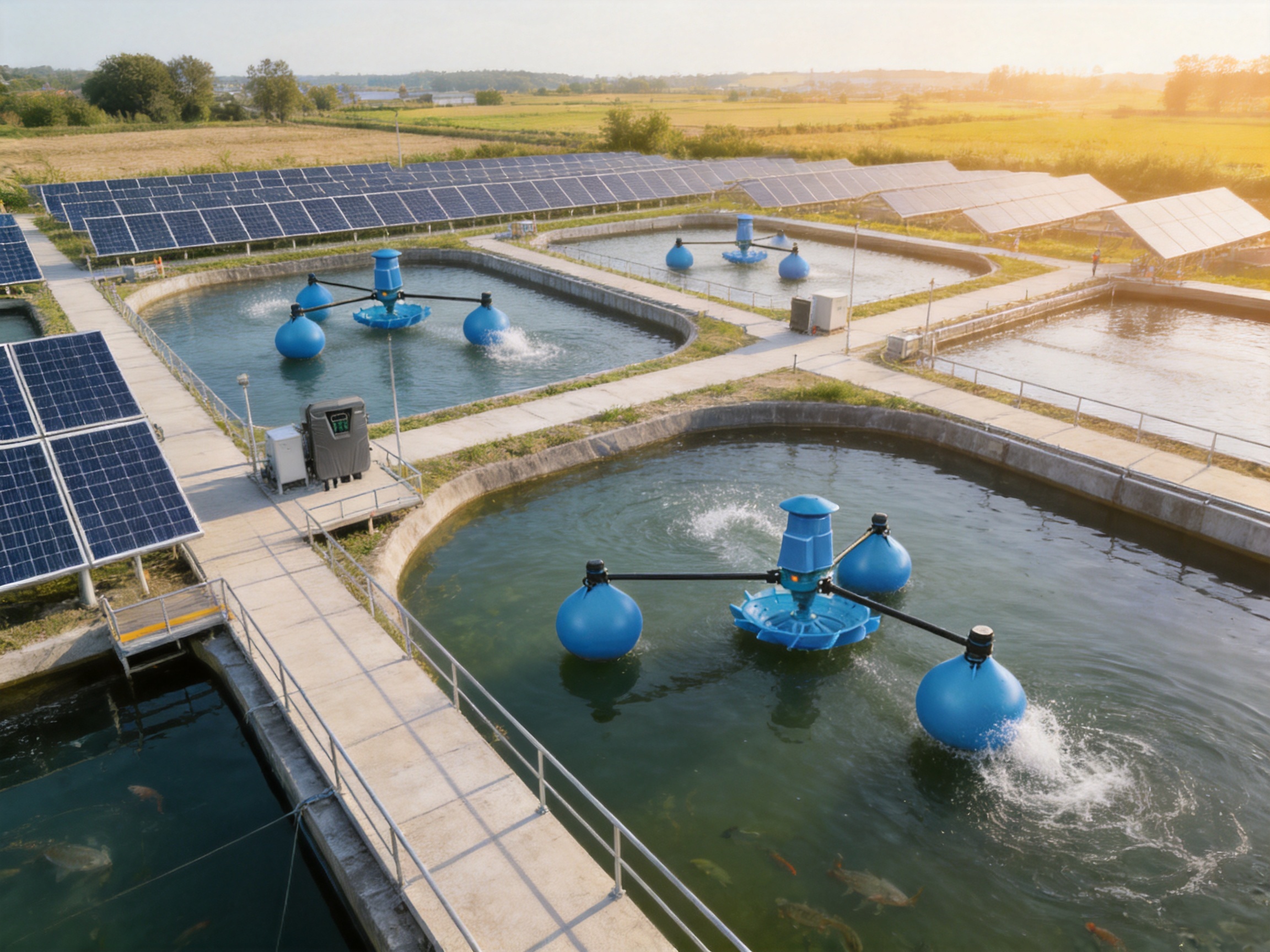
Before placing an order, the buyer should prepare basic technical information. This includes pond length, width, average depth, maximum depth, water volume, number of ponds, cultured species, stocking density, feeding rate, and expected operating hours.
The buyer should also identify the available solar resource. Important information includes average daily sunlight, seasonal cloud cover, panel installation space, shading conditions, and whether the system must operate after sunset. If nighttime operation is required, the buyer should ask for a separate battery or hybrid-system design rather than assuming direct solar power will be available throughout the night.
Model selection should consider both oxygenation rate and coverage area. The listed coverage range provides a reference, but high stocking density or high water temperature may require additional aeration capacity. In some cases, several smaller units provide better distribution and redundancy than one large unit.
Buyers should request confirmation of the complete system configuration. Questions may include whether the solar controller, cables, connectors, mounting structure, protection devices, and installation accessories are included. Clear confirmation prevents misunderstandings and makes project budgeting more accurate.
It is also useful to establish a spare-parts plan. Commonly required items may include impellers, bearings, seals, cables, connectors, fasteners, and control components. Keeping appropriate spares on site can shorten downtime during critical production periods.
Solar aeration can reduce the recurring cost associated with grid electricity or fuel. The actual savings depend on the local energy price, solar resource, operating schedule, system size, and maintenance requirements. Even when the initial solar installation cost is higher, long-term operating savings may improve the overall economic value.
Remote farms may benefit from reduced fuel transportation and fewer electrical extension requirements. This can simplify operations and lower the risks associated with fuel storage and generator maintenance. Solar panels can provide power near the pond, reducing the need to build long electrical distribution routes.
The brushless motor can also contribute to lower maintenance demand by eliminating brush replacement. Fewer wear components may reduce service interruptions and help extend the useful life of the aerator when it is properly installed and maintained.
Environmental benefits include the use of renewable energy and the potential reduction of direct emissions associated with fuel-powered aeration. Improved oxygen distribution may also support better pond management, although aeration must be combined with responsible feeding, stocking, sediment control, and water-quality monitoring.
It is a solar-powered impeller aerator designed for fish ponds, shrimp ponds, and ecological aquaculture farms. A brushless DC motor drives an impeller at high speed, pushing water upward, creating bubbles, and promoting circulation between upper and lower water layers.
The impeller increases water movement and surface turbulence, which improves contact between water and air. This supports the transfer of atmospheric oxygen into the pond. The resulting circulation can also distribute oxygen-rich water through a larger area.
Yes. The impeller-type design is intended to support circulation in deeper water and to promote movement between upper and lower layers. Actual effectiveness depends on pond depth, installation position, water quality, and the selected model.
A paddle-wheel aerator mainly creates surface splashing and horizontal movement, while the ESIA impeller aerator is designed to push water upward and promote vertical circulation. Paddle wheels remain useful in many applications, but the impeller design can be advantageous in deeper ponds and situations where upper-to-lower water movement is important.
The ESIA-48-750 is listed for a coverage range of approximately 666–2,000 square meters, so it may be a suitable starting point for a 1,000-square-meter pond. The final selection should also consider depth, stocking density, water temperature, oxygen demand, and pond shape.
The ESIA-110-1500 provides the highest listed oxygenation rate, at least 2.3 kg/h. It has a rated power of 1,500 W and a listed coverage range of approximately 2,000–4,000 square meters.
The published data recommends solar panel power of at least 1.3 times the pump power. This corresponds to approximately 975 W for the 750 W model, 1,430 W for the 1,100 W model, and 1,950 W for the 1,500 W model. Final sizing should account for local sunlight, temperature, shading, wiring losses, and system-control requirements.
The ESIA-48-750 should use a solar panel system with an open-circuit voltage below 120 V. The ESIA-72-1100 requires an open-circuit voltage below 170 V, while the ESIA-110-1500 requires an open-circuit voltage below 220 V. These limits should be confirmed during system design and must not be exceeded.
The provided product information describes a solar power supply system but does not state that batteries are included. Buyers who need nighttime aeration should discuss a separate battery-storage system or hybrid power arrangement with the supplier.
A brushless motor does not require routine replacement of mechanical carbon brushes. However, the aerator still requires inspection and cleaning of the impeller, motor housing, mounting structure, cables, connectors, and solar panels. Debris and algae should be removed promptly.
The product is described as having a three-year warranty. Buyers should confirm the detailed warranty terms, installation requirements, covered parts, exclusions, and after-sales procedure before purchase.
Yes. Multiple units can be used to cover several ponds or create a distributed circulation pattern in a larger pond. Using several units may also provide operational flexibility and partial redundancy if one unit requires maintenance.
The ESIA Series is manufactured by Taizhou Edwin Electric Co., Ltd., an integrated enterprise specializing in research and development, mass production, and global export of pumps and related water-management products.
The ESIA Series Brushless DC Motor Solar Impeller Aerator provides a specialized solution for aquaculture operators who need efficient oxygenation, vertical water circulation, and reduced dependence on conventional energy sources. Its high-speed impeller creates bubbles and upward water movement, while the brushless DC motor supports efficient operation and reduced mechanical wear.
With three power configurations, the series can serve different pond sizes and operating requirements. The 750 W model is suitable for smaller coverage areas, the 1,100 W model addresses medium-scale requirements, and the 1,500 W model provides the highest listed oxygenation capacity for larger ponds and deeper-water applications.
Its advantages over many conventional alternatives include solar DC compatibility, reduced brush-related maintenance, suitability for deep-water circulation, multiple model options, and a three-year warranty. These features are supported by the manufacturer’s experience in pump research, mass production, solar technology, intelligent equipment, and international export.
For the best results, the aerator should be selected as part of a complete pond-management plan. Correct model sizing, solar voltage matching, proper installation, routine cleaning, water-quality monitoring, and appropriate stocking and feeding practices are all essential. When these factors are addressed, the ESIA Series can become an important part of a reliable, energy-conscious, and modern aquaculture operation.
Taizhou Edwin Electric Co., Ltd. ESIA Series Brushless DC Motor Solar Impeller Aerator Performance Data.
Taizhou Edwin Electric Co., Ltd. Product and Company Information for Solar Pumps, Submersible Pumps, Booster Pumps, and Circulation Pumps.
Food and Agriculture Organization of the United Nations. Aquaculture Water Quality and Aeration Management Principles.
American Society of Agricultural and Biological Engineers. General Considerations for Aquaculture Aeration Equipment.
International Renewable Energy Agency. Renewable Energy Applications in Agriculture and Rural Infrastructure.
edwina@edwin-pump.com
+86-13586290903 (WhatsApp)
Xuri Gongliang Cutting Tool Entrepreneurship Park, Wenqiao Town, Wenling City, Taizhou City, Zhejiang Province, China

High Performance Smart Pump Factory


 English