edwina@edwin-pump.com

View All Products
en
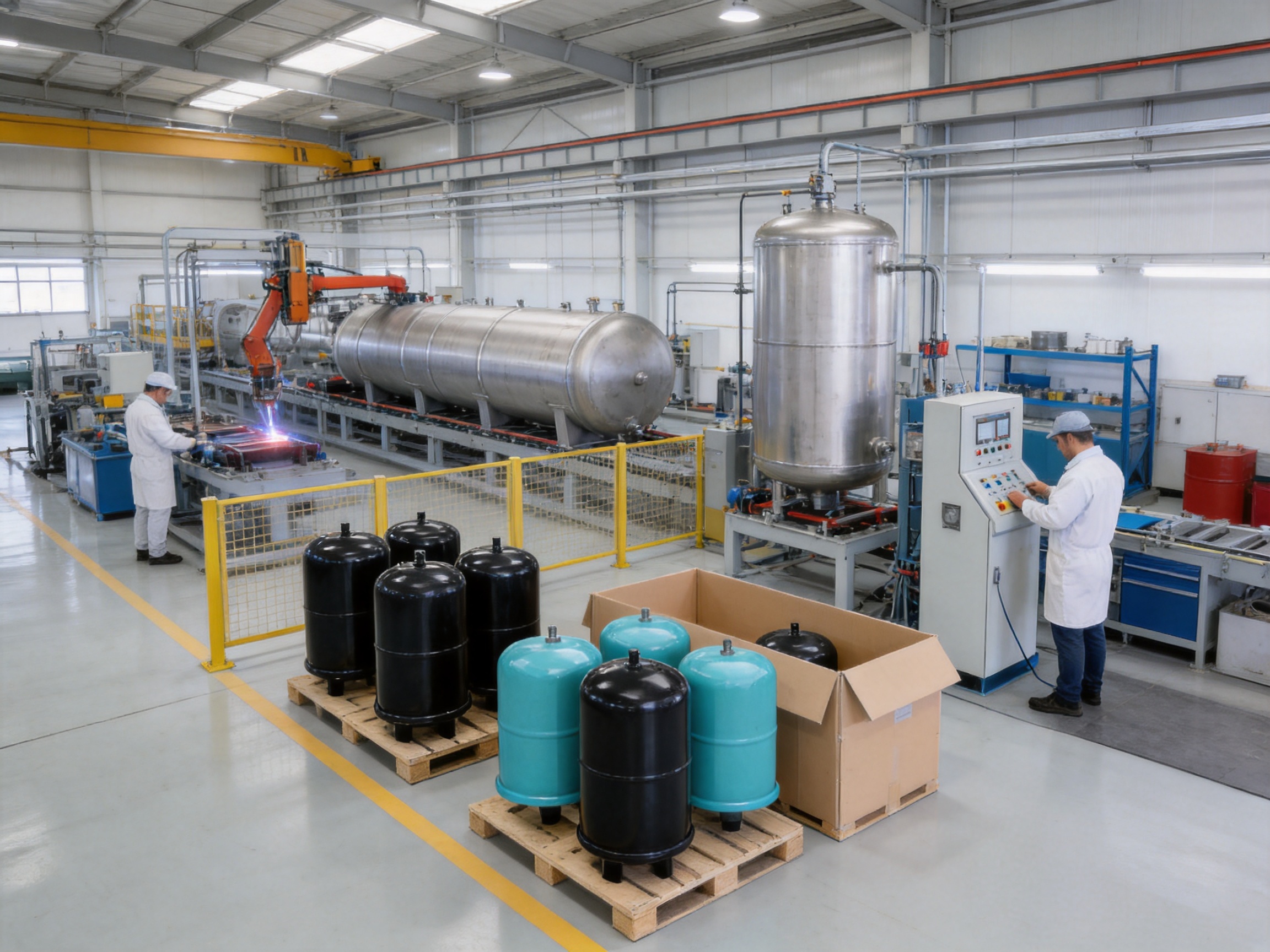
Modern solar heating, boiler, and thermal circulation systems require more than a reliable pump. They also need a pressure-management component that can absorb fluid expansion, stabilize operating conditions, and protect pipes, valves, heat exchangers, and other equipment. The VT2 Series Vertical Tank is designed for this purpose. It is a compact carbon steel pressure tank with a fixed diaphragm membrane, a factory pre-charge pressure of 1.5 bar, and a maximum working pressure of 3.5 bar.
Although expansion tanks are often small compared with the rest of a heating or solar installation, their role is essential. Water and heat-transfer fluids expand as their temperature increases. If this expansion has nowhere to go, system pressure can rise sharply. Excessive pressure may cause leakage, premature valve operation, noise, component fatigue, or damage to equipment. By providing a controlled volume for expansion, the VT2 Series helps create a more stable and dependable system.
The tank is suitable for thermal systems, boiler systems, and solar systems. Its carbon steel construction provides a practical balance between strength, manufacturing efficiency, and cost. The EPDM diaphragm is designed for a working temperature range of -10°C to 99°C, making the product suitable for many low- and medium-temperature heating and solar-water applications.
In a sealed hydronic or solar system, fluid is contained within pipes, collectors, heat exchangers, storage tanks, and circulation equipment. When the fluid is heated, its volume increases. Because the system is closed, even a relatively small volume increase can produce a significant rise in pressure.
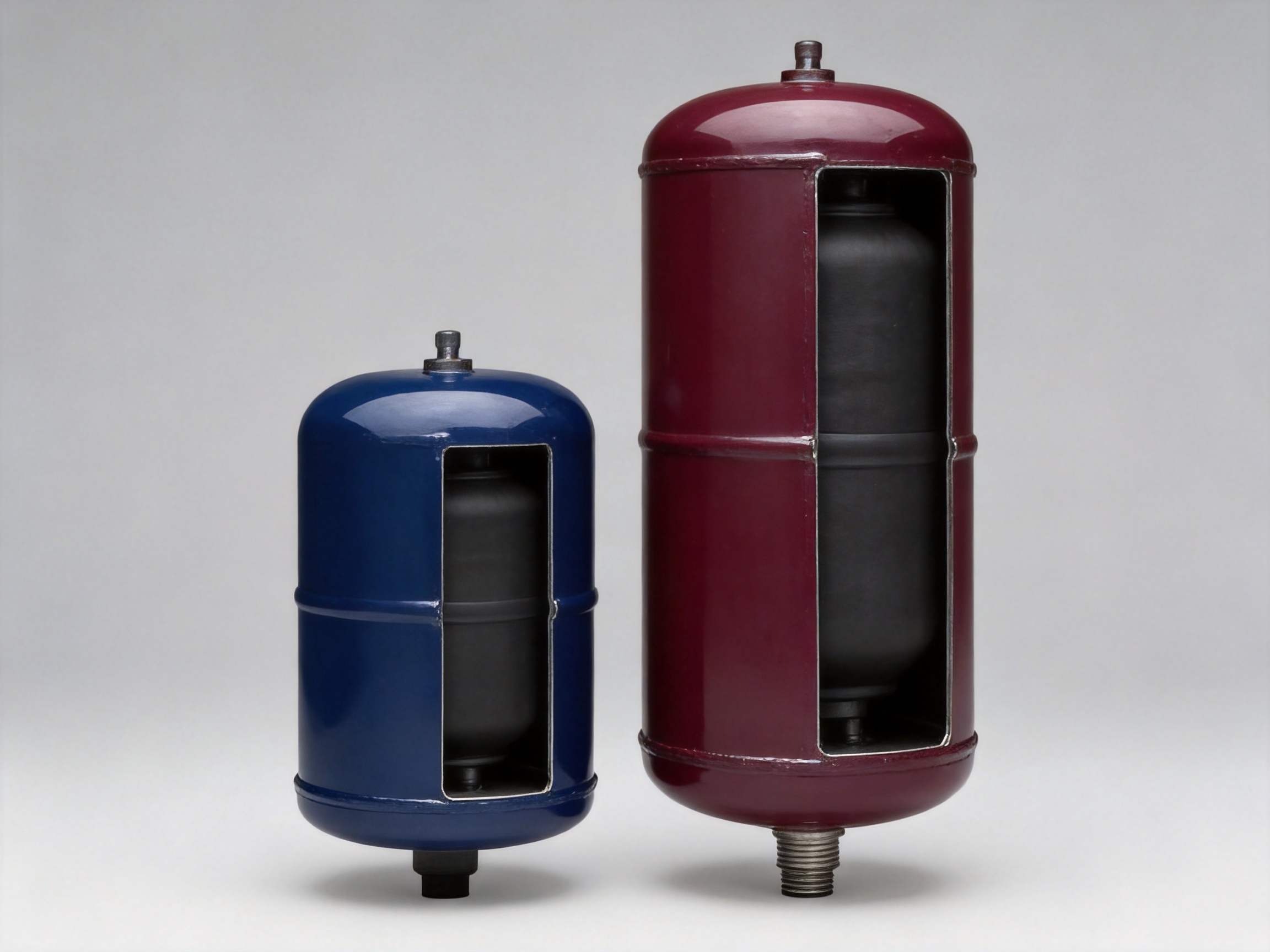
An expansion tank provides a flexible pressure-absorption zone. The tank is divided into two areas by a diaphragm. One side contains the system fluid, while the other side contains compressed air or gas. As the system fluid expands, it moves into the fluid side of the tank and pushes against the diaphragm. The gas side compresses and absorbs the additional volume. When the system cools, the compressed gas pushes the diaphragm back and helps return fluid to the system.
This operating principle is simple, but the tank must be correctly designed and installed. The pressure vessel must withstand the expected operating pressure. The diaphragm must remain flexible through repeated expansion and contraction cycles. The connection must be compatible with the system piping. The pre-charge pressure must also be suitable for the installation.
The VT2 Series addresses these requirements through a fixed diaphragm membrane, carbon steel tank body, 1.5-bar pre-charge pressure, and 3.5-bar maximum working pressure. Its compact dimensions make it convenient for equipment manufacturers, installers, and system integrators working with space-limited assemblies.
The VT2 Series Vertical Tank is a compact pressure tank developed for solar, boiler, and thermal applications. It is available in two listed models: VT2-2 and VT2-3. Both models use a 1/2-inch connector and a 1.5-bar pre-charge pressure. The models differ in their stated diameter, height, and packing volume.
The tank uses a carbon steel shell. Carbon steel is widely used for pressure vessels because it provides good mechanical strength, can be formed efficiently, and supports economical large-scale production. The external tank structure is intended to contain pressure reliably within the specified operating range.
A fixed diaphragm membrane separates the gas chamber from the system-fluid chamber. The fixed design helps keep the membrane positioned inside the tank during normal operating cycles. It also creates a controlled expansion volume without requiring the tank to be opened during routine operation.
The diaphragm material is identified as EPDM, with a stated working temperature range of -10°C to 99°C. EPDM is commonly selected for water-related sealing and membrane applications because it offers useful resistance to heat, water, and many common environmental conditions. As with every pressure component, the system designer should confirm fluid compatibility before using the tank with special additives or unusual heat-transfer media.
The standard pre-charge pressure is 1.5 bar. Pre-charge is the pressure applied to the gas side before the tank is connected to the system. It influences how the diaphragm responds during filling, heating, and cooling. Correct installation pressure should always be checked against the system design, static head, safety controls, and installation instructions.
The maximum working pressure is 3.5 bar. This value establishes an important operating boundary. It should not be treated as a target pressure. The system must be designed so that normal operating pressure remains within a safe range and that suitable pressure-relief protection is installed where required.
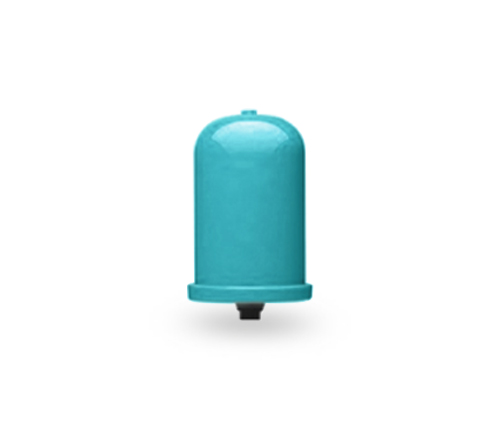
VT2 Series Vertical Tank for Solar System
The following table summarizes the available technical data for the VT2 Series models provided in the product information.
| Model | Diameter | Height | Pre-charge Pressure | Connector | Packing Information |
|---|---|---|---|---|---|
| VT2-2 | 110 mm | 222 mm | 1.5 bar | 1/2 inch | 0.0625 CBM / 20 pieces |
| VT2-3 | 106/116 mm | 192 mm | 1.5 bar | 1/2 inch | 0.0520 CBM / 20 pieces |
Both models are designed around the same basic pressure-management concept. The model selection should be based on the required expansion volume, available installation space, connection arrangement, and system design. The listed dimensions are useful for preliminary layout planning, but installers should confirm final dimensional drawings and connection details before fabrication or installation.
The compact dimensions provide several practical advantages. A smaller tank is easier to position in a solar control cabinet, boiler room, pump assembly, or packaged heating unit. It can also reduce the amount of structural support required. For original equipment manufacturers, compact packaging can help create smaller finished products and improve the use of internal cabinet space.
The fixed diaphragm design provides a permanent separation between the system fluid and the gas chamber. This separation is important because direct contact between water or heat-transfer fluid and compressed gas can accelerate gas absorption, corrosion, and pressure instability. By maintaining the separation, the diaphragm supports more predictable pressure behavior.
A fixed membrane also simplifies the product structure. Compared with more complex replaceable-bladder assemblies, a fixed diaphragm tank can be compact and economical. It is suitable for applications where a standardized tank is integrated into a heating or solar package and where the operating conditions remain within the specified limits.
The membrane moves as the system fluid expands and contracts. This repeated movement requires a material that can tolerate thermal cycling and pressure changes. EPDM is used in many water and heating applications because it remains flexible across a broad temperature range and offers useful resistance to water-based environments.
The membrane also helps protect the gas charge from direct contact with the system fluid. This contributes to more stable expansion control and reduces the likelihood of fluid entering the gas chamber during normal operation. Proper pre-charge maintenance remains important, because pressure loss on the gas side can reduce the useful expansion capacity of the tank.
Carbon steel is a practical material for the tank shell because it offers a strong and economical foundation for a pressure vessel. Its mechanical properties support the formation of cylindrical tanks that can withstand internal pressure within the specified working range. It also allows manufacturers to use established cutting, forming, welding, coating, and inspection processes.
Compared with some higher-cost materials, carbon steel can reduce the initial cost of the expansion tank and make it attractive for larger-volume purchasing. This is particularly valuable for boiler manufacturers, solar-system assemblers, heating-equipment distributors, and wholesalers that need repeatable products at competitive prices.
Material selection must always be matched to the installation environment. The tank should be installed in a suitable location and protected from conditions that could cause external corrosion or mechanical damage. If the system uses an aggressive fluid or unusual chemical additive, fluid compatibility should be reviewed before selection.
The carbon steel body also supports consistent industrial production. A manufacturer with experience in electric motors, water pumps, pressure components, and related equipment can integrate the tank into a broader product-development and procurement system. Common supplier channels, production planning, quality procedures, and export experience can all support reliable availability for international customers.
Solar thermal systems can experience significant temperature variation. During periods of strong solar radiation, fluid temperature may rise rapidly. At night or during periods of low demand, the system may cool substantially. These cycles create repeated expansion and contraction, so the expansion tank must be selected for the expected temperature range.
The VT2 Series lists a working temperature range of -10°C to 99°C for the EPDM membrane. This range is appropriate for many domestic solar-water systems, boiler circuits, and thermal circulation systems operating below the upper limit. The application designer must nevertheless consider the actual collector temperature, stagnation conditions, system fluid, pressure-relief setting, and tank location.
In a solar installation, the tank is often connected near the return side of the solar circuit or in another position selected by the system designer. The final arrangement depends on the collector type, heat-transfer fluid, pump group, expansion-loop design, and local installation standards. The tank should not be placed where its membrane or shell will be exposed to temperatures beyond the specified range.
For boiler systems, the tank can help manage the volume changes associated with heating the system water. It may be used in packaged boiler assemblies, heating modules, or circulation systems, provided that the total expansion volume and operating pressure are correctly calculated.
For thermal systems more generally, the tank supports pressure stability during normal operation. It does not replace a pressure-relief valve, automatic air vent, pressure gauge, temperature controller, or other required safety device. It is one component within a complete pressure-management arrangement.
Product comparisons should be based on application suitability rather than on appearance alone. The VT2 Series offers several advantages over basic tanks that are not properly matched to solar or thermal systems.
First, the specified 1.5-bar pre-charge provides a clearly defined starting point for system integration. A tank with an unknown or inconsistent pre-charge can make commissioning more difficult and may lead to poor pressure behavior. A stated pre-charge helps installers plan the system and allows quality-control personnel to check the product more efficiently.
Second, the stated 3.5-bar maximum working pressure gives engineers a clear operating boundary. Products with unclear pressure information create unnecessary uncertainty during system design. Defined pressure data supports better selection of safety components and reduces the risk of using an underspecified vessel.
Third, the EPDM diaphragm and stated temperature range make the product more suitable for heating and solar-water applications than a general-purpose tank designed only for cold-water service. A tank selected without considering temperature may experience premature membrane aging or unstable performance.
Fourth, the compact vertical form can be easier to integrate than a larger horizontal tank. It can occupy less floor space and may fit within a narrow service area. This is useful for packaged solar stations, boiler modules, domestic heating equipment, and small commercial installations.
Fifth, the 1/2-inch connector provides a familiar interface for many small and medium thermal assemblies. It can simplify sourcing and integration when the surrounding piping is designed around a matching connection size. The installer must still verify thread standards, sealing method, and local piping requirements.
Sixth, the availability of two models gives customers more flexibility. The VT2-2 and VT2-3 have different listed dimensions and packing volumes, allowing purchasers to consider both technical requirements and logistics. A choice of models can be especially valuable for OEM customers that use the tank in more than one equipment platform.
Finally, the product is supported by a manufacturer that provides OEM support and operates within a broader water-pump and water-treatment product environment. This can help buyers coordinate expansion tanks with pumps, circulation equipment, booster systems, valves, and other components through a more organized procurement process.
The quality of a pressure tank depends not only on its design but also on manufacturing discipline. A tank must be formed accurately, assembled consistently, sealed properly, and inspected before shipment. The manufacturer behind the VT2 Series is an integrated enterprise involved in independent research and development, mass production, and global export.
The company was founded in 2008 and has developed experience in deep-well pumps, submersible pumps, domestic booster pumps, circulation pumps, solar water pumps, intelligent booster pumps, and related equipment. This product background is relevant because pressure management is closely connected with pumping and water-system performance.
A manufacturer familiar with pumps understands the operating conditions that pressure components face in real installations. Pump starting and stopping can create pressure changes. Circulation systems can experience temperature cycling. Solar systems can require stable operation under changing heat input. Experience across these applications supports more practical product development.
The production of a carbon steel expansion tank typically involves several controlled stages. Material is selected and prepared according to the required shell dimensions. Steel components are cut, formed, and joined to create the pressure vessel. Welding must be consistent and free from defects that could compromise the shell. The connection assembly must be correctly positioned and securely attached. The membrane must be fitted without damage or distortion.
After assembly, the tank should undergo appropriate pressure and appearance checks. A professional production process may include dimensional inspection, weld inspection, leakage testing, pressure testing, membrane and connector checks, coating inspection, and packaging verification. The exact inspection plan depends on the product design, customer requirements, and applicable standards.
Manufacturing control is also important for repeat orders. OEM customers need the same dimensions, connector location, pre-charge characteristics, and appearance from one production batch to the next. Consistency helps customers avoid redesigning their equipment or changing their assembly procedures.
Mass-production experience provides additional benefits. It can improve material utilization, reduce unnecessary process variation, support stable purchasing, and make delivery planning more predictable. For distributors and project suppliers, these advantages may be as important as the individual tank specification.
Independent research and development allows a manufacturer to adapt products to changing market needs. Solar heating, domestic water supply, agricultural irrigation, municipal systems, construction projects, mining, and HVAC applications often have different pressure and temperature requirements. A product manufacturer that works across these fields can collect practical feedback and use it to improve designs.
The company has invested in new-energy and intelligent technology since 2018. This direction is relevant to the VT2 Series because solar systems and intelligent pumping systems increasingly require coordinated components. A solar pump may regulate flow according to available sunlight, while a thermal system may experience frequent changes in temperature and demand. An expansion tank helps the hydraulic system remain stable while these conditions change.
R&D strength also supports OEM customization. Customers may require alternative branding, packaging, colors, connection arrangements, labeling, or documentation. Some projects may require a different tank size or a special integration approach. OEM support allows the manufacturer and buyer to discuss technical parameters before production rather than relying only on standard catalog selection.
Customization should not compromise pressure-vessel safety. Any change to the shell, membrane, connector, operating pressure, or temperature range should be reviewed by qualified technical personnel. A responsible OEM process distinguishes between cosmetic customization and changes that affect engineering performance.
Reliability in an expansion tank is measured over many operating cycles, not just during the first installation. The tank must continue to control expansion as the system heats and cools. The diaphragm must retain its flexibility. The gas charge must remain within an appropriate range. The shell and connector must remain free from leakage.
Correct product selection is the first quality consideration. The VT2 Series is intended for thermal, boiler, and solar systems within its specified limits. It should not be used automatically for every pressure application. The system designer should calculate the required expansion volume and compare it with the selected tank capacity.
Installation quality is equally important. The tank should be mounted securely and positioned so that the connector and shell are not exposed to unnecessary stress. Pipework should be independently supported where needed. The tank should not be used as a structural support for heavy piping or equipment.
Pre-charge should be checked with the tank isolated from system pressure, using an appropriate pressure gauge. The required setting depends on the system design. The listed factory pre-charge is 1.5 bar, but field conditions and local engineering practice may require verification or adjustment by a qualified installer.
Periodic maintenance may include visual inspection, checking for corrosion or leakage, and verifying pre-charge. If the system pressure changes abnormally, the installer should investigate the tank, membrane, safety valve, air charge, and other components. A pressure tank cannot correct a problem caused by a blocked pipe, defective valve, excessive temperature, or incorrectly sized pump.
Solar thermal systems convert sunlight into heat and transfer that heat to water or another circulating fluid. Their output varies with weather, season, collector temperature, and hot-water demand. These changing conditions produce a dynamic hydraulic environment.
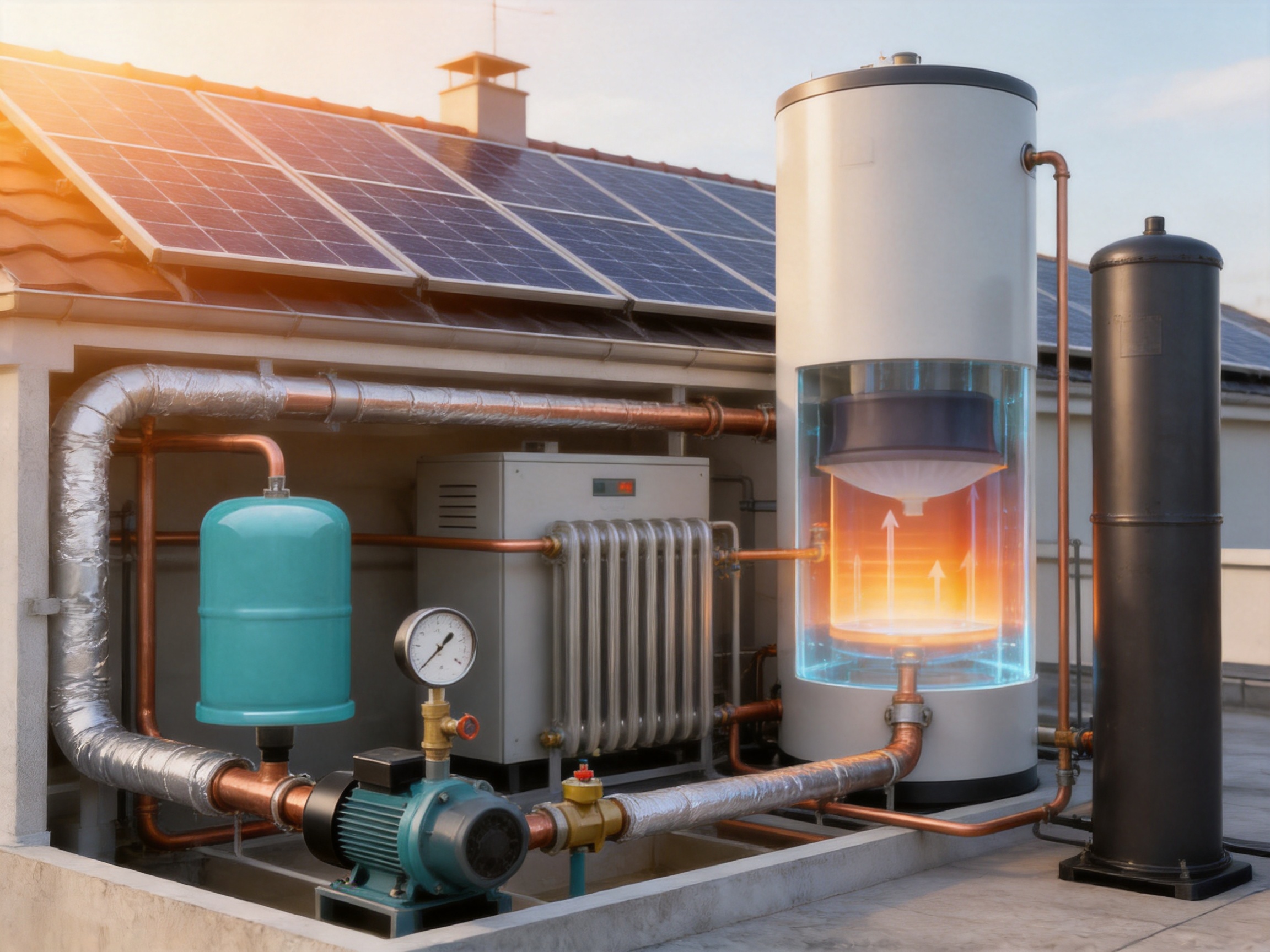
The VT2 Series can serve as a compact expansion component in suitable solar installations. When the solar fluid warms, it expands and moves against the diaphragm. The gas chamber compresses to accommodate the additional volume. When the fluid cools, the tank assists the system in maintaining a more stable pressure condition.
For a solar installer, the main selection questions include system fluid, operating temperature, static height, total circuit volume, maximum pressure, connection size, and available installation space. The tank should be selected after these factors have been reviewed rather than by nominal pipe size alone.
The tank should be installed according to the solar system design. The connection point should allow the tank to respond effectively to system pressure changes. The installation should also protect the tank from excessive heat, vibration, impact, and weather exposure. Where glycol-based fluids are used, the installer should confirm chemical compatibility with the EPDM membrane and all wetted materials.
Solar systems may also require additional components such as a pressure-relief valve, flow meter, check valve, isolation valve, pressure gauge, temperature sensor, controller, and circulation pump. The expansion tank works together with these components but does not replace them.
In boiler systems, water temperature changes as the boiler starts, operates, modulates, and shuts down. These changes affect fluid volume and system pressure. An expansion tank can reduce pressure fluctuation and help protect the heating circuit from unnecessary stress.
The VT2 Series is suitable for applications where the system temperature and pressure remain within the stated limits. It may be used in compact boiler packages, heating modules, hydronic circuits, and other thermal assemblies. The installer must consider the total water volume, system height, fill pressure, operating temperature, and safety-valve setting.
A correctly selected tank can help reduce the frequency of pressure relief during normal heating cycles. It may also reduce noise associated with pressure changes and help maintain more consistent circulation conditions. However, if a safety valve opens frequently, replacing the tank without investigating the cause may not solve the problem. The entire system should be inspected.
For commercial heating applications, multiple tanks or a larger expansion vessel may be required. The compact VT2 models are most suitable where the required expansion volume is compatible with their capacity and where the equipment layout benefits from a small vertical format.
Thermal circulation systems are used in residential buildings, commercial facilities, workshops, hotels, agricultural projects, and industrial support systems. They may circulate heated water through radiators, floor-heating loops, heat exchangers, storage tanks, or process equipment.
The VT2 Series can support these systems by providing a controlled volume for thermal expansion. Its compact dimensions can help equipment manufacturers build integrated circulation modules. Its 1/2-inch connector is convenient for smaller assemblies, while the tank's carbon steel shell offers a cost-conscious solution for repeated production.
When used with a circulation pump, the tank should be located and connected according to the hydraulic design. Pump pressure, system static pressure, and tank pre-charge interact with one another. A qualified designer should ensure that the tank remains effective across the full operating cycle and that the pump does not create excessive pressure at the tank connection.
OEM support is one of the most important commercial advantages of the VT2 Series. Equipment manufacturers often need components that can be integrated into their own product lines without major design changes. A standardized compact tank can be supplied with customer-specific packaging, labeling, documentation, and procurement arrangements, subject to technical review.
For OEM customers, consistency is critical. The tank must fit the assembly, maintain the expected connection position, and arrive with stable specifications. Production planning and mass-manufacturing experience can help support repeat orders and reduce supply interruptions.
Wholesale buyers may also benefit from the packing information provided for the two models. The listed packing volumes are 0.0625 CBM per 20 pieces for the VT2-2 and 0.0520 CBM per 20 pieces for the VT2-3. This information can assist with container planning, warehouse allocation, and freight estimation. Final logistics calculations should be confirmed with the supplier according to packaging dimensions and shipment requirements.
The manufacturer operates an export-oriented business structure and has established related import and export service companies to support procurement planning, order tracking, cross-border delivery, and foreign-trade services. For international buyers, this can simplify communication and coordination across product selection, production, documentation, and shipment.
The expansion tank is not a pump, but it is closely related to pump-system performance. The manufacturer supplies deep-well pumps, submersible pumps, domestic booster pumps, circulation pumps, solar water pumps, intelligent booster pumps, commercial multistage pumps, end-suction pumps, garden pumps, pool and spa pumps, and other water-system products.
This broad portfolio can be useful for customers seeking a coordinated procurement solution. A solar project, for example, may require solar pumps, circulation equipment, valves, pipes, controls, and a pressure tank. A domestic water system may require a booster pump, pressure tank, check valve, and control device. A commercial project may require multistage pumps and pressure-management accessories.
One-stop procurement can reduce the number of separate suppliers involved in a project. It may also make it easier to coordinate technical communication, order tracking, packaging, and delivery. The final selection must still be based on application calculations and compatibility, but a broader product platform can improve purchasing efficiency.
Installation should be carried out by trained personnel familiar with pressure vessels and the relevant heating or solar system. Before installation, inspect the tank for transport damage, check the connector, confirm the model, and verify that the shell and coating are intact.
Confirm that the system design is compatible with the tank's 3.5-bar maximum working pressure and -10°C to 99°C membrane temperature range. Check the fluid type and confirm that the EPDM membrane is suitable. Review the required expansion volume and make sure the selected model is not too small for the system.
Verify the pre-charge before the tank is placed into service. The listed factory value is 1.5 bar. The tank should be isolated from system pressure when the pre-charge is measured. If adjustment is necessary, it should be performed using an appropriate gas and procedure approved by the system designer or equipment manufacturer.
Install a suitable isolation arrangement if permitted by local regulations and the system design. An isolation valve can make inspection and maintenance easier, but it must not be left closed during normal operation if doing so would remove the expansion tank from the protected system. Any isolation arrangement must be installed and managed safely.
Fill and vent the system carefully. Air trapped in the piping can cause noise, poor circulation, and unstable pressure readings. After filling, check all connections for leakage and observe the system during heating and cooling. Record the initial pressure and commissioning conditions for future maintenance.
The maximum working pressure of the VT2 Series is 3.5 bar. This limit must be respected at all times. System designers should provide suitable pressure-relief protection and ensure that the relief setting is compatible with all components in the installation.
The tank should never be modified by drilling, welding, cutting, or changing the connector without formal engineering approval. Unauthorized modification can affect structural integrity and invalidate the original design assumptions.
The tank should not be exposed to fire, direct flame, severe impact, freezing conditions beyond its stated range, or temperatures above the specified limit. If the surrounding environment is corrosive, the shell should be protected through appropriate installation and maintenance practices.
Any sign of leakage, severe corrosion, deformation, damaged connection, or abnormal pressure behavior requires immediate inspection. The tank should be depressurized and isolated by qualified personnel before service or replacement.
A pressure tank may appear to be a simple product, but dependable performance depends on disciplined manufacturing. The shell, membrane, connector, pre-charge, packaging, and documentation must all be controlled. A supplier with only limited assembly capability may struggle to maintain stable quality across large orders or customized requirements.
An integrated manufacturer with its own R&D, production, and export experience can offer a more complete support structure. Product development can be connected with manufacturing feedback. Procurement teams can coordinate raw materials and production schedules. Quality personnel can establish repeatable inspection procedures. Export teams can manage documentation and delivery.
The company's history since 2008, its investment in intelligent and new-energy technologies since 2018, and its experience in pump manufacturing provide a foundation for serving customers in both traditional and emerging water-system markets. This background is particularly relevant as solar energy, energy-efficient circulation, and intelligent water supply continue to expand.
The company's products are used in new-energy projects, agricultural irrigation, municipal engineering, mining, construction, HVAC systems, and household water supply. Exposure to these varied application environments can help strengthen practical understanding of system requirements, although each project still requires individual technical review.
Before ordering the VT2 Series, buyers should confirm the intended application. Determine whether the tank will be used in a solar system, boiler circuit, thermal circulation system, or another approved application.
Confirm the total system volume and calculate the required expansion capacity. A compact tank is beneficial only when its capacity is appropriate for the system. If the volume is insufficient, pressure may still rise excessively during heating.
Check the maximum operating pressure and temperature. The listed maximum working pressure is 3.5 bar, and the EPDM working temperature range is -10°C to 99°C. System conditions should remain within these boundaries.
Verify the connector requirement. Both listed models use a 1/2-inch connector, but buyers should confirm thread type and connection details with the supplier before finalizing the piping design.
Review the installation dimensions. The listed VT2-2 dimensions are 110 mm in diameter and 222 mm in height. The VT2-3 is listed with a diameter of 106/116 mm and a height of 192 mm. Allow additional space for piping, inspection, tools, and safe access.
Discuss OEM requirements early. If the product will be installed inside another manufacturer's equipment, confirm branding, labels, packaging, technical documentation, color, order quantity, and inspection requirements before production.
Finally, request current technical drawings and commercial terms. Product data should be confirmed before purchase because packaging, production details, and order conditions may vary according to customer requirements.
The VT2 Series is a carbon steel pressure tank designed for thermal systems, boiler systems, and solar systems. Its main function is to absorb fluid expansion and help stabilize pressure in a closed system.
The fixed diaphragm separates the system fluid from the compressed gas chamber. When the fluid expands during heating, it pushes against the diaphragm and compresses the gas. When the system cools, the gas expands and helps return fluid to the circuit.
The listed pre-charge pressure is 1.5 bar. The actual installation setting should be checked and adjusted only when appropriate for the system design and by qualified personnel.
The maximum working pressure is 3.5 bar. Normal system pressure should remain within a safe operating range below this limit, and suitable pressure-relief protection should be provided.
The product information identifies the membrane as EPDM. The stated working temperature range for the EPDM membrane is -10°C to 99°C.
The tank is specified for thermal systems, boiler systems, and solar systems. The system designer must verify fluid compatibility, pressure, temperature, expansion volume, and installation conditions before selection.
The listed models are VT2-2 and VT2-3. Both use a 1/2-inch connector and a 1.5-bar pre-charge. Their listed dimensions and packing information are different, so buyers should select the model that fits the technical and space requirements.
No. Solar installations vary in temperature, fluid, circuit volume, pressure, and collector design. The tank is suitable only when the actual conditions remain within its specifications and the expansion capacity is adequate.
OEM support is available. Customers should discuss labeling, packaging, appearance, documentation, quantity, and any technical changes with the manufacturer before production. Changes affecting pressure or temperature performance require engineering review.
No. The tank manages expansion, but it does not replace a pressure-relief valve, pressure gauge, temperature controller, air vent, or other required safety equipment.
The tank should be isolated from system pressure before measuring the gas-side pre-charge. A suitable pressure gauge and approved procedure should be used. Inspection and adjustment should be performed by trained personnel.
The VT2 Series provides a defined 1.5-bar pre-charge, a stated 3.5-bar maximum working pressure, an EPDM membrane for the listed temperature range, a compact vertical design, and a 1/2-inch connector. These characteristics make it easier to evaluate for solar and thermal applications than a product with incomplete or unclear specifications.
The manufacturer supplies a broad range of pumps and water-system products, including solar pumps, circulation pumps, booster pumps, submersible pumps, and multistage pumps. Buyers can discuss coordinated procurement according to project requirements.
The VT2 Series Vertical Tank is a practical pressure-management component for suitable solar, boiler, and thermal systems. Its fixed EPDM diaphragm, carbon steel shell, 1.5-bar pre-charge, 3.5-bar maximum working pressure, and compact vertical design provide a useful combination of functionality, integration convenience, and cost-conscious construction.
Its advantages become more significant when considered together with the manufacturer's broader capabilities. Experience in independent R&D, mass production, pump manufacturing, new-energy technology, OEM support, and international export provides a strong foundation for serving equipment manufacturers, distributors, installers, and project buyers.
As with any pressure vessel, correct sizing, compatibility review, safe installation, and periodic maintenance are essential. When selected within its specified operating range and integrated into a properly designed system, the VT2 Series can help manage thermal expansion, stabilize pressure, and support reliable operation in solar and heating equipment.
1. Product specification sheet for the VT2 Series Vertical Tank, including model dimensions, connector size, pre-charge pressure, and packing information.
2. Manufacturer technical information concerning fixed diaphragm expansion tanks for thermal, boiler, and solar systems.
3. General engineering principles for hydronic expansion, pressure control, and closed-loop heating systems.
4. General material and application references for EPDM membranes in water and thermal equipment.
5. General design guidance for solar thermal circulation systems, pressure-relief protection, and expansion-volume calculation.
6. General installation and maintenance practices for carbon steel pressure vessels used in heating and water-system equipment.
edwina@edwin-pump.com
+86-13586290903 (WhatsApp)
Xuri Gongliang Cutting Tool Entrepreneurship Park, Wenqiao Town, Wenling City, Taizhou City, Zhejiang Province, China

High Performance Smart Pump Factory


 English