edwina@edwin-pump.com

View All Products
en
Reliable access to water is essential for households, farms, workshops, commercial facilities, and industrial sites. In many locations, however, conventional grid electricity is expensive, unstable, or unavailable. Solar pumping systems provide an efficient alternative by converting sunlight into practical water supply without depending entirely on utility power or fuel-powered generators. The 4HVLR wide-voltage DC brushless motor copper outlet solar deep well pump is designed for precisely this type of application.
Built as a 4-inch submersible solar pump, the 4HVLR series combines a wide-voltage brushless DC motor, corrosion-resistant copper components, an energy-efficient plastic impeller, and NSK bearings. Its configuration allows it to operate across a broad DC input range, making it suitable for photovoltaic systems whose voltage changes throughout the day. Depending on the model, the series provides flow rates from 5 to 22 cubic meters per hour, maximum heads from 45 to 110 meters, and power ratings from 750 W to 2,200 W.
Unlike many conventional pumps that are selected for a fixed electrical supply, this series is engineered around the variable nature of solar energy. The pump can work with changing photovoltaic output while maintaining a practical balance between hydraulic performance, energy consumption, durability, and installation flexibility. Its range of configurations also allows system designers to select a model according to well depth, required flow, discharge height, pipe size, and available solar capacity.
This article examines the product’s operating principle, construction, performance range, competitive advantages, application possibilities, manufacturing strengths, installation considerations, and maintenance requirements. It also explains how Taizhou Edwin Electric Co., Ltd. supports the product through integrated research and development, production, export, and technical service capabilities.
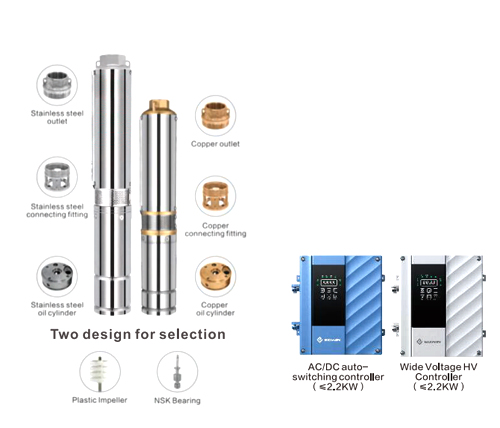
4HVLR Wide Voltage DC Brushless Motor Copper Outlet Solar Deep Well Pump
The 4HVLR is a solar deep well pump categorized as a DC submersible solar pump. It is intended to be installed below the water level in a deep well, borehole, storage source, or similar submerged environment. As a submersible design, the pump pushes water upward through a delivery pipe rather than relying on surface suction. This makes it suitable for applications where the water source is located far below ground level.
The pump uses a 4-inch diameter format. This compact bore size is compatible with many standard deep-well installation conditions and offers a practical compromise between installation space and hydraulic capacity. The series contains several performance combinations, including lower-flow, higher-head models for deep lifting and higher-flow, lower-head models for bulk water transfer.
At the center of the system is a wide-voltage brushless DC motor. Solar panels do not produce a constant voltage or power level. Their output varies according to sunlight intensity, weather, panel temperature, shading, and time of day. A wide-voltage motor is therefore valuable because it is designed to operate within a broader DC voltage range instead of depending on one narrow input condition.
The listed models operate at optimum DC input ranges of 110–350 V, 150–350 V, or 200–350 V, depending on the selected power and performance configuration. The photovoltaic array must have an open-circuit voltage below 450 V, while the recommended solar panel power is at least 1.3 times the pump power. These specifications provide a starting point for system sizing and should be evaluated together with the actual site conditions.
The product incorporates a copper water outlet and copper cylinder. These components are exposed to important mechanical and environmental demands during operation. Copper provides a combination of strength, wear resistance, and corrosion resistance that is valuable in submerged pumping equipment. The material selection helps support long-term reliability in installations where the pump may operate for extended periods without convenient access for servicing.
The impeller is made from a lightweight engineering plastic. Reducing rotating mass can lower the energy required to accelerate the impeller and can contribute to smoother motor operation. The impeller is designed to guide water efficiently through the hydraulic passage, helping the pump achieve useful flow while keeping the electrical demand appropriate for solar operation.
NSK bearings are used to support low-friction rotation. Bearing quality directly affects motor noise, heat generation, mechanical stability, and service life. By using recognized bearing components, the pump is designed to maintain stable rotation under continuous operating conditions.
The product also emphasizes a durable and low-maintenance structure. A properly selected submersible pump should be able to operate for long periods with limited intervention, especially in remote solar installations. The 4HVLR’s material combination and compact structure are intended to reduce routine maintenance demands while making the unit practical for professional installation.
A solar pumping system usually consists of photovoltaic panels, a solar pump controller or compatible drive system, electrical protection equipment, the submersible pump, a water delivery pipe, and the required valves and fittings. The panels generate DC electricity, and the controller manages the available electrical input before supplying the pump motor.
When sunlight is strong, the photovoltaic array can deliver more power. When clouds pass over the panels or the sun is low, voltage and current may change. A wide-voltage brushless DC motor is designed to tolerate a broad operating range and use the available energy more effectively than a motor intended for only one fixed DC voltage.
The brushless design eliminates the mechanical brushes and commutator found in traditional brushed motors. This reduces contact wear and removes a common source of electrical arcing and maintenance. Electronic commutation controls the motor’s magnetic field, allowing the rotor to turn efficiently and consistently.
Water enters through the pump intake and passes through the rotating impeller. The impeller increases the water’s velocity, and the pump’s hydraulic passages convert part of that velocity into pressure. The resulting pressure allows water to rise through the discharge pipe to a storage tank, irrigation network, household supply system, or industrial process.
The actual flow rate depends on more than the maximum value shown in a product table. It is influenced by total dynamic head, pipe length, pipe diameter, bends, valves, elevation, water level, and the power available from the solar array. Maximum flow and maximum head are reference points rather than values normally achieved at the same time. Correct system selection must therefore consider the complete pump curve and site duty point.
A pump powered directly by solar energy faces operating conditions that differ from a pump connected to a stable grid supply. During early morning and late afternoon, sunlight may be insufficient to reach the pump’s optimum operating condition. During midday, the pump may operate closer to its rated capacity. In partially cloudy conditions, the available power can change repeatedly.
The wide-voltage concept helps the system remain useful over a larger portion of the solar day. Instead of being limited to a narrow voltage window, the pump can work with an appropriately designed photovoltaic array across a broad input range. This can increase daily water production and reduce the need for batteries in applications where water can be pumped into a storage tank during daylight hours.
Eliminating or reducing battery storage can provide important benefits. Batteries add purchase cost, weight, maintenance requirements, replacement expenses, and environmental considerations. For agricultural, domestic, and remote community systems, storing water in a tank is often simpler and more economical than storing large amounts of electrical energy.
The 4HVLR series contains multiple models so that users can match pumping performance to actual project requirements. The available configurations range from 750 W to 2,200 W. Maximum flow values range from 5 m³/h to 22 m³/h, and maximum head values range from 45 m to 110 m.
| Model | Optimum DC Input | Power | Maximum Flow | Maximum Head | Outlet | Recommended Solar Power |
| 4HVLR5-85-110-750 | 110–350 V | 750 W | 5 m³/h | 85 m | 1.25 in | At least 1.3 times pump power |
| 4HVLR7.5-65-110-750 | 110–350 V | 750 W | 7.5 m³/h | 65 m | 2 in | At least 1.3 times pump power |
| 4HVLR7.5-100-110-1100 | 110–350 V | 1,100 W | 7.5 m³/h | 100 m | 2 in | At least 1.3 times pump power |
| 4HVLR7.5-110-150-1500 | 150–350 V | 1,500 W | 7.5 m³/h | 110 m | 2 in | At least 1.3 times pump power |
| 4HVLR12-50-110-750 | 110–350 V | 750 W | 12 m³/h | 50 m | 2 in | At least 1.3 times pump power |
| 4HVLR12-75-110-1100 | 110–350 V | 1,100 W | 12 m³/h | 75 m | 2 in | At least 1.3 times pump power |
| 4HVLR12-100-150-1500 | 150–350 V | 1,500 W | 12 m³/h | 100 m | 2 in | At least 1.3 times pump power |
| 4HVLR15-45-110-750 | 110–350 V | 750 W | 15 m³/h | 45 m | 2 in | At least 1.3 times pump power |
| 4HVLR15-60-110-1100 | 110–350 V | 1,100 W | 15 m³/h | 60 m | 2 in | At least 1.3 times pump power |
| 4HVLR16-70-150-1500 | 150–350 V | 1,500 W | 16 m³/h | 70 m | 2 in | At least 1.3 times pump power |
| 4HVLR17-95-200-2200 | 200–350 V | 2,200 W | 17 m³/h | 95 m | 2 in | At least 1.3 times pump power |
| 4HVLR20-45-150-1500 | 150–350 V | 1,500 W | 20 m³/h | 45 m | 2 in | At least 1.3 times pump power |
| 4HVLR22-70-200-2200 | 200–350 V | 2,200 W | 22 m³/h | 70 m | 2 in | At least 1.3 times pump power |
Head is the vertical and pressure-related resistance that the pump must overcome. It includes the lift from the dynamic water level to the discharge point, elevation above the ground, pressure required at the outlet, and friction losses in the pipeline.
For deep wells with a substantial elevation difference, a higher-head model is necessary. The 4HVLR5-85-110-750 model, for example, offers a relatively low maximum flow with an 85-meter maximum head, making it more suitable for applications that prioritize lifting height over bulk delivery.
For systems requiring approximately 100 meters of head, the 7.5 m³/h, 12 m³/h, and other higher-head configurations provide alternatives at 1,100 W or 1,500 W. The actual selection should be based on the duty point rather than the maximum head alone. Operating close to a pump’s maximum head may result in a much lower flow than the nominal maximum flow.
Flow is the volume of water delivered over a specified time. A domestic water system may require a modest daily volume, while irrigation, livestock watering, commercial cleaning, and industrial processes may require much larger quantities.
The series includes models from 5 m³/h to 22 m³/h. Lower-flow models can be appropriate for storage tank filling and remote household supply. Higher-flow models may be better suited to agricultural irrigation, landscape water management, industrial transfer, or larger community systems where a high volume of water must be collected during available sunlight hours.
Users should estimate daily water demand, available sunshine hours, required storage capacity, and expected seasonal variation. A pump that supplies sufficient water in summer may need additional solar capacity or storage during winter and cloudy periods.
The photovoltaic array must be designed so that its operating voltage falls within the pump’s recommended DC input range. The open-circuit voltage of the solar panel array must remain below 450 V, while the selected model may require an optimum operating range beginning at 110 V, 150 V, or 200 V.
Solar panels should be connected in a series and parallel arrangement that satisfies both voltage and current requirements. The recommended solar panel power is at least 1.3 times the pump power. For a 750 W pump, the minimum recommended panel power is therefore approximately 975 W. For a 1,100 W pump, it is approximately 1,430 W; for a 1,500 W pump, approximately 1,950 W; and for a 2,200 W pump, approximately 2,860 W.
These values are sizing guidelines rather than a substitute for a complete electrical design. Local solar radiation, panel orientation, temperature, cable length, controller efficiency, and shading should all be considered by a qualified installer.
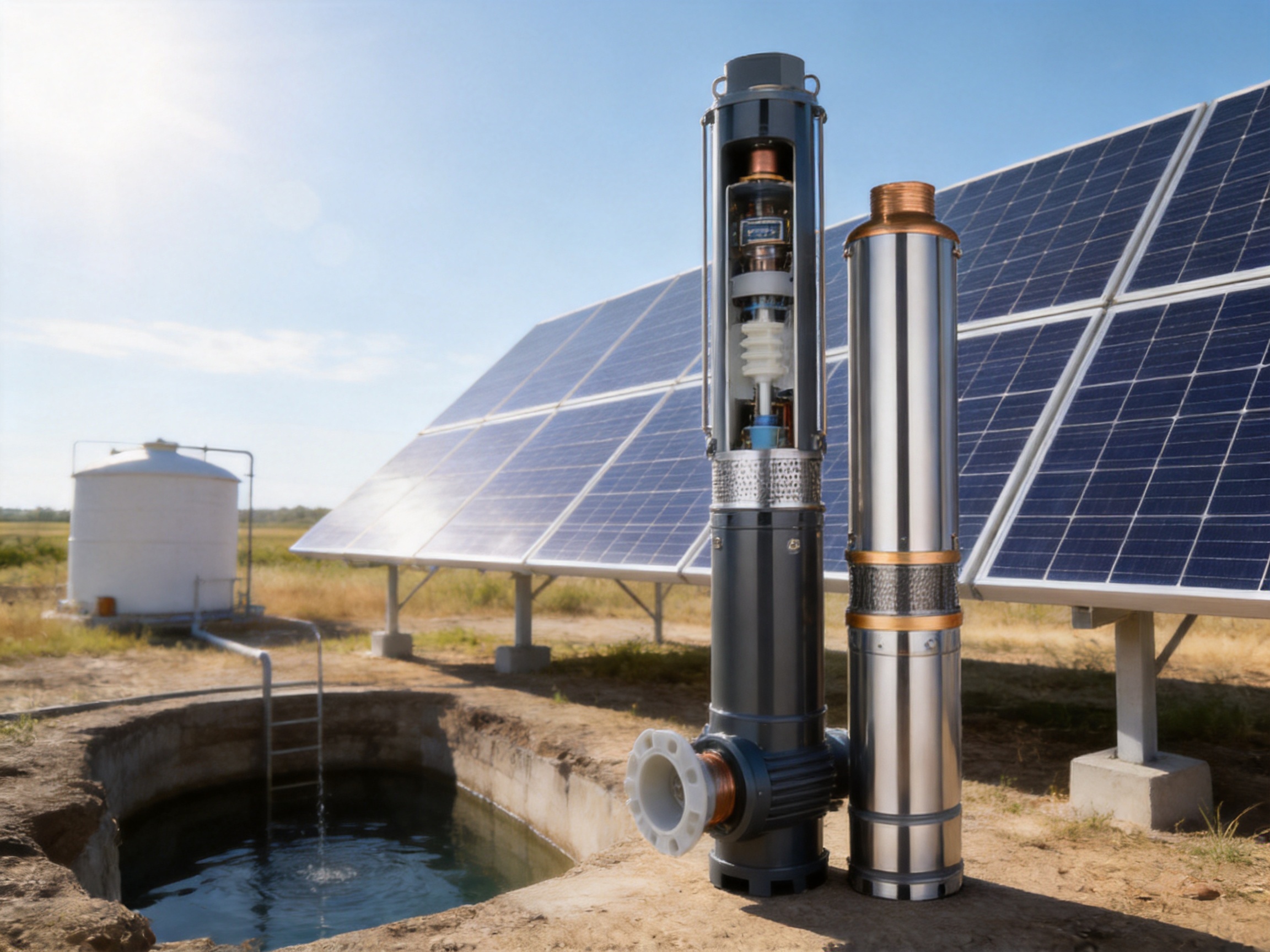
Traditional AC submersible pumps are effective where a stable electrical grid is available. However, grid-dependent equipment is not always practical for remote farms, rural homes, construction areas, and off-grid facilities. Extending a power line can be costly, and voltage fluctuations may affect pump operation.
The 4HVLR is designed around DC solar input, allowing it to operate in locations where grid electricity is unavailable or unreliable. This can reduce dependence on utility infrastructure and make water access possible in remote areas. Where an AC supply is available only intermittently, the solar pump can also provide an independent water source during daylight hours.
Diesel and gasoline pumps can deliver high power, but they require fuel transport, engine oil, regular servicing, and noise control. Fuel costs can become significant when water must be pumped every day. Exhaust emissions may also be undesirable near homes, livestock, crops, or environmentally sensitive locations.
A solar pump has no fuel combustion during operation. Once the photovoltaic system is installed, its energy source is available without daily fuel delivery. The brushless motor and low-maintenance construction further reduce the number of wear components compared with an engine-driven pump.
Fuel-powered pumps still have a role in emergency or high-demand applications, but the 4HVLR can provide a cleaner and quieter primary water supply where solar resources are suitable. A hybrid system can also combine solar pumping with a backup generator for periods of extended poor weather.
Some DC pumps are optimized for a specific voltage, such as 24 V, 48 V, or another fixed input. These products can be suitable for small systems, but high-power pumping at low voltage requires substantial current. Large current increases cable size, voltage drop, connection demands, and installation complexity.
The 4HVLR’s higher-voltage operating range allows higher-power systems to be configured with lower current than an equivalent low-voltage arrangement. This can support more manageable cable sizing and reduce losses over long distances between the solar array and the pump controller. The wide-voltage architecture also provides more flexibility when arranging panels in series.
Brushed motors use physical contacts that wear over time. Brushes may require replacement, and electrical arcing can reduce efficiency and create additional maintenance concerns. In a deep-well installation, servicing the pump may require lifting long lengths of pipe and cable, so reducing maintenance points is particularly valuable.
The brushless motor used in the 4HVLR avoids conventional brush wear. Electronic commutation supports stable operation, and the NSK bearings are intended to provide smooth, low-friction rotation. Together, these features contribute to a design that is better suited to repeated or extended operation in locations where access is difficult.
Deep-well pumps must withstand a demanding combination of water exposure, mechanical rotation, hydraulic pressure, and temperature variation. Material selection has a direct influence on product service life and maintenance frequency.
The copper outlet provides a durable connection point for the discharge pipe. It must withstand water pressure, mechanical loading, and repeated installation forces. Copper also offers corrosion resistance in many water environments and can help maintain the integrity of the outlet over long-term use.
The copper cylinder contributes to the structural strength of the pump body. In a submersible application, the cylinder protects internal components and supports the hydraulic assembly. Its material properties make it suitable for an environment in which water exposure is continuous rather than occasional.
Water chemistry varies widely between locations. Some wells contain dissolved minerals, sand, or other substances that may accelerate wear. Although copper provides useful resistance, a complete installation should still include proper filtration or sediment management where necessary. Water quality testing is recommended for demanding industrial or agricultural sites.
The impeller must be carefully balanced because it rotates at high speed inside the pump. A lightweight plastic impeller can reduce rotational inertia and support efficient motor starting. This is especially relevant in solar applications, where the available starting power may be lower in the morning or during variable sunlight conditions.
Engineering plastic can also provide resistance to certain forms of corrosion that affect metallic components. Its low mass helps the motor use available energy effectively, while the hydraulic geometry determines how efficiently water is moved through the pump.
Bearings influence the alignment and smooth rotation of the motor shaft. Low-friction bearings can reduce mechanical losses, operating temperature, and vibration. NSK bearings are included in the design to support stable operation and extended service life.
Even high-quality bearings require proper operating conditions. The pump must remain adequately submerged, the water must be suitable for the pump design, and the motor should not be operated under conditions that cause excessive overheating or repeated dry running.
The performance of a pump depends not only on its design but also on the consistency of manufacturing. Dimensional accuracy, material control, motor assembly, sealing, electrical testing, hydraulic testing, and final inspection all influence field reliability.
Taizhou Edwin Electric Co., Ltd., operating under the Edwin Pump name, was founded in 2008. The company is described as an integrated manufacturing enterprise with capabilities covering independent research and development, mass production, and global export. This integrated structure supports more direct control over the product development and supply process.
Independent research and development allows a manufacturer to adapt pump designs to changing market requirements. Solar pumping requires different priorities from conventional fixed-frequency AC pumping. Motor efficiency, DC voltage flexibility, controller compatibility, thermal performance, hydraulic balance, and low-maintenance operation must be considered together.
The development of the 4HVLR series reflects this approach. Its wide-voltage brushless motor is suited to photovoltaic power conditions, while its hydraulic configurations address different combinations of flow and head. The company’s wider investment in new-energy and intelligent technology since 2018 has helped expand its product portfolio to include solar water pumps and intelligent booster pumps.
Mass production can provide important advantages for distributors, contractors, and project buyers. Consistent production procedures help maintain repeatability between batches. This is particularly important when several pumps are installed in one agricultural project, municipal system, or commercial development.
A structured manufacturing process may include incoming material inspection, component machining, motor winding, rotor and stator assembly, bearing installation, hydraulic assembly, sealing inspection, electrical testing, and final performance verification. While individual test procedures depend on the manufacturer’s internal standards, each stage contributes to reducing variations in finished products.
Production scale can also improve spare-parts availability and support more predictable delivery schedules. For international buyers, the ability to supply repeat orders is a significant consideration when developing a standard equipment package.
The company’s core product lines include deep well pumps, submersible pumps, domestic booster pumps, and circulation pumps. This product breadth provides experience across several water-handling conditions, including high-lift pumping, household pressure boosting, HVAC circulation, and general water transfer.
The broader portfolio also supports one-stop procurement. A buyer working on a complete water system may require a deep well pump, booster pump, circulation pump, valves, piping components, or related accessories. A manufacturer with experience in multiple categories can help simplify product coordination and order management.
International pump projects require more than factory production. They may involve product selection, technical communication, packaging, documentation, order tracking, customs coordination, and cross-border delivery. In 2012, the company established Taizhou Haipai Import & Export Co., Ltd. and Golden Falcon Industrial Co., Ltd. to support procurement planning, order tracking, foreign trade, and delivery services.
This structure is valuable for overseas distributors and engineering contractors who need consistent communication throughout the purchasing cycle. The company reports that its products are used in new-energy projects, agricultural irrigation, municipal engineering, mining, construction, HVAC systems, and household water supply.
Remote homes often require dependable water without access to a municipal network. A borehole equipped with a 4HVLR pump can supply a storage tank during daylight hours. Water can then be distributed by gravity or through a secondary booster pump when required.
The system can be configured to prioritize tank filling rather than direct continuous household pressure. This approach allows the solar pump to operate when energy is available and provides water during evening or low-sunlight periods. A float switch or level-control system can stop the pump when the tank is full.
Small rural communities may use a solar pumping station to transfer groundwater to an elevated tank or communal reservoir. The choice of model depends on the number of users, daily consumption, well depth, storage volume, and distribution pressure.
For community systems, reliability and maintainability are especially important. The pump should be protected against dry running, excessive sediment, overvoltage, and abnormal operating conditions. Properly designed storage can reduce the need to run the pump at night and can provide water during short periods of reduced solar output.
Agricultural irrigation is one of the most suitable applications for solar pumping. Water demand often occurs during daylight hours, when solar energy is available. The 4HVLR series can be used to supply drip irrigation, sprinkler systems, storage ponds, or elevated tanks.
Higher-flow models can support larger irrigation volumes, while higher-head models can serve fields located above the well or systems with longer pipelines. Irrigation designers should calculate friction losses carefully because undersized pipes can significantly increase the required head and reduce delivered flow.
Rural gardens, parks, nurseries, and landscape projects may need water transfer from wells, ponds, or underground sources. A solar pump can reduce operating costs and provide water where electrical infrastructure is limited.
The pump can be connected to a tank, irrigation manifold, or water distribution system. Because landscaping requirements vary by season, a storage tank and automatic control system can help match pumping activity with actual water demand.
Workshops, rural factories, storage yards, and small commercial facilities may require water for cleaning, processing, cooling, or general use. A solar deep well pump can supply a tank that serves several daily operations.
These facilities may also combine the pump with an existing AC water system. Solar pumping can reduce daytime grid consumption, while a conventional booster pump maintains pressure at points of use. The 4HVLR’s available power and flow range makes it adaptable to different commercial water requirements.
Industrial sites may use deep-well water for cleaning, preliminary processing, dust suppression, cooling support, or utility services. The 4HVLR series includes higher-power models that can move substantial volumes of water where the required head is within the equipment range.
Industrial users should confirm water chemistry, temperature, suspended solids, and required operating schedule before final selection. For specialized liquids or aggressive chemical conditions, additional material verification may be necessary.
Correct installation is essential to achieving the expected service life and performance of any submersible solar pump. The well should be evaluated before installation, including its internal diameter, water level, yield, sediment content, and recovery rate.
The pump must fit freely inside the well without rubbing against the casing. The delivery pipe should be sized according to the required flow and total length. A pipe that is too small may create excessive friction losses, forcing the pump to operate at a higher head than expected.
The pump should remain sufficiently submerged during operation. The installer should determine the lowest expected dynamic water level and position the pump accordingly. It should not be placed directly on the bottom of the well, where sediment can enter the intake. A suitable clearance should be maintained to promote clean water entry.
The cable must be selected for submerged service and protected against abrasion. Cable joints should be sealed using appropriate waterproof procedures. The listed cable length for the models is 2 meters, so the installation may require a properly engineered extension connection depending on well depth and control-panel location.
Electrical protection should include equipment appropriate to the DC voltage and current of the system. The photovoltaic array must remain below the specified 450 V open-circuit limit. Polarity, grounding, overcurrent protection, disconnects, and controller compatibility should be checked before energizing the pump.
A non-return valve may be required to prevent the water column from flowing backward when the pump stops. Where the system fills a tank, a float switch or level sensor can prevent overflow and reduce unnecessary pump operation. Surge protection may also be appropriate in locations with frequent lightning or long exposed cable runs.
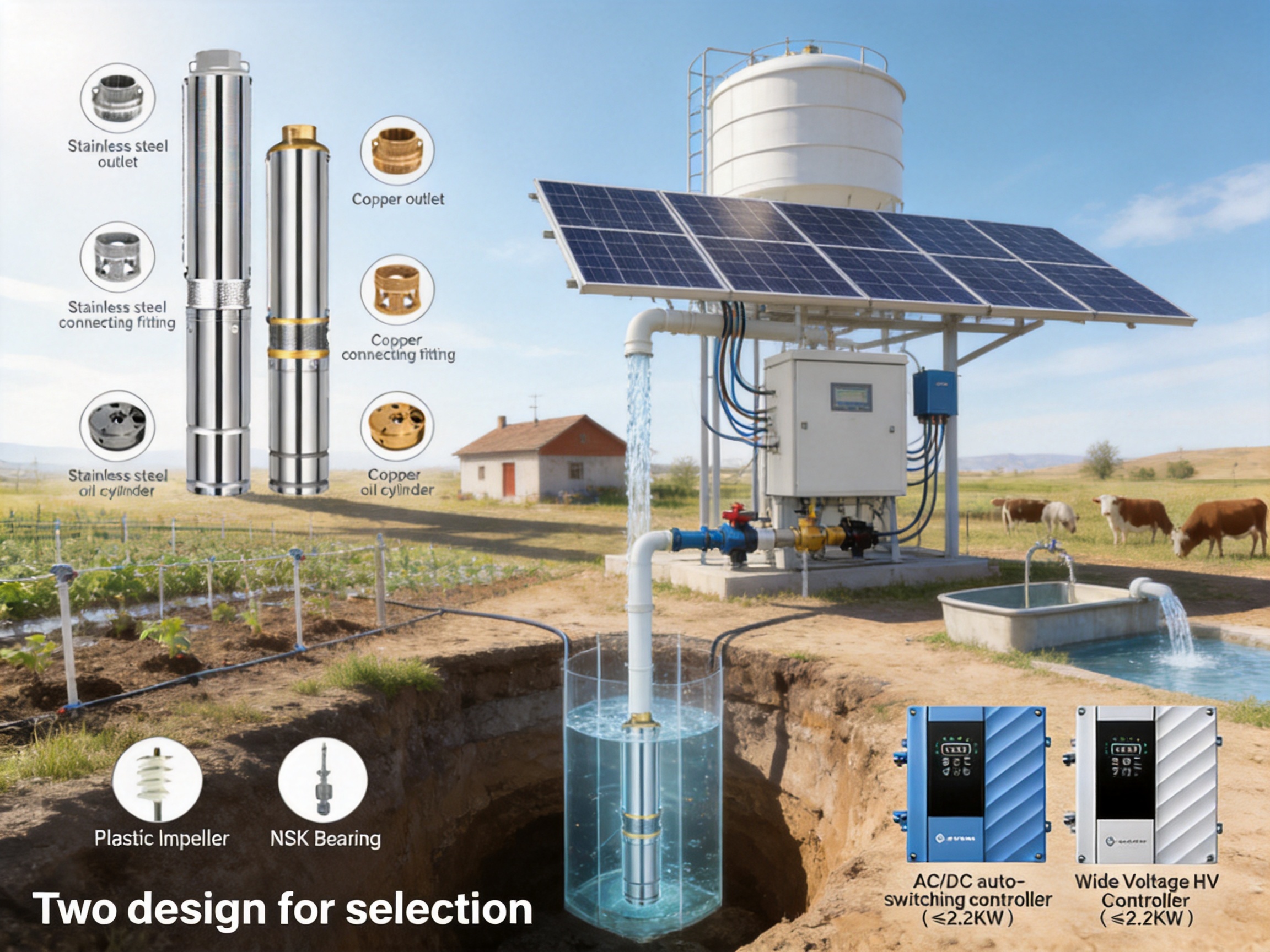
One of the principal benefits of the 4HVLR design is reduced routine maintenance. The brushless motor avoids brush replacement, and the durable copper and bearing components are intended for long-term use. Nevertheless, every solar pumping system benefits from periodic inspection.
Dust, leaves, bird deposits, and shading can reduce photovoltaic output. Panels should be inspected and cleaned according to local conditions. Cable connections, mounting structures, and junction boxes should be checked for looseness, corrosion, or physical damage.
Because pump performance depends on available solar energy, a reduction in panel output may appear as lower flow or shorter daily operating time. Inspecting the solar array should therefore be one of the first steps when performance changes.
Well water should be monitored for sand, silt, mineral deposits, and changes in water level. Excessive sediment can accelerate wear in hydraulic components and may block screens or valves. If the well produces sand, the cause should be investigated and suitable filtration or well-development measures considered.
The pump should never be operated dry. Dry running can prevent the motor and hydraulic components from receiving the cooling and lubrication provided by surrounding water. A low-water sensor or suitable controller protection can help reduce this risk.
Leaks, blocked filters, damaged valves, and partially closed outlets can alter system performance. A small leak may not immediately stop the water supply, but it can increase operating time and reduce the amount of water reaching the intended destination.
Connections should be inspected periodically, particularly after the first operating period when components may settle. The non-return valve, isolation valve, tank inlet, and pipe supports should remain accessible for inspection and service.
If the pump must be removed from a deep well, the work should be performed by trained personnel using suitable lifting equipment. The cable and pipe should be supported so that the pump’s electrical connection and discharge fitting are not subjected to excessive tension.
Before reinstallation, the pump should be checked for sediment accumulation, cable damage, seal condition, bearing noise, and impeller obstruction. Any repair or replacement should use compatible components and follow the manufacturer’s technical recommendations.
The most efficient solar pumping system is not necessarily the one with the highest-rated pump. Efficiency depends on matching the pump, well, pipework, solar array, controller, and storage method to the actual requirement.
Oversizing the pump can result in insufficient solar power during much of the day, while undersizing may fail to meet daily water demand. The best approach is to calculate the required daily volume and identify the expected operating duty point.
Water storage is an important part of the design. A tank can absorb variations in solar output and allow the pump to operate when sunlight is available. It also separates pumping from consumption, meaning the pump does not need to start every time a user opens a tap.
For irrigation, operation can be scheduled around the strongest solar period. For household systems, water can be pumped into an elevated tank during the day and distributed by gravity at night. For commercial applications, the tank can act as a buffer between solar pumping and process demand.
High-voltage DC operation can also help reduce transmission losses between the solar array and the pump equipment. However, high-voltage DC systems require careful design because they can present serious electrical hazards. Installation, maintenance, and commissioning should be handled by qualified professionals.
For professional buyers, product quality includes more than the pump’s material specifications. It also includes consistency, documentation, packaging, order accuracy, and after-sales communication.
An integrated manufacturer can coordinate product development, production scheduling, inspection, and export preparation. This is particularly useful for distributors that need stable model availability and repeatable specifications across multiple orders.
Quality control should address the motor, winding insulation, electrical connections, shaft alignment, bearing fit, hydraulic assembly, outlet dimensions, sealing, and final operating performance. Packaging should protect the pump body, cable, outlet, and accessories during domestic handling and international transport.
Project buyers should request the appropriate technical documents before placing an order. These may include model tables, pump curves, wiring information, installation guidance, product labels, packing lists, inspection records, and recommended spare-parts information.
Taizhou Edwin Electric Co., Ltd. combines manufacturing with foreign-trade and procurement service capabilities. This makes the company suitable for international customers seeking a long-term supply partner rather than a single uncoordinated product purchase.
The 4HVLR series offers several advantages that distinguish it from basic solar pump alternatives. Its wide-voltage DC architecture is suited to the fluctuating output of photovoltaic systems. Its brushless motor reduces mechanical wear. Its copper outlet and cylinder provide a durable construction for submerged use. Its lightweight plastic impeller supports efficient rotation, and NSK bearings contribute to low-friction operation.
The model range is another important advantage. Buyers can choose from low-flow, high-head options and high-flow, moderate-head options while maintaining a common product family. This simplifies product selection for distributors, contractors, and system integrators who serve several types of customers.
The pump also offers a practical 4-inch format. Larger pumps may provide greater capacity but can require larger wells and more complicated installation conditions. Smaller pumps may not deliver enough water for commercial or agricultural needs. The 4-inch structure provides broad compatibility with deep-well applications that require moderate to substantial water flow.
Compared with fuel-driven equipment, the pump offers quiet operation and does not consume fuel during normal solar operation. Compared with brushed DC pumps, it reduces brush-related maintenance. Compared with narrow-voltage DC pumps, its broad operating range provides greater flexibility in photovoltaic array design.
These advantages do not eliminate the need for proper engineering. Every pump has operating limits, and the 4HVLR must be selected according to its actual head, flow, water quality, electrical input, and installation environment. When correctly matched, however, it can provide a dependable and energy-conscious solution for off-grid and hybrid water systems.
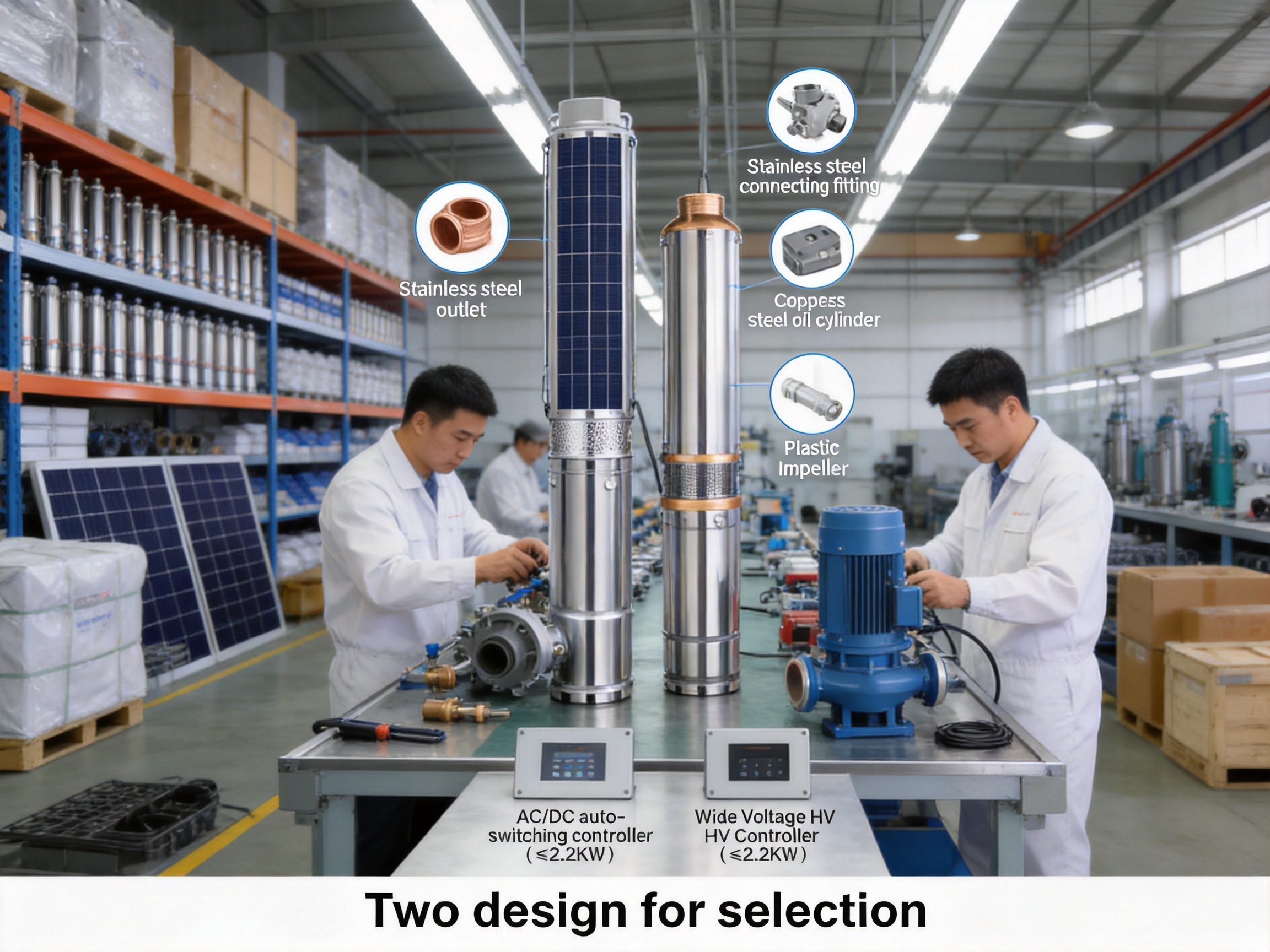
The 4HVLR is a 4-inch DC submersible solar deep well pump. It is designed to be installed in a well or other submerged water source and powered by a suitable photovoltaic DC system.
Wide-voltage operation means that the motor is designed to work across a broader DC input range than a fixed-voltage motor. Depending on the model, the optimum input range begins at 110 V, 150 V, or 200 V and extends to 350 V. The photovoltaic array’s open-circuit voltage must remain below 450 V.
Not necessarily. The pump can operate from a correctly designed solar array during daylight hours. A water storage tank is often used to provide water when sunlight is weak or unavailable. Batteries may be added in special system designs but are not inherently required for daytime pumping.
The listed models provide maximum flow values from 5 m³/h to 22 m³/h. Actual flow depends on total head, pipe resistance, solar power, water level, and the selected model’s pump curve.
The series provides maximum head values from 45 m to 110 m. Maximum head and maximum flow are different operating points, so the correct model should be selected using the required duty point rather than either maximum value alone.
The listed recommendation is solar panel power of at least 1.3 times the pump power. This corresponds to approximately 975 W for a 750 W pump, 1,430 W for a 1,100 W pump, 1,950 W for a 1,500 W pump, and 2,860 W for a 2,200 W pump. A qualified designer should verify the final array based on local conditions.
A brushless motor does not use conventional mechanical brushes, so there is less brush wear and no brush replacement requirement. Electronic commutation supports efficient and stable operation, which is useful in remote installations where maintenance access may be limited.
The copper outlet and cylinder provide durability, mechanical strength, and resistance to corrosion and wear. These properties are valuable in a submerged environment. Water chemistry and sediment levels should still be evaluated before installation.
Yes. The pump can be used for agricultural irrigation, storage tank filling, garden watering, and landscape management. Model selection should consider the irrigation flow requirement, field elevation, pipe length, sprinkler or drip-system pressure, and available solar capacity.
It can supply a household water system when properly designed, but many installations use the pump to fill a storage tank. A separate booster pump or pressure-control system may then provide stable pressure at household outlets.
A low-water sensor, level controller, or compatible pump protection system can stop operation when the water level falls too low. The pump should be positioned correctly in the well and should remain submerged during operation.
The product is manufactured by Taizhou Edwin Electric Co., Ltd., a Chinese integrated pump manufacturer founded in 2008. The company develops and produces deep well pumps, submersible pumps, booster pumps, circulation pumps, solar pumps, and other water-handling products for international markets.
The 4HVLR wide-voltage DC brushless motor copper outlet solar deep well pump is designed to address the practical challenges of off-grid and variable-power water supply. Its 4-inch submersible format, broad DC voltage range, brushless motor, copper outlet and cylinder, lightweight plastic impeller, and NSK bearings create a product platform focused on efficient, durable, and low-maintenance pumping.
With models ranging from 750 W to 2,200 W, maximum flow rates from 5 m³/h to 22 m³/h, and maximum heads from 45 m to 110 m, the series can serve a wide variety of domestic, agricultural, commercial, and industrial requirements. Its performance is especially relevant where solar power is abundant but grid electricity is limited or fuel logistics are costly.
The product’s competitive value is supported by the manufacturing capabilities of Taizhou Edwin Electric Co., Ltd. The company combines independent research and development, mass-production experience, a broad pump portfolio, and international procurement and export services. Its investment in solar and intelligent pumping technology further supports the development of solutions for modern water infrastructure.
Successful operation depends on correct sizing, photovoltaic array design, well assessment, pipe selection, electrical protection, and regular inspection. When these factors are properly managed, the 4HVLR can help provide a dependable water supply while reducing dependence on grid electricity and fossil fuels.
1. Taizhou Edwin Electric Co., Ltd. Product information for the 4HVLR wide-voltage DC brushless motor copper outlet solar deep well pump.
2. Taizhou Edwin Electric Co., Ltd. 4HVLR model performance data, including voltage range, power, flow, head, outlet size, cable length, and photovoltaic sizing guidance.
3. General engineering principles for photovoltaic water pumping system design and water storage integration.
4. General principles of submersible pump installation, well assessment, pipe friction calculation, and motor protection.
5. General technical principles of brushless DC motor operation, bearing performance, and hydraulic pump efficiency.
edwina@edwin-pump.com
+86-13586290903 (WhatsApp)
Xuri Gongliang Cutting Tool Entrepreneurship Park, Wenqiao Town, Wenling City, Taizhou City, Zhejiang Province, China

High Performance Smart Pump Factory


 English