
edwina@edwin-pump.com

View All Products
en
Price is usually easy to compare on a deep well pump quotation. Long-term cost is not. A lower purchase price may look attractive at the beginning, yet the total investment also includes installation, motor power, electricity consumption, replacement parts, and potential downtime. This is why buyers looking for cost-effective deep well pumps should look beyond the initial equipment price.
At Edwin Pump, we consider cost value from the complete pumping system. Flow, total dynamic head, pump efficiency, motor configuration, well depth, and operating hours all influence the economics of a deep well installation.
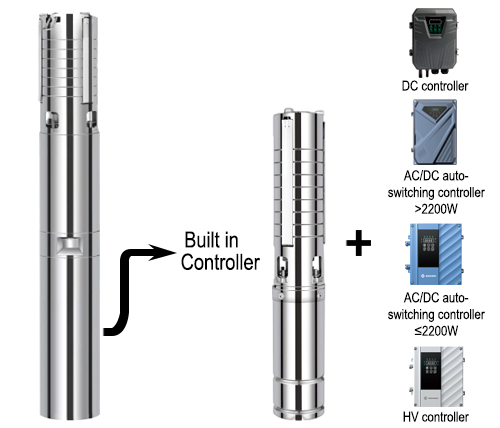
A deep well pumping system normally contains more than the pump itself. Installation depth can affect labor and cable requirements, while the motor and electrical system contribute to the operating cost throughout the equipment's service period.
| Cost Factor | What Buyers Should Review |
| Pump & Motor | Model, power, materials, stages, and rated performance |
| Installation | Well depth, lifting equipment, pipe, cable, and labor |
| Energy | Motor power, pump efficiency, operating hours, electricity rate |
| Replacement Parts | Availability of wear and service components |
| Downtime | Potential cost of an unexpected pump outage |
Research on deep well pumping systems has found that energy consumption can represent a very large share of lifecycle cost over extended operating periods. This makes operating performance relevant even for buyers who initially focus on equipment price.
A deep well pump does not provide its maximum flow and maximum head at the same operating point. The actual duty point depends on the relationship between flow and total head, which is why a pump performance curve is essential during product evaluation. The Hydraulic Institute explains that pump curves can show head, efficiency, input power, and other performance parameters across the operating range.
Consider a project requiring:
A pump advertised with a maximum head of 140 m may not necessarily provide 50 m³/h at 100 m head. The buyer needs to locate the actual duty point on the pump curve and verify the corresponding power and efficiency.
This small technical check can prevent a common purchasing mistake: paying for a larger motor or pump configuration that does not provide meaningful value under the actual operating conditions.
Electricity consumption becomes increasingly important as operating hours accumulate. A difference in pump efficiency may appear small on a quotation, but it can become significant across thousands of operating hours.
The basic relationship is straightforward:
Hydraulic Power = Flow × Head × Fluid Density × Gravity
Actual electrical input also depends on pump and motor efficiency. A pump curve can therefore tell buyers more than simply how much water the equipment can deliver. It helps reveal the power requirement associated with the specified duty point.
| Item | Pump A | Pump B |
| Required Flow | 50 m³/h | 50 m³/h |
| Required Head | 100 m | 100 m |
| Pump Efficiency | 72% | 78% |
| Motor Configuration | Higher input requirement | Lower input requirement |
| Purchase Price | Lower | Higher |
The lower-priced option may not remain the lower-cost option after years of operation. This is especially relevant for agricultural irrigation, municipal water supply, industrial water transfer, and other applications with substantial annual running hours.
Deep wells often require substantial head because the pump must overcome vertical elevation, drawdown, pipe friction, valves, fittings, and downstream pressure requirements. Adding stages to a multistage pump can increase the available head while maintaining the required flow range.
For example, a deep well system may require 120 m of total head at 40 m³/h. Rather than simply increasing motor power, the pump configuration can be evaluated around the required head and flow relationship.
Technical guidance from North Dakota State University demonstrates how head and brake horsepower values can scale with the number of stages in a deep-well turbine pump, while flow remains associated with the pump's hydraulic configuration.
Deep well equipment is installed below ground, so replacing an unsuitable pump can involve considerably more than purchasing another unit. Pipe, electrical cable, lifting work, labor, and site access may all add to the replacement bill.
A technically appropriate pump that fits the existing well infrastructure can therefore offer value beyond its catalog price.
Motor selection is another area where cost and performance intersect. An oversized motor can add unnecessary equipment cost, while an undersized motor may struggle to provide the required duty.
At Edwin Pump, we evaluate the motor together with the pump curve rather than treating horsepower as an isolated specification. Rated voltage, frequency, power, speed, starting method, and operating conditions all deserve consideration.
The idea of cost-effective deep well pumps should not be reduced to the lowest quotation. A practical cost evaluation combines purchase price with energy consumption, installation requirements, hydraulic performance, motor configuration, and future service needs.
At Edwin Pump, we focus on matching the pump to the actual duty point instead of evaluating a model only by its maximum flow, maximum head, or motor horsepower. A well-sized deep well pump can provide a more balanced investment by delivering the required water supply without adding unnecessary capacity to the system.
For buyers comparing deep well pump solutions, the more useful question is not simply “How much does the pump cost?” It is “What will this pump cost to purchase, install, and operate for the application it is actually serving?”
edwina@edwin-pump.com
+86-13586290903 (WhatsApp)
Xuri Gongliang Cutting Tool Entrepreneurship Park, Wenqiao Town, Wenling City, Taizhou City, Zhejiang Province, China

High Performance Smart Pump Factory


 English