
edwina@edwin-pump.com

View All Products
en
Choosing a Solar Water Pump for irrigation, livestock, or household supply raises a few practical questions: how much water can you actually move per day, what happens when the sun hides, how long does the equipment last, and how does it stack up against electric or diesel units? Below is a clear, evidence-based Q&A to guide your decision.
How much water can a Solar Water Pump supply per day?
Daily volume depends on three levers: (1) the pump’s rated flow at your required head (lift), (2) available solar input (“peak sun hours”), and (3) system efficiency (panels + controller/inverter + motor). A simple planning formula is:
Daily water (m³/day) ≈ Rated flow (m³/h) × Effective pumping hours (h/day).
For context, Edwin Pump describes an AC photovoltaic pumping package capable of up to 130 m³/h with a head up to 325 m, and an inverter conversion efficiency up to 98%. Using the formula, if your site offers 5 effective sun hours, a high-capacity configuration like that could deliver on the order of hundreds of cubic meters per day—subject to your actual head, panel sizing, and irradiance.
Correctly sizing the Solar Water Pump to your well depth, head, and demand is crucial; Edwin’s guidance emphasizes matching pump size to well depth and required flow so that the rated numbers translate into real daily yield at your site.
Does it work on cloudy days or at night?
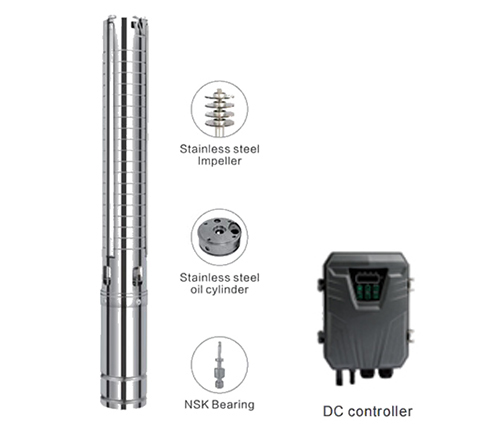
Yes—with caveats. A Solar Water Pump’s output tracks sunlight, so flow typically drops under clouds and pauses at night. Edwin highlights that solar power output fluctuates through the day, which directly affects pumping capacity; careful system design and load matching help smooth these effects.
There are two common ways to improve reliability when sunlight is limited:
Low-light performance & variable speed. Edwin’s pump and panel offerings emphasize operation in low-light conditions and variable-speed control so the Solar Water Pump continues to run—often at reduced flow—when skies are overcast.
Energy storage. Adding batteries allows a Solar Water Pump to operate during cloudy periods or at night, which is especially useful for irrigation schedules and domestic supply.
(Panel choice matters too; some mono-crystalline modules are designed for better low-light behavior, which supports steadier pumping on gray days.)
What is the lifespan of a Solar Water Pump?
Modern systems are built for longevity. Two components drive the service life profile:
Brushless pump and motor. Edwin’s articles note that brushless DC designs reduce friction and internal wear, generate less heat, and therefore extend lifespan while lowering maintenance—advantages that are particularly valuable in remote sites where service visits are costly.
Solar array. The panels powering your Solar Water Pump commonly last 25–30 years, so the generating side of the system has a long service window when installed and maintained correctly.
Taken together, a well-sized brushless Solar Water Pump plus quality panels offers a durable, low-maintenance solution for long-term water supply.
How efficient is a Solar Water Pump compared to an electric or diesel pump?
Efficiency shows up in several ways:
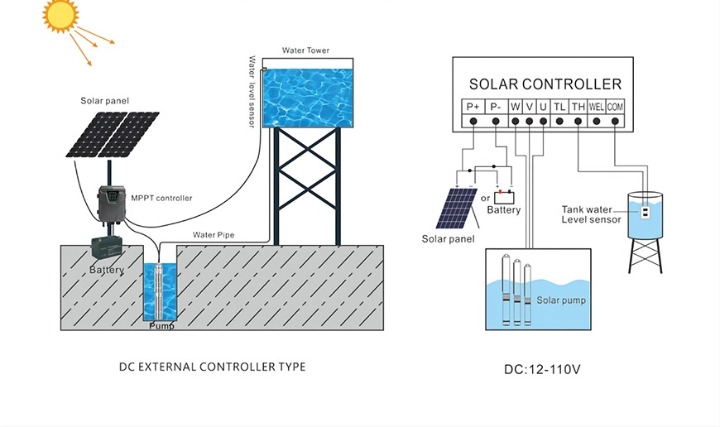
Energy conversion & control. Edwin cites inverter conversion efficiencies up to 98% and explains how variable-frequency control tunes pump speed to available sunlight—improving overall system efficiency versus simple on/off operation. This helps a Solar Water Pump deliver useful flow across changing conditions.
Mechanical efficiency & reliability. Brushless motors avoid brush contact losses and wear, to higher electrical-to-mechanical conversion efficiency and fewer failures, which means more of your harvested solar energy becomes water moved.
Operating cost and independence. Compared with diesel (fuel + logistics) and grid-electric pumps (tariffs + access), a Solar Water Pump offers independence from volatile energy prices, lower ongoing costs, and reduced environmental impact—benefits highlighted across Edwin’s resources and sustainability discussions.
While a grid pump can deliver constant output regardless of weather and a diesel unit can run on demand, a Solar Water Pump often wins on life-cycle cost and maintenance in sunny regions—especially when paired with storage or scheduled pumping windows.
A well-engineered Solar Water Pump can supply anything from modest daily volumes for household use to very high outputs for agriculture—so long as you size the pump, panels, and head correctly. Expect reduced flow on cloudy days unless you add batteries; it is designed for low-light performance and variable speed to keep water moving. With brushless technology and panels rated for decades, system lifespan is strong, and overall efficiency—electrical, mechanical, and economic—compares favorably to electric and diesel alternatives in many real-world cases. If you define your head, daily demand, and sun profile, a Solar Water Pump can be a reliable, cost-aware, and environmentally considerate choice for long-term water supply.
edwina@edwin-pump.com
+86-13586290903 (WhatsApp)
Xuri Gongliang Cutting Tool Entrepreneurship Park, Wenqiao Town, Wenling City, Taizhou City, Zhejiang Province, China

High Performance Smart Pump Factory


 English