View All Products
en

A Submersible Pump is a critical tool for moving water and other fluids from wells, tanks, or reservoirs. Unlike surface pumps, submersible...
READ MOREAccess to groundwater is a critical concern for agriculture, residential use, and industrial operations. A borehole pump is designed to ext...
READ MOREA Deep Well Pump is designed to draw water from wells that are significantly deeper than standard household sources. These pumps are widely...
READ MOREWater management is an essential part of agriculture, and efficient irrigation systems depend on reliable pumps. An Irrigation Pump Factory...
READ MOREA submersible pump factory is responsible for producing pumps that operate fully underwater while maintaining stable performance. These pump...
READ MOREThe material of PP compression fittings can influence flow rate and water velocity, although the effect is generally indirect and related to internal geometry rather than the material itself. Polypropylene is a thermoplastic with a smooth internal surface, which contributes to relatively low friction losses in water transport systems.
One important factor is surface roughness. PP has a lower surface roughness compared to many metal materials. This smoothness reduces friction between the fluid and the pipe wall, helping to maintain stable flow and reduce energy losses. In low- and medium-pressure water systems, this characteristic supports consistent water velocity.
Another consideration is internal diameter consistency. PP compression fittings are manufactured to tight dimensional tolerances. When fittings match the pipe diameter closely, flow disruptions at connection points are minimized. Any reduction in internal diameter caused by fitting design, rather than material, has a greater impact on flow rate than the material composition itself.
Material stiffness and deformation also play a role. Polypropylene has adequate rigidity for typical water system pressures, but it is more flexible than metals. Under normal operating conditions, deformation is minimal and does not significantly affect water velocity. However, if fittings are improperly installed or subjected to pressures beyond their rating, slight deformation could alter internal flow characteristics.
Temperature resistance is another indirect factor. PP performs well within its rated temperature range, maintaining structural integrity and smooth internal surfaces. If temperatures exceed recommended limits, material softening may occur, potentially affecting internal geometry and flow performance.
In properly designed systems, the material of PP compression fittings does not substantially restrict flow rate or increase water velocity beyond expected design values. System layout, fitting geometry, and installation quality have a greater influence on hydraulic performance than the polypropylene material itself.
Polypropylene compression tube fittings are available in various configurations to accommodate different piping layouts and operational requirements. Each fitting type serves a specific function within the system.
Straight Couplings
These fittings connect two pipes of the same diameter in a straight line. Their function is to extend pipeline length while maintaining a consistent internal bore and reduce flow disturbance.
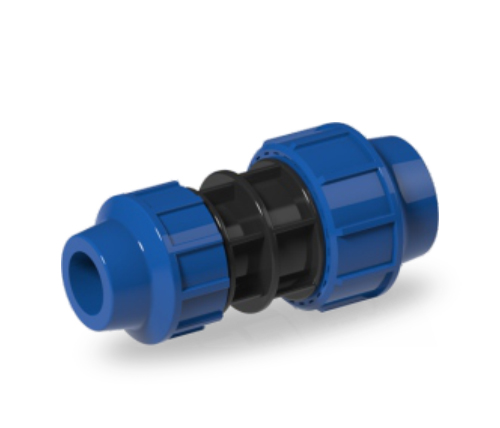
Reducing Couplings
Reducing couplings connect pipes of different diameters. They allow system designers to transition between pipe sizes while controlling flow velocity and pressure changes.
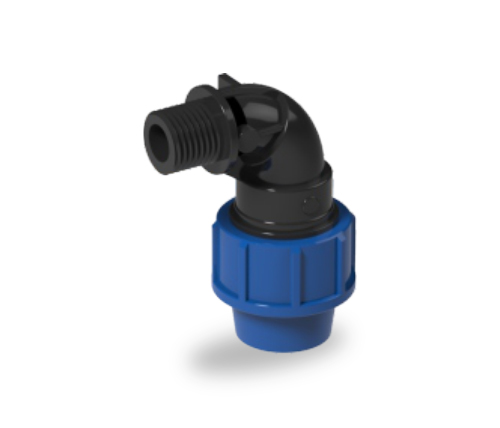
Elbows (90° and 45°)
Elbow fittings change the direction of flow. A 90-degree elbow redirects flow at a right angle, while a 45-degree elbow provides a gentler directional change, reducing pressure loss compared to sharper bends.
Tees
Tee fittings create branch connections, allowing fluid to split into two directions or merge from two lines into one. They are commonly used in distribution networks and irrigation systems.
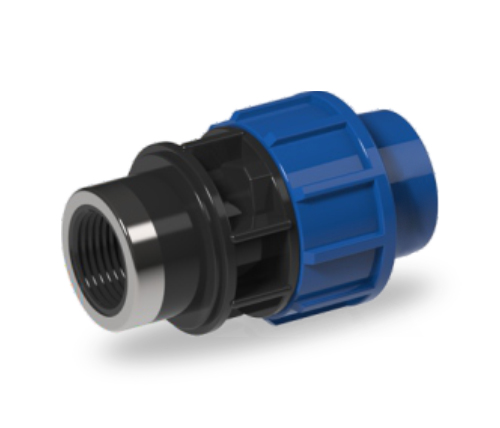
Adapters (Male and Female Threaded)
Adapters connect compression piping to threaded components such as valves, pumps, or metal pipes. They provide compatibility between different connection standards.
End Caps and Plugs
End caps and plugs are used to terminate pipelines or close unused outlets. They are essential during system expansion planning or temporary shutdowns.
Ball Valve Compression Fittings
These fittings integrate a shut-off valve into the compression connection. Their primary function is to isolate sections of the pipeline for maintenance or flow control.
Each of these fittings is designed to maintain sealing integrity while allowing quick installation and disassembly. Proper selection of fitting type helps ensure balanced flow, manageable water velocity, and reliable system operation.
+86-13586290903 (WhatsApp)
Xuri Gongliang Cutting Tool Entrepreneurship Park, Wenqiao Town, Wenling City, Taizhou City, Zhejiang Province, China

PP Compression Fittings Manufacturer


 English